
Charles Schwab - Expanding Online Trading Applications
🌐 International Buyers — Pay via PayPal
Details
ITSY007
12
2002
YES
300
The Charles Schwab Corporation
Financial Services
US
Digital Marketing
Abstract
The case examines how WAS was utilized for upgrading Schwab’s website. The case also discusses the company’s decision to utilize Java technologies for preparing a website that could handle increased traffic effectively in the future.
Learning Objectives
The case is structured to achieve the following Learning Objectives:
- Importance of technology infrastructure for providing online financial services.
Contents
“Schwab needed a more efficient IT infrastructure to improve both time to market and hardware resources utilization. With the rapid growth of our online brokerage solution, we needed to start looking into more efficient ways to leverage our hardware and our development resources.”
- Purna Roy, Director, Web Systems Availability, Charles Schwab, in 1998.
US based Charles Schwab & Co. Inc. (Schwab), the market leader in the global online broking and financial services industry had a 30% market share of the industry in 2001 and accounted for one- third of overall global Internet trading businesses. The company provided high volume trading and customized, timely financial services for NASDAQ securities and brokerage-dealers and institutional customers through over 310 branches spread over the US, Canada, UK, Japan, Switzerland, Hong Kong, Australia and New Zealand. Schwab’s main business activities included trading for investors, phone/online trading, futures and commodities trading, online mortgaging and supply of investment-related educational material. It was one of the top three mutual fund distributors in 1999 in the US (Refer Exhibit I & II for Schwab’s products and services).
Schwab was established in 1971 by Charles Schwab (Charles). Schwab pioneered the concept of discount brokerage i.e., offering ‘no-frills’ transaction services to customers. Schwab was known for cutting commission rates consistently, even as other US brokerages raised theirs by as much as 50%. As a result, the company’s revenues grew thirty times, from $ 4.6 million in 1976 to $ 126 million in 1983.
In 1983, Charles sold the company to BancAmerica, a US-based bank. However, as US banks were prohibited from expanding into the brokerage business, BancAmerica had to sell back the company to Charles in 1987. In the same year, Schwab came out with an IPO. The US stock market crash in October 1987 had a severe impact on the brokerage industry. As trading volumes fell, commissions came down. Since Schwab depended heavily on discount brokerage commissions, it was forced to explore the possibilities of expanding the range of services it offered.
Schwab was one of the first financial services companies to realize the business opportunities offered by the World Wide Web. The company offered a wide array of online services. It launched its website, www.schwab.com in 1995 and commenced trading from April 1996. Schwab’s website, like that of most other online financial services companies that had mushroomed in the early 1990s, allowed customers to get real time stock quotations, enter trade orders, create a personalized asset allocation model, and access research information. Schwab constantly added new features to enhance the performance of its website.
By the late 1990s, the traffic on Schwab’s website had increased manifold, putting the technology infrastructure under severe strain. If the Website crashed, Schwab could lose transactions and clients. The company realized that it needed to update its infrastructure to handle this high traffic without affecting the mission-critical trading applications. It also needed to ensure that the new infrastructure could be easily integrated with the existing setup.
Schwab’s existing infrastructure, developed using C language and CGI (Common Gateway Interface)3 technology, seemed to be working well for the time being. However, as the number of customer transactions was growing at a high rate, Schwab needed to create a new enterprise infrastructure that could easily accommodate higher traffic, provide greater flexibility and economy and render superior customer service.
In late 1997, Purna Roy (Roy) realized that servlet technology would offer better results than the existing CGI setup. Much of the presentation logic and transaction logic were embedded inside the CGI programs, thus requiring constant coordination of tasks between the web designers and software developers for performing even small tasks like altering the presentation of a web page. The process also needed each group to have a working knowledge of the other’s functional area.
Roy decided to use Sun Microsystems’ programming language Java, and the WebSphere Application Server (WAS) of IBM5 to develop the new infrastructure (Refer Exhibit III). Though other computer languages like C and C++ were ideal for high-scalability situations, they were not flexible enough to incorporate modifications. And while scripting and interpreted languages such as Visual basic were flexible to easy modifications, they were not known for their scalability. As a result, the company decided in favor of Java.
WebSphere is a middleware that enables companies to develop, deploy and integrate e-business applications. Moreover, it also offered Java Server Pages (JSPs), which were not restricted to any server or specific platform and allowed developers and designers to rapidly develop and easily maintain applications. Roy expected that the integration of Java and WebSphere would increase the efficiency of hardware utilization in the website.
Roy then identified the areas for deploying the technology, listed the benefits, and presented the concept before the senior and middle management committees. After a series of presentations, he succeeded in convincing the board that the new technology would offer long-term business value to the company. The project was approved on the condition that it would not affect the mission critical trading applications. The development team for the new infrastructure was divided into two groups: software developers and web-page designers.
Schwab decided to go in for a phased application of WAS technology, applying it first only to the non-critical applications. It did so because it did not want to hamper the website’s functioning by introducing radical changes at one go. Thus, WAS was initially used for new-account opening, an important, but not critical, business application. The implementation began in January 1998, and the project passed through various phases through the four quarters of 1998 (Refer Table I & II).
Table I
Implementation of WAS
|
QUARTER I
|
QUARTER II
|
|
QUARTER III
|
QUARTER IV
|
Source: www2.software.ibm.com
By March 1999, deployment of WAS for the account opening application was completed across all of Schwab’s transaction servers. The successful completion of the project was largely due to the integrated effort of the Schwab personnel and the IBM expert team. While the Schwab personnel performed the core programming, IBM expert team provided continual problem-solving guidance. WAS significantly increased the application development efficiency of the software developers as JSP technology enabled separation of transaction logic from presentation logic. WAS thus enabled Schwab to reduce the interdependence between software developers and web page designers. As a result, the time taken for application implementation and modification was reduced considerably. This ultimately resulted in a reduction in development costs. The clear division of logic and presentation content considerably reduced the total development cycle as it enabled the programmer to quickly customize a part of the data to suit business needs, without worrying about the need to change the logic part of the application.
Table II
The Technology Used
|
Source: www.4-ibm.com
After the implementation of WAS was completed, Schwab decided to take further measures to expand its online trading business. As a part of this initiative, Schwab decided to shift all its internal applications, including the mission-critical ones, to Java in early 1999. The company deployed the Java 2 Enterprise Edition 1.3 (J2EE) as part of this exercise. Java applications were deployed across all business units such as the investment management unit, fixed income products department, brokerage department, mutual fund unit and international and retail branch offices. Schwab also deployed the Web Logic Application Server solution of BEA Systems, for creating its investment management applications.
During 1999-2000, Schwab continued its efforts to expand its range of services. Velocity, an online trading system introduced in April 1999, provided enhanced trade information and order execution services to traders. Schwab also developed a new electronic communications network (ECN), REDIBOOK ECN, which enabled it to launch extended-hour trading sessions for certain NASDAQ and select exchange-listed stocks.
In early 2000, Schwab’s website was running on around 700 RS/6000 servers with four CPUs each, serving over 90,000 parallel end users. A majority of the web applications were still based on C/CGI technology. The website averaged 96 million visitors a day and conducted 14.5 million transactions on an average.
In mid-2000 Schwab announced its plans to increase online trading further and to set up new infrastructure to meet these goals. The company was searching for a solution, which promised better scalability and robustness. Based on the success of the previous WAS deployment, Schwab again decided to implement Java-based architecture built on the WebSphere Software Platform. The new architecture was code-named Barista. Through Barista, Schwab not only planned to offer an integrated view of its various channels to customers, but also to leverage future development by capitalizing on the opportunities offered by e-business. by leveraging future development. Barista was also intended to divide business and presentation logic to enable easy and quick modification of applications (or a part of an application) and thus reduce costs.
The Barista project was approved only after it had been tested for scalability and reliability in comparison with the existing C/CGI technology. To test Barista, a benchmark environment was set up to prove the suitability of Barista architecture for Schwab’s online trading applications. After successful completion of the tests, Schwab proceeded with the deployment of new Barista architecture (Refer Table III).
Table III
System Test Results
|
Administration: An efficient administration process was developed along with Java based Scalability: Scalability was proved in configuration up to 64 nodes by showing nearly linear Performance: The Barista architecture performed at 300% of the set goal. For low workload, Stability: A test was performed to prove the stability of large-scale WebSphere |
Source: www.7b.builder.ibm.com
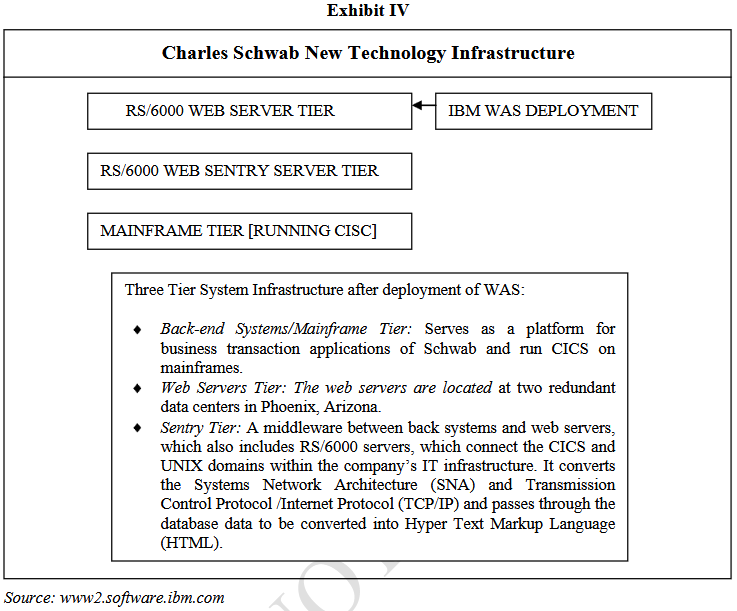
The new Schwab infrastructure that emerged after Barista’s deployment was a three-tier system that included Web Servers, Schwab entry (SEntry) and backend systems (Refer Exhibit IV). By May 2000, Schwab had 3.7 million online accounts with online customer assets worth $ 418 billion. The website had emerged as one of the leading e-commerce sites in the world, handling over $2 billion in securities transactions every week. This was largely attributed to the efficiency of Java-based applications coupled with Velocity and other enhanced online services. By the end of 2001, applications written in Java at Schwab had increased to 200 from the 1999 level of 30.
Company sources revealed that Java-based applications on the website were handling more money than earlier applications. According to company estimates, 80% of the 386,000 daily revenue trades in 2001 were done through the website or Velocity, compared to 65% of revenue trades done online in early 1999. As a result, Schwab was able to effectively use Java in a highly scalable environment. By mid 2001, Schwab extended the WAS technology to all its trading and investment servers, including backup procedures and automatic alerts. Schwab retained its leadership in the online broking and financial services market in 2001 and reported revenues of $ 4.35 billion for the year (Refer Table IV).
Table IV
Charles Schwab - Financial Summary (1998-2001)
(In $ „000, except per share data)
| Year ended December 31, | 2001 | 2000 | 1999 | 1998 |
| Revenue | 4,353.0 | 5,787.7 | 4,713.2 | 3,388 |
| Net Income | 199.0 | 718.1 | 588.9 | 348.5 |
| Net Profit Margin (%) | 4.6 | 10.1 | 12.5 | 10.3 |
| Diluted Earnings Per Share ($) | 0.23 | 0.51 | 0.47 | 0.43 |
In late 2001, Schwab announced its decision to extend its Java-based applications and use WebSphere software for its next-generation trading applications. Schwab planned to use a wide variety of WebSphere products to further expand its online trading business. Schwab also planned to utilize WebSphere software tools that would enable the development and deployment of various applications on the Internet and help manage a high volume of transactions.
Once the Java-WAS integration was completed, Schwab expected to deliver much more consistent products and services to customers through a more integrated front-end presentation layer across different financial product channels. Other major benefits to the company’s customers included enhanced services, faster service, and improved productivity and quality due to a more reusable code (The code once invented and tested can be reused in new ways, eliminating the need for code reinvention).
As WAS was implemented on a small-scale, Schwab did not initially realize all its benefits such as increased run-time efficiency of applications and cost reduction on account of increased efficiency in hardware utilization.12 With the company focused on expanding its online trading operations and planning more deployments using Java-based WAS, Schwab expected to realize all the benefits of WAS in the future and retain its leadership in the market.
1. Examine why Schwab’s chose to utilize WAS and Java technologies in place of the C/CGI setup. Discuss the underlying objectives of the new system. Also comment on the company’s decision to go in for a phased deployment of these solutions.
2. Study the system architecture put in place during the deployment of WAS for developing a new infrastructure for Schwab’s website. Critically comment on how the company benefited from the initiative.
3. Analyze the rationale for the Barista initiative and examine its benefits. Is Schwab banking too heavily on WAS to sustain increased traffic in the future? Give reasons to support your answer.
Exhibit I
Charles Schwab - Products and Services
| Products |
*Schwab Accounts (Refer Exhibit II)
*Mutual Fund MarketPlace and OneSource |
| Services |
*Retirement Plan services
*Institutional Services (operational support, trading services and technology
*Automated Telephone Services
|
Source: IBS Center for Management Research
Exhibit II
Types of Schwab Accounts
| Schwab Account |
Standard brokerage account with:
|
| Schwab One |
Financial management account. All the features of the Schwab account plus:
|
| Schwab Access |
For Signature Services qualified customers only. Online checking at Schwab:
|
| Schwab IRAs | Traditional Contributory, Rollover, Roth or convert the existing Traditional IRA to a Roth IRA. |
| College Saver |
|
| Custodial | The flexibility of a regular brokerage account with special tax advantages. |
| Schwab One Trust |
|
| Estate | Facilitates distribution of estate assets to the beneficiaries. |
| Schwab One Estate |
Facilitates distribution of estate assets to the beneficiaries. Access to account funds with Schwab One checks. |
| Schwab One International |
Specifically tailored for individuals and corporations outside the U.S. |
| Small-Company Retirement |
Choose Self-Employed Person (SEP), SEP-IRA, SIMPLE IRA, and Qualified Retirement Plans (QRP). |
Source: www.schwab.com
Exhibit III
WebSphere Application Servers
|
WebSphere is Internet infrastructure software known as middleware. It enables companies to
|
Source: www-3.ibm.com
Keywords
WAS, utilized, upgrading, Schwab's, website, company, decision, Java technologies, website, increased traffic, effectively