The East India Company - Organization Structure, Control and Governance
 |
Keywords
Procter & Gamble, American Express, Johnson & Johnson, Merck, Philip Morris, General Electric, Nordstrom, Ford, Governance
Links
Tools


Organization Structure and Control Systems Contd...
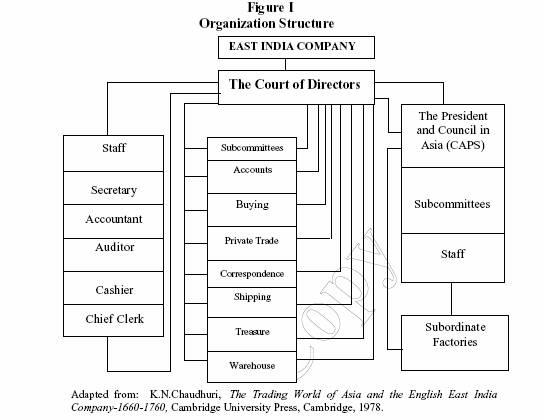
The Court of Directors had the highest authority to set, modify or change the goals of the company. It also had the power to suspend trading activities altogether. However, the Presidencies in Asia had limited powers and could vary their actions within prescribed limits. Thus it is clear that the parent company had a strong control over its subsidiaries.
The Court of Directors had the highest authority to set, modify or change the goals of the company. It also had the power to suspend trading activities altogether. However, the Presidencies in Asia had limited powers and could vary their actions within prescribed limits6. Thus it is clear that the parent company had a strong control over its subsidiaries.
According to Chaudhuri7 , the EIC controlled three separable components. The first component was the economic, political and social environment which affected the company's internal state; the second was the decision-making part which was a controlling mechanism; and the third was the operational part which dealt with the actual physical aspects of trade. Chaudhuri further says that the environmental factors were both exogenous and endogenous to the internal functioning of the company. Outbreaks of war, weather fluctuations, and harvest failures which affected the company's economic position were exogenous factors and were ‘inputs'from the environment. Decisions and responses of the company which affected the systematic external elements such as government policy or economic behavior of consumers were ‘outputs'coming from the company's trading system and were thus endogenous.
6] K.N.Chaudhuri, The Trading World of Asia and the English East India Company-1660-1760, Cambridge University Press, Cambridge, 1978.
7] K.N.Chaudhuri, The Trading World of Asia and the English East India Company-1660-1760, Cambridge University Press, Cambridge, 1978.