Consumers Behavior
 |


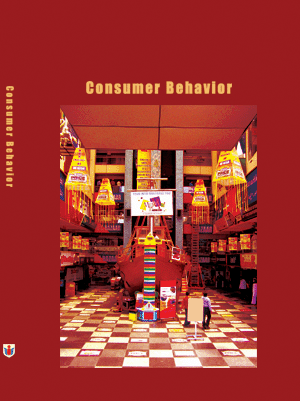
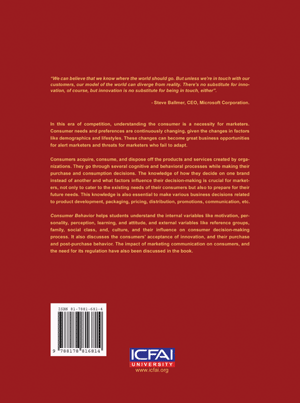
Details
Chapter Code: CBC02
Textbook:
210 X 275 mm approx.
Short Case Studies
Detail Table of Contents
Workbook:
Pages : 304; Paperback;
210 X 275 mm approx
Pricing
Textbook Price: Rs. 750;
Workbook Price: Rs. 700;
Shipping & Handling Charges: Rs. 50 per book;
Books Available only in INDIA
Chapter Price : Rs. 100
To download this chapter in electronic format, click on the button below,
and select the chapter from the list of available chapters.

Buy Now
To order the entire book click on the button below, and select the book from
the list of available books:
Please allow 5 to 10 days for delivery of the
Book.

Consumer Behavior : Chapter 2
SUMMARY:
Market segmentation is the process of dividing the market on the basis of certain major factors - geography, demography, psychology, psychographics, socio-culture factor, use-related factor, use-situation factor, and benefits, or on multiple factors like psychographic-demographic segmentation, geodemographic segmentation, and SRI Consulting's VALS. |
|
Psychographic segmentation divides consumers on the basis of difference in lifestyle, attitude, interest, and opinions. Socio-cultural segmentation divides consumers on the basis of culture, sub-culture, cross-culture, religion, social class, and family life cycle. Use-related segmentation divides consumers on the basis of usage rate, awareness status, and brand loyalty. Use-situation segmentation involves segmenting consumers on the basis of time, objective, location, and person. Benefit segmentation segments consumers on the basis of the benefit they seek like prestige, confidence, health, nutrition etc.
Multi-segmentation involves combining segmentation various variables to effective segmentation. Some popular multi-segmentation tools are psychographic-demographic segmentation, geodemographic segmentation, and SRI Consulting's Values and Lifestyle System (VALS). Segmentation yields positive results only if the right segment is chosen. While choosing a target segment care should be taken that the segment is measurable (quantifiable in terms of market size), substantial (commercially viable), accessible (easy to reach and address to), and differentiable (different in some way from the other segments).
After selecting the relevant segment(s), the marketer has to formulate a marketing mix. The marketers may choose to cater to a single segment or multiple segments, with single or multiple products - single product-single segment strategy (concentration strategy); single product-multiple segments (product specialization strategy); single segment-multiple products (market specialization strategy); and multiple products-multiple segments (selective segmentation strategy).
Big marketers, at times, may also employ a full market coverage strategy, which may further be differentiated (different marketing mix for different products) or undifferentiated (single marketing mix for all products). Sometimes marketers adopt too many micro segments, which later become redundant. In such a case, all segments are clubbed together with a single marketing mix (counter segmentation).
Related Case Books:-
 Case Studies in Consumer Behavior
323 pages, Paperback,
Available only in INDIA

Related Textbook:-
 Marketing Communications Textbook
210 X 275 mm approx,
Price: Rs. 750;
Available only in INDIA
