Consumers Behavior
 |


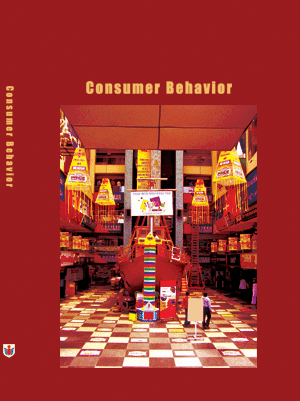
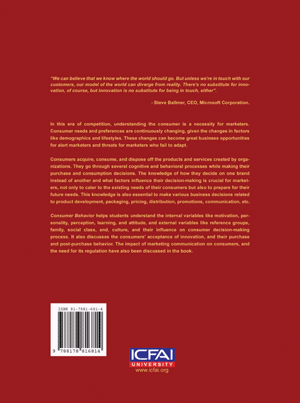
Details
Chapter Code: CBC06
Textbook:
210 X 275 mm approx.
Short Case Studies
Detail Table of Contents
Workbook:
Pages : 304; Paperback;
210 X 275 mm approx
Pricing
Textbook Price: Rs. 750;
Workbook Price: Rs. 700;
Shipping & Handling Charges: Rs. 50 per book;
Books Available only in INDIA
Chapter Price : Rs. 100
To download this chapter in electronic format, click on the button below,
and select the chapter from the list of available chapters.

Buy Now
To order the entire book click on the button below, and select the book from
the list of available books:
Please allow 5 to 10 days for delivery of the
Book.

Consumer Behavior : Chapter 6
SUMMARY:
Learning is a behavioral modification that occurs through experience or conditioning. Researchers have carried out studies to understand consumer learning. According to the behavioral learning theory, learning occurs from exposure to external stimuli such as advertising and according to the cognitive learning theory, consumer learning takes place by a process of internal knowledge transfer. |
|
Instrumental conditioning, like classical conditioning, also has an association between stimulus and response but in instrumental conditioning, the stimulus that provides the most rewarding response will be learned. B.F. Skinner, a behavioral scientist, conducted some experiments on pigeons to prove this point. When the environmental conditions reward a certain behavior it is said to be a positive reinforcement.
When a particular behavior results in punishment or less satisfaction, the individual will try to avoid such behavior. This is called negative reinforcement. According to cognitive learning theory, the human mind processes the information it receives from the environment. There are three stages in the memory of a human being. They are sensory memory, short-term memory, and long-term memory.
Involvement theory is developed from research called split-brain theory. This theory views the human brain as being divided into left and right hemispheres. The left hemisphere functions rationally and logically, processing information pertaining to reading, writing, speaking, and such other forms of information and forms mental images based on this. The right hemisphere of the brain, unlike the left, is emotional and spontaneous, and is involved in analyzing nonverbal and pictorial representations of information.
If an individual resorts to information processing for purchasing a product then he is considered to be highly involved. Otherwise, he is said to be making a purchase with low involvement. There are five types of involvement - Ego involvement, commitment, communication involvement, purchase importance, and response involvement.
Brand loyalty can be considered as the conscious or unconscious decision of a consumer that is reflected in his/her expressed intent or behavior to purchase and repurchase a product on a continuous basis. The amount of additional income expected from a branded product over and above what might be expected from an identical, but unbranded product is called brand equity. Product positioning can be considered as a technique that marketers use to create an identity and image for their products. When marketers leverage on the brand equity by using the existing brand name for new products, it is called brand leverage.
Related Case Books:-
 Case Studies in Consumer Behavior
323 pages, Paperback,
Available only in INDIA

Related Textbook:-
 Marketing Communications Textbook
210 X 275 mm approx,
Price: Rs. 750;
Available only in INDIA
