Consumers Behavior
 |


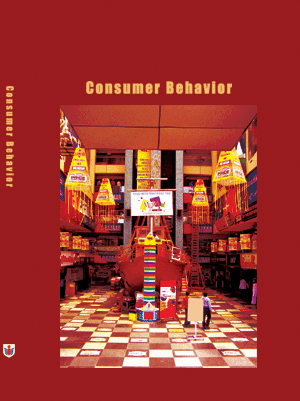
Details
Chapter Code: CBC12
Textbook:
210 X 275 mm approx.
Short Case Studies
Detail Table of Contents
Workbook:
Pages : 304; Paperback;
210 X 275 mm approx
Pricing
Textbook Price: Rs. 750;
Workbook Price: Rs. 700;
Shipping & Handling Charges: Rs. 50 per book;
Books Available only in INDIA
Chapter Price : Rs. 100
To download this chapter in electronic format, click on the button below,
and select the chapter from the list of available chapters.

Buy Now
To order the entire book click on the button below, and select the book from
the list of available books:
Please allow 5 to 10 days for delivery of the
Book.

Consumer Behavior : Chapter 12
SUMMARY:
The concept of diffusion of innovation refers to the spreading of consumption of an innovation, through communication channels in a social system. An innovation is a product, service, idea, process, behavior, or any other object which is considered new by consumers. Innovations require acceptance from consumers to be successful, but they also require them to change their existing behavioral pattern and habits. |
|
Communication channels are the tools which help the marketer reach the consumer, and the consumer to reach out to other consumers in a social network. Information can flow through impersonal (mass media), interpersonal (salespeople), and personal channels (word-of-mouth) of communication.
A social system is a social environment in which consumers with similar beliefs co-exist. A social system has a social hierarchy and a communication network which decide the flow and speed of adoption through the social system. Time is the factor which connects the adoption process, the consumers' innovativeness, and the rate of adoption.
The adoption process consists of five stages of consumer decision making - awareness, interest, evaluation, trial, and adoption/rejection. The longer the process and larger the number of decision makers, the longer the time taken to adopt. The innovativeness of the consumer depends on the adoption stage at which he/she is, as compared to other consumers. Based on these criteria, consumers have been classified as innovators, early adopters, early majority, late majority, and laggards. The rate of adoption is the speed with which the innovation is being adopted by consumers. It can be slow, moderate, or fast.
Consumer innovators are identified on the basis of time elapsed after the launch or as a specific percentage of people out of total purchasers who buy early. Consumer innovators are venturesome, young, highly educated, high status and income individuals, who have an interest in new products and seek variety in life. They have low risk perception and have a positive attitude towards change. They are very sociable and in the role of opinion leaders and market mavens, they can be quite influential.
Related Case Books:-
 Case Studies in Consumer Behavior
323 pages, Paperback,
Available only in INDIA

Related Textbook:-
 Marketing Communications Textbook
210 X 275 mm approx,
Price: Rs. 750;
Available only in INDIA
