
The Tug of War over Gesco Corporation
Details
BECG028
10
2002
YES
200
Gesco Corporation
Real Estate
India
Corporate Governance
Abstract
The case “The tug of war over Gesco Corporation”, traces the various developments that had taken place in the tug of war over Gesco Corp. In October 2000, Abhishek Dalmia made an open offer for 45% stake in Gesco Corp at Rs. 27 per share. Since then, the battle between the Sheths-the promoters of Gesco Corp and the Dalmias had strengthened. The late 2000, saw both the sides making offers and counter offers. They had reached a stage where both the groups were fighting a losing battle. The price of the share went up to Rs. 45 per share with the Dalmias’ making the last call. In January 2001, good sense prevailed on both the sides and they reached an agreement. By the agreement, the Dalmias’ sold their 10.5% stake in Gesco at Rs. 54 per share. With this, one of the most engrossing corporate battles had come to an end.
Learning Objectives
The case is structured to achieve the following Learning Objectives:
- Corporate takeovers.
Contents
INTRODUCTION
“We will stay as long as the price is economically viable, even though we are committed to taking control of Gesco. If they announce a knock-out price and we are forced out of the game, we will remain in the company as minority shareholders and with enough stake to have an influence on management decisions.”
- John Band, CEO, ASK-Raymond James, the investment banker for Dalmia group involved in acquiring shares of Gesco Corporation.
On July 21, 2000, at the Gesco Corporation’s1 (Gesco Corp’s) annual general meeting (AGM), a shareholder stood up and asked executive vice-chairman, Sudhir Mulji (Mulji) a question: “If your market cap is so low (Rs 230 million on that date) and the promoter stake less than 15%, isn't Gesco Corp a sitting duck for a raider?” Mulji responded lightly-heartedly: “If there’s a takeover bid, I will welcome that since shareholders will gain.” Mulji and Ghanshyam Sheth (Sheth), CEO, Gesco Corp, should have taken this question seriously for, seated among the shareholders was Sanjay Bakshi (Bakshi), an Abhishek Dalmia2 (Dalmia) confidante. Even as Mulji dismissed the takeover issue, Dalmia was busy mopping up shares of the Sheth-managed company.
By October 2000, Dalmia and his associates had cornered 10.5% of Gesco Corp stock. On October 18, Dalmia made an open offer of Rs. 23 (through his company-enaissance Estates Ltd.) for acquiring an additional 45% of Gesco Corp shares. On October 21, the offer price was raised to Rs. 27. If Dalmia’s offer was accepted, his stake in the company would cross 55%. The fear of losing a newly spun off company, made the Sheths look for help. Sheth approached HDFC CEO Deepak Parekh (Parekh) for advice, who in turn put him in touch with the Mahindras. Anand Mahindra’s Mahindra Realty and Infrastructure Developers (MRID) joined the Sheths in making a counter-offer of Rs 36 per share versus Dalmia’s Rs 27.
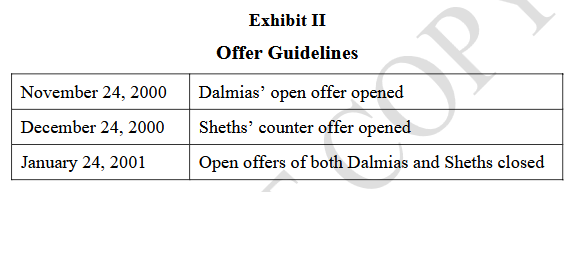
This drama of offer and counter offer continued for some time. However, in January 2001, one of the most engrossing corporate battles came to an end. (Refer Exhibit I & II for chronology of events and offer guidelines). The Sheths-Mahindras combine and the Dalmia group announced they had reached a settlement in the battle for Gesco Corp, with the combine buying out the Dalmias’ 10.5% stake at Rs 54 per share. Following the deal, the combine’s stake in Gesco Corp went up close to 30% (MRID 17% and the Sheths 13%).
BACKGROUND
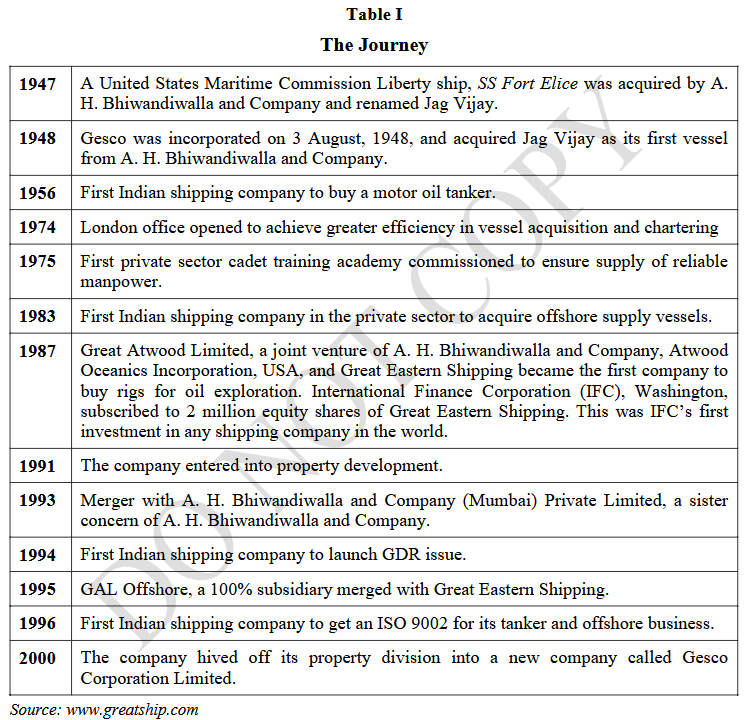
By the early 1990s, Gesco had consolidated its position in shipping and offshore operations. In 1991, Gesco entered into real estate and property development. In 2000, the real estate division was hived off as a separate company, the Gesco Corp Limited, as part of the corporate restructuring effort. According to Sheth, “The restructuring will lead to a greater focus and enhance shareholder value.” It was felt that through the demerger, Gesco would be able to substantially reduce its property exposure by the financial year 2000-01 and focus on its core business-shipping and offshore services.
STRATEGIC MOVES BY THE DALMIA GROUP
In October 2000, ASK-Raymond James, the investment banker for the Dalmia group involved in acquiring shares of Gesco Corp, was eyeing Global Depository Receipts (GDRs) holders for increasing its client’s holding in the target company. GDR holders had a 6% stake in Gesco; and there was hardly any trading in these shares. These GDRs came into existence after the de-merger of the real estate business of Gesco (who had issued GDRs) when all the shareholders, including GDR holders, were given a stake in Gesco.
John Band (Band), CEO, ASK-Raymond James, commented: “We have written to the Securities and Exchange Board of India (Sebi) about our intention to acquire the six per cent share in the form of GDRs.” In the letter to Sebi, Band argued that the GDR holders be given the choice to convert their holdings into domestic shares so that they could participate in the open offer given by Renaissance Estates Ltd. The letter further said that Raymond James, London, one of the partners of ASK-Raymond James, was keen to buy the GDRs from the holders. Band said that the price for purchasing the GDRs had not been fixed but stated that it would be at a discount to the proposed domestic open offer of Rs 27. According to him, the discount in the offer price to GDR holders made sense, as they would get the money immediately. If they went through the usual process for coverting them into domestic shares, it would take at least three months.
Analysts felt that this was a strategic move adopted by the Dalmias for acquiring shares at less than the current market price. Gesco’s shares were currently higher than the offer price (Rs. 27). Under these circumstances, if the Dalmias were to buy shares from the open market, they would have to buy at a higher price than their offer price. Band also said ASK-Raymond was talking to various institutions, both domestic and foreign, on behalf of the Dalmias to increase the Dalmia group's stake in Gesco. Domestic financial institutions—UTI, GIC, LIC—together held around 12.6%, FIIs 10%, Renaissance Estates and associates 10.5% and promoters (Sheth family) 12.5%, while the rest was with public.
Since October 21, after the open offer, the Dalmias did not purchase any shares from the market. Band said that they were waiting for the next move by Gesco's promoters. He added, “In case the Sheths give a counter offer, we might also increase the offer price but if it is higher than the book value at Rs 55, then there would be second thoughts on making the counter offer.”
In late October 2000, in a fresh twist to the ongoing takeover battle, the Dalmia group made an aggressive gameplan to acquire control of Gesco Corp. Dalmia was talking to Foreign Institutional Investors (FIIs) to acquire their holdings at the current offer price of Rs 27 or higher. This strategy was aimed at ensuring that the FIIs came to them with their holdings if there was any counter-bid from Gesco’s promoters. The Sheths’deadline for making a counter-offer would expire on November 11, and the stock market was keenly awaiting a move from the Gesco camp. Dalmia said there was no immediate hurry for the group to increase its offer price.. He said the Dalmia group would prefer to wait till Gesco’s promoters made the counter-offer before deciding on its next course of action.
Meanwhile, the promoters of Gesco Corporation said they would take some more time to decide on their counter offer to the hostile bid but would finalise it well before November 11, the deadline for making such an offer.
SHETHS MAKE A COUNTER MOVE
On November 5, 2000, the Sheths made a counter move, not a counter offer. The Sheths formed an alliance with MRID to jointly make a counter-offer. Deepak Parekh, CEO, HDFC, Played a key role in bringing the two sides together. HDFC requested the Mahindras to form the alliance at the instance of the Sheths; the bank also extended a line of credit to the Sheths to finance the transaction. While there was no final word yet on what the price for the joint counter-offer would be, it was believed that after a successful counter-offer, MRID and the Sheths would hold shares in Gesco Corp in the ratio of 3:2.
Analysts' felt that HDFC’s masterstroke-getting the two parties together- was prompted by the institution’s belief that there should be consolidation in the construction business. Commented a top HDFC official, “The stronger companies should come together in the construction business. There's so much land being released everywhere which can be developed. And if the Tatas and the Birlas can join hands in the telecom business, there’s no reason why the Sheths and the Mahindras can’t work together to develop projects”. Commenting on the alliance, Parekh said, “This alliance is in the interest of Gesco Corp and the real estate industry and its customers. This consolidation of two formidable real estate players would also result in the acceleration of professionalism of industry practices.” According to Sheth, Gesco would benefit from the alliance in many ways: “The shareholders of Gesco Corp will derive tremendous benefits by virtue of this association with Mahindra Realty. The association will give us access to Mahindra Realty’s expertise, besides giving us directly the positive benefits of the goodwill of the Mahindra group. It will also promote growth prospects for the employees of Gesco.”
On November 8, 2000, the Sheths and MRID announced that they would be making a counter open offer for Gesco Corp at Rs 36 a share. The offer would be for 33.5% of the equity capital of Gesco which, along with the 12.5% held by the Sheths, would add up to more than 45% of the total paid-up capital of Gesco.
Responding to the offer, the Dalmia group said that it was in no hurry to announce a price to counter the offer. Dalmia said, “It is an informed decision that we have to take. Besides, we have a lot of time on our hands.” He further added that the family had to hold consultations with all its advisors before announcing a price. However, informed sources said that the group was considering increasing its offer price to Rs 40-42 per share. Dalmia dismissed such statements as mere speculation. He said, “We haven't arrived at any decision so far. We can announce the new offer price uptil seven days before their counter offer closes. So we have time till January next year.” The open offer made by Renaissance Estates Ltd would open on November 24. The Sheth-Mahindra counter offer would open a month later and would close only in January 2001.
Dalmia told a business daily that he would take his offer price up to the limit where he believed the company was still good value. “I will not offer a ridiculously high price for it,” he added. Analysts felt that the counter offer made by the Sheths and MRID could well lead the whole takeover drama into a prolonged winter.
THE TUG OF WAR
The Dalmia group was planning to raise its offer price of Rs 27 by November 20. Band said, “We are definitely in the game, and determined to take control of Gesco Corporation. We will take a final decision on the price after seeing the fine print of their (the Sheths-Mahindras combine) public announcement. Since we would be mailing the offer notice to Gesco shareholders on November 20, in all likelihood we would have decided on the revised price by then.” The Dalmia camp was also planning another move to counter the Sheths-Mahindras combine. It was considering coming out with a statement to Gesco’s shareholders revealing MRID’s financial condition. The Dalmias were likely to highlight the fact that the Sheths’ white knight, MRID, was a loss-making company and had huge negative cash flows. (MRID posted losses of Rs 178.5 million in 1999-2000, and cash flows were a negative Rs 590 million in that period). According to Band, “The quality of real estate assets of Gesco are far superior to that of Mahindra Realty. I do not know whether Gesco shareholders need the Mahindras in the first place. This is something that we would like to point out.”
In mid-November 2000, in a significant development, MRID bought out the Washington-based International Finance Corporation’s entire 6.34% stake in Gesco for Rs 44 per share. This meant that the Mahindras-Sheths combine’s offer price for Gesco Corp was automatically revised to Rs 44 per share. According to a statement issued by MRID, the company had acquired 18,23,059 equity shares, equivalent to 6.34% of Gesco Corp’s share capital, from IFC, at Rs 44 per share, in accordance with the Reserve Bank of India’s (RBI) guidelines for the sale of shares by non-residents to a resident. With this acquisition, the combine’s stake in Gesco Corp went up close to 19 % as the Sheths already held 12.5% in the company. With IFC selling its stake to the Mahindras, the first round of the corporate battle had clearly gone in favor of the combine. The ball was now in the Dalmias' court.
Analysts were of the opinion that the revised offer price, Rs 8 higher than the combine's original counter-offer price of Rs 36, signaled the combine's growing aggression to control Gesco Corp and thwart the Dalmias' attempts to take over the company. Meanwhile, Dalmia had been camping in Mumbai to meet numerous financial institutions and explain the group’s stand on what it intended to do with Gesco Corp. The Dalmias had also roped in S Gurumurthy, key strategist and chartered accountant from Chennai, to advise them on the issue. They had until early January 2001, to revise the offer price upwards to counter the increased Sheths-Mahindras offer price of Rs 44 per share.
The Dalmias had also requested HDFC to extend a line of credit to them, identical to what they had extended to MRID. The Dalmias’ contended that if HDFC was a mere financier in the deal, and not a party to the offer, then it should have no problem in funding them as well. HDFC said it was still examining the Dalmias’ proposal.
Meanwhile, in late November 2000, in a renewed effort to woo institutional investors, the Sheths-Mahindras alliance was gearing up to make a detailed presentation to the Financial Institutions (FIs). Among the FIs, LIC held a 4.5% stake in the company, UTI 1.3%, GIC 6.8%. The combine was likely to brief the FIs on the work culture and the flat organizational structure of their corporations.
On November 25, 2000, the open offer made by the Dalmia group company Renaissance Estates Ltd for 45% shares of Gesco Corp commenced. However, neither the Dalmia group nor its merchant banker ASK Raymond James expected a significant response to it. Since the Sheth-Mahindra combine had increased the counter offer price to Rs 44, it was unlikely that the shareholders would respond favorably to the initial offer. “We were anyway not expecting a response,” said Band. However, neither Dalmia nor Band were willing to comment on whether they would make a counter offer. But it was clear that the Dalmia group was getting prepared to better the offer price of Rs 27.
In early December, 2000, the Dalmia group was looking for a strategic partner for its takeover bid. Company sources said, “We might bring in a strategic investor at this stage who could give us inputs in various ways. One way could be that the investor picks up some stake in Gesco, but nothing is finalised as of now.” Dalmia declined to comment, saying, “all options are under consideration, but no decision has been taken as yet.” The Dalmias had time till January 6 2001, to revise their offer, which would close on January 14, 2001. The Dalmias were holding negotiations with their merchant banker, ASK-Raymond James, on various options. In late December 2000, the Dalmias consolidated their position in the takeover battle by increasing their offer price substantially from Rs 27 to Rs 45.
STALEMATE!
In January 2001, a leading business daily wrote, “Even as the stock markets and Corporate India wait with bated breath, the bidding war between the Sheths-Mahindras combine and Dalmia group for the control of GESCO Corporation is unlikely to continue for long.” Analysts felt that the increase in the offer price by the Dalmias had taken the battle to altogether another level- one where economic and corporate sense would have to prevail. With the Dalmias making it clear that they too had deep pockets to match the might of the Sheths-Mahindras combine, chances were that if the bidding war continued, both sides might end up with substantial stakes. This would make it virtually impossible for any one of them to run Gesco Corp. Thus, all signs pointed to the fact that the bidding game might actually get over soon and the battle for control might come to an end. Both offers would end on January 24, 2001. The last day for revising the price by any of the two sides was January 15.
By January 2001, the Dalmias had about 11% and the Sheths-Mahindras about 19% of Gesco Corp shares. Thus, the total stake of Gesco Corp already in the hands of the two bidders was about 30% This left 70% to be taken up by way of offers. The two offers taken together (Dalmias' offer for 45% and the combine’s for 33.5%), would amount to 78.5%, more than the stake in the hands of non-bidder shareholders. Analysts felt that this would provide a guaranteed exit to shareholders opting for either offer, particularly when the price difference between the two offers was very little. Eventually, if the shareholders sold to both the bidders because of the low price difference, both bidders would end up with substantial stakes. There would be a total stalemate which would be difficult for either side to tackle at that point. According to an analyst, "In such a situation, no side will be at peace with the shares held by it. It, therefore, makes little sense to continue a bidding war."
THE TRUCE
As expected, on January 8, 2001, the Sheths-Mahindras combine and the Dalmia group announced they had reached a settlement in the battle for Gesco Corporation, with the combine buying out the Dalmias' 10.5% stake at Rs 54 per share. The deal amount worked out to Rs 160 million. Following the deal, the combine's stake in Gesco Corp went up close to 30% (MIRD 17% and the Sheths 13%). After the completion of the open offer for 33.5%, and assuming it would be successful, the combine’s stake was expected to stand at close to 65% of the company's paid-up equity capital. The open offer price of the combine automatically stood revised from Rs 44 per share to Rs 54 per share, which was the price at which the Dalmias sold to the combine. The Dalmias' open offer, however, continued, and the Dalmias were willing to pick up whatever shares might be tendered under its offer, of Rs 45 per share.
The Dalmia group was expected to own about 5% equity stake in Gesco Corp even after it reached an agreement with the Sheths-Mahindras combine. But the Dalmias planned to sell back this holding, preferably to the Sheth-Mahindras combine, at the best market price once they got physical possession of the shares. According to Dalmia, “Dalmia Group was not interested in owning this stake in Gesco anymore' and it would 'offload them, preferably to the Sheths-Mahindras combine since they are the majority stake holders in GESCO now.”
Commenting on the settlement, Dalmia said, “We were getting into a phase of uncertainty which is not good for anyone and a settlement was the best option. A price war would have led to irrational and uneconomic acquisition, which I always wanted to avoid. I am glad that with this settlement, the period of uncertainty is over for Gesco’s stakeholders.” Speaking to reporters while announcing the settlement, Arun Nanda, director, MRID, said, “The real work for us starts now. Our work will be to exploit the synergies between the Sheths and the Mahindras in the best interests of the Gesco shareholders.”
The Sheths might have successfully staved off a hostile takeover bid, but they had to submit to great changes in the company. Gesco Corp was to change its name by including the Mahindra name in it. A clause in the shareholders’ agreement between the Sheths and the Mahindras gave the latter the right to include Mahindra in the company’s name. However, the new name for Gesco Corp was yet to be decided. The changes would not end here. All future projects taken up by Gesco would also be co-branded. That is, the name Mahindra would be included in every new assignment taken up by the Gesco-Mahindra combine. In addition, the Mahindras would have 60% of the combined promoters’ stake if the open offer was fully subscribed. The Gesco board would also see a significant change with Mahindra nominees making up 60% of the board.
In January 2001, the Sheths-Mahindras combine received an overwhelming response to its open offer, with proposals totalling over 40% equity in the company as against their original target of 33.5 per cent. The Sheth family was likely to retain 40% of the equity acquired through the open offer route while the remaining 60% would go to MRID. Company sources said that the Sheth-Mahindra combine would keep only 33.5% of the equity and return the oversubscribed portion back to shareholders.
In May 2001, the board of directors of Gesco Corp appointed Kotak Mahindra Capital Company as its advisor in connection with the proposed scheme for merging Gesco and MRID. Gesco Corp was also planning to float a wholly-owned subsidiary to take advantage of the boom in the real estate market in southern India.
QUESTIONS FOR DISCUSSION
1. In July 2000, in the Gesco Corp's AGM, when a shareholder said that Gesco Corp was a “'itting duck for a raider', Mulji said he would welcome a takeover bid since the shareholders would gain. Do you think the shareholders were the ultimate beneficiary in the tug of war between the Sheths and Dalmia?
2. Do you think Dalmia was serious in his quest for Gesco Corp or it was more of an arbitrage play like that of Arun Bajoria’s bid for Bombay Dyeing?
3. In the late 2000, four high profile real or mock takeover dramas were played out. (Bombay Dyeing-Ballarpur Industries vrs Arun Bajoria, Gesco Corp vrs Dalmia, Delhi based stockbroker Harish Bhasin vrs Jai Prakash Industries and East India Hotels vrs ITC). Who do you think should be held responsible for making the companies vulnerable to takeover?
EXHIBITS
Exhibit I
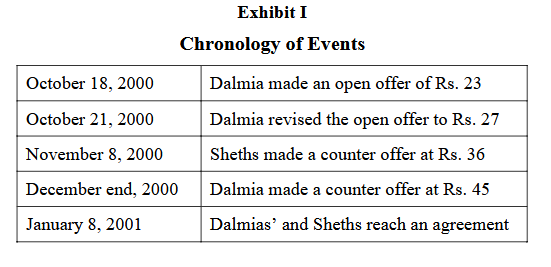
Exhibit II
Keywords
The tug of war over Gesco Corporation, October 2000, Abhishek Dalmia , 45% stake, Gesco Corp ,Rs. 27 per share, Sheths-the promoters , Dalmias, 2000, Rs. 45 per share , January 2001, agreement, the Dalmia,10.5% , Rs. 54 per share