
News Corp in 2005: Consolidating the DirecTV Acquisition
Details
BSTA003
13
2005
NO
300
News Corporation
Leisure & Entertainment
Global
M&A,Growth Strategy, Service Operations
Abstract
The acquisition of DirecTV has given Rupert Murdoch's News Corp considerable bargaining power. With DirecTV, Murdoch has gained access to 12 million subscribers in the US. DirecTV is also expected to fortify News Corp's own channels against competition from Comcast and Time Warner. Murdoch has dismantled everything at DirecTV that does not have anything to do with satellite broadcasting. He has also moved fast to acquire complete control of Fox Entertainment Group, which holds a controlling interest in DirecTV. DirecTV has launched new satellites. Modeling itself on the success of BSkyB (UK), DirecTV has announced it will introduce interactive television features to the American audience. Betting heavily on the popularity of football, DirecTV is finalising deals with the National Football League (NFL) for broadcasting rights. The case covers the history of DirecTV, its businesses and events starting from the acquisition of DirecTV in 2003 till early 2005.
Learning Objectives
The case is structured to achieve the following Learning Objectives:
- 0
Contents
News Corp in 2005: Consolidating the DirecTV Acquisition
DirecTV is important to News Corp. because it provides the missing link in News Corp's network of satellite TV platforms around the world.
- Rupert Murdoch
Introduction
Rupert Murdoch, (Murdoch), News Corpís Chairman, seemed to be on top of the world in early 2005. With the successful acquisition of DirecTV, Murdochís dreams of building a content and distribution empire were coming true. With savvy investments in Internet technologies, quality content and a strong hold on distribution, News Corp looked like an invincible media powerhouse at the end of 2004. This optimism was reflected in Murdochís own words,
“Our satellite platforms now span four continents, and we have more than 26 million subscribers. What that network of platforms gives us is, I believe, the perfect balance of assets for any media company: We have a great mix of subscription and advertising revenue, as well as a great mix of content and distribution businesses -- (and) we're spread geographically in a way no other media company in the world can match”.
Background Note
The DirecTV acquisition seemed to mark a turning point for Murdoch. DirecTVís roots went back to 1932, when Hughes Aircraft was set up to build experimental airplanes for Howard Hughes (Hughes). During World War II, the company began building a mammoth flying boat to serve as a troop carrier. After the war, the company entered the growing defense electronics field. In 1953, it underwent a major shake-up when about 80 of its top engineers walked out, dissatisfied with Hughes, who was becoming distant and difficult to deal with. The US Air Force also threatened to cancel the company's contracts because of Hughes' erratic behavior. Hughes transferred the company's assets to the Howard Hughes Medical Institute (with himself as its sole trustee) and hired former Bendix Aviation executive Lawrence Hyland (Hyland) to run the company. The institute produced the first beam of coherent laser light in 1960 and placed the first communications satellite into geosynchronous orbit in 1963. The Hughes-built Surveyor landed on the moon in 1966.
In 1984, the Department of Defense canceled several missile contracts and the institute found it difficult to fund R&D. The next year the institute sold Hughes Aircraft to General Motors (GM) for $5.2 billion. GM combined its Delco Electronics auto parts unit with Hughes to form GM Hughes Electronics (GMHE). GMHE acquired General Dynamics' missile business in 1992.
In 1995, GMHE became Hughes Electronics and launched its DirecTV satellite service. The same year, the company strengthened its defense business by acquiring CAE-Link (training and technical services) and Magnavox Electronic Systems (warfare and communications systems). Hughes bought a majority stake in satellite communications provider PanAmSat in 1996. In 1998, the company boosted its stake in PanAmSat to 81%3. The investment and sluggish sales led to a drop in profits for 1998. Hughes also took a public relations hit in 1998, when several of its satellites failed and temporarily halted most US pager activity.
To gain customers and expand its broadcast channel offerings, Hughes bought United States Satellite Broadcasting and the satellite business of rival PRIMESTAR and folded the businesses into DirecTV in 1999.
In early 2000, Hughes sold its satellite manufacturing business to Boeing in an effort to focus on its faster growing communications services businesses. GM also issued a tracking stock for Hughes but retained ownership of all the company's assets. Also that year, GM announced that it would try to sell Hughes.
Hughes bought Telocity (later renamed DirecTV Broadband), an Internet Service Provider that used DSL (digital subscriber line) technology, for about $177 million in 2001. As negotiations to sell Hughes to Rupert Murdoch's News Corp continued in 2001, EchoStar made an unsolicited bid to buy Hughes for $30.4 billion in stock and $1.9 billion in assumed debt. Soon News Corp dropped out of the bidding and GM reached a $25.8 billion deal with EchoStar. Even as the Justice Department and the FCC looked likely to block the company's sale to EchoStar, Hughes announced that it was confident the deal would win regulatory approval by the end of the year. However, the companies abruptly called off the merger in December 2002.
In a sudden turn of events, GM sold its 19.8% interest in Hughes Electronics to News Corp in 2003. News Corp acquired another 14.2% from common stockholders, amounting to a 34% stake in Hughes Electronics, which it quickly transferred to its 82%-owned Fox Entertainment Group. In 2004, Hughes Electronics changed its name to The DirecTV Group, declaring its focus and commitment to the DirecTV brand.
DirecTV’s Business
DirecTV, the first entertainment service in the US to deliver all digital-quality, multi-channel TV programming to an 18-inch satellite dish, provided people across the US with a much-needed alternative to cable. For the first time, rural consumers who were not being served by cable, had access to programming like their urban and suburban counterparts. DirecTVís business included:
- DirecTV US, which was the largest provider of direct broadcast satellite (DBS), television services and the second largest MVPD4 provider in the US behind Comcast. DirecTV provided its customers with access to hundreds of channels of digital-quality video and audio programming that was transmitted directly to its customersí homes or businesses via high-powered geosynchronous satellites. As of December 31, 2003, DirecTV had about 12.2 million subscribers, of whom about 10.7 million were DirecTVís subscribers. The remaining subscribers received DirecTV service from members and affiliates of the National Rural Telecommunications Cooperative. DirecTV also provided premium professional and collegiate sports programming such as the NFL5 SUNDAY TICKET package, which allowed subscribers to view as many as 14 NFL games played each Sunday during the regular season.
- PanAmSat, which owned and operated 25 satellites that were capable of transmitting signals to geographic areas covering over 98% of the worldís population. PanAmSat provided satellite capacity for the transmission of cable and broadcast television programming from the content source to the cable operator or to the consumerís home. PanAmSatís satellites were able to reach nearly 100% of all cable subscribers in the US. In addition, PanAmSat provided satellite services to telecommunications carriers, government agencies, corporations and Internet service providers.
- Hughes Network Systems provided broadband satellite networks and services to both consumers and enterprises. Hughes Network Systems (HNS) constituted the DirecTV Network Systems segment. HNS was a leader in the global market for VSAT private business networks with more than 500,000 terminals shipped or ordered. SPACEWAY, a more advanced satellite broadband communications platform under development would provide customers with highspeed, two-way data communications on a more cost-efficient basis than systems that were currently available. The first SPACEWAY satellite service was expected to be introduced in 2005.
The DirecTV Deal
Don’t worry. We don’t want to take over the world. We just want a piece of it.”
- Murdoch
Television programs were delivered by cable or through satellite. Satellite had much wider reach than cable. Cable operators beamed programming content through cables to the subscribersí homes. In case of Satellite television, satellites orbiting in the sky did the job, without the need for any cable connection.
Murdoch had been excited about satellite communications right from his childhood. In the mid 1980s, Murdoch paid £ 10 million for a controlling interest in Sky Television (Sky), a pan-European channel that aired common programs to several European countries. By 1987, Murdoch had spent £ 40 million on Sky, which reached nearly 12 million homes in 20 European countries. In 1990, after prolonged negotiations, BSB, a television channel, merged with Sky, into a single company, British Sky Broadcasting (BSkyB). Between 1989 and 1992, the combined entity made losses of about $ 1.2 billion. As BSkyB introduced better programs and aired soccer matches exclusively, it achieved a turnaround by the end of 1992 and revenues rose to £ 385 million. By 1993, BSkyB reached financial stability. Over the next four years, the company developed new content and innovative programs. By 1997, 25% of British homes were subscribers to the channel. By 2001, Sky had 5 million customers and had become the first digital television channel in the world by moving its operations from analog to digital. By June 2002, BSkyB had 6.1 million subscribers and a 20% increase in revenues over 2001.
Meanwhile, DirecTV had made significant progress with its direct broadcast satellite services. Attractive sports content, aggressive marketing and free installation resulted in rapid penetration of DirecTV. By 2000, DirecTV had enrolled more than 9.5 million subscribers to become the largest satellite-based provider of television content in the US. DirecTV offered more than 225 programming channels, to 60 million homes in about 40 cities in the US.
Murdoch realized DirecTV would add the strategic US market to his worldwide network of satellite distribution that included BSkyB in Britain, Star TV in Asia, Foxtel in Australia, SkyTel in Latin America, and Stream in Italy. DirecTV would eliminate dependence on cable distribution in the US market and fortify News Corpís fast-growing cable networks, which included Fox News, Fox Sports, National Geographic, and Speed Channel, which carried motor sports. DirecTV gave Murdoch the missing link in News Corpís worldwide satellite-distribution system. As press reports put it, the DirecTV acquisition made Murdoch
"ìa general in both the content and distribution campsî"
In September 2000, Murdoch offered $ 22 billion for a 35% stake in DirecTV. But negotiations between News Corp and DirecTV proceeded slowly. A 25% decline in the stock of Hughes Electronics in February 2001 slowed down the talks further. In April 2001, Murdoch reduced his bid for a 30% stake and got Microsoft to commit $3 billion in cash for the deal. In August 2001, EchoStar surprised everyone by announcing an unsolicited $32.3 billion bid for DirecTV. EchoStar and DirecTV together controlled about 92% of the US satellite pay-TV market. Murdoch lobbied intensely and succeeded in getting the merger blocked on antitrust grounds. Finally in April 2003, News Corp acquired GMís 19.9% stake in Hughes and a further 14.1% from public shareholders and GMís pension and other benefit plans.
Following the completion of the acquisition, Murdoch became Chairman of Hughes, while News Corpís former Co-Chief Operating Officer, Chase Carey (Carey) became the President and Chief Executive Officer. The public shareholders as well as GMís pension and other benefit plans owned all of GMís Common Stock, which represented 80.1% of interest in Hughes Electronics. GM retained a 19.9% stake in Hughes.
DirecTV gave News Corp considerable bargaining power. News Corp had plans to add one million subscribers a year, using DirecTV. Fox TV Stations were expected to let DirecTV viewers choose their angle on their television sets at sports events or create their own video newsmagazines8. At any given time, as many as one in five US households would be watching News Corpís shows. DirecTV was also expected to fortify News Corpís own channels against competition from Comcast and Time Warner. News Corp looked well placed to drive down the prices of entertainment and sports programming. With so many viewers hooked up to DirecTV, no programmer would risk not being in News Corpís system. At the same time, Murdoch, known for his aggressive marketing tactics, would have the leverage to force his cable and satellite rivals to carry his programs at premium prices.
It was widely reported that Murdoch might distribute set-top boxes at a very low price to attract subscribers to DirecTV. Meanwhile, rivals such as Comcast and Time Warner Cable were attempting to expand their own distribution networks. Comcast acquired AT&T Broadband in 2003 for $54 billion. AT&T Broadband owned regional sports rights, telephony and two-way Internet interactivity over cable lines. Comcast was also seeking to enhance its partnership with programmers such as Viacom.
In many ways, Comcast, the Number 1 cable system in the US, looked the only rival, which could remotely match the power of News Corp. After closing the AT&T Broadband deal, Comcast had pursued various deals to strengthen its distribution network. Comcast had even made a hostile bid to take over Walt Disney in February 2004 for $ 56 billion before backing out. Comcast had held firm on fees for pricey cable channels, won favorable deals for equipment, and put pressure on Hollywood to change its long-standing movie-release tradition so that it could get movies ahead of video stores and sell them over cable.
Comcast had launched various initiatives to strengthen its content. It had partnered with Radio One to launch a new channel targeting African Americans. Comcast had also acquired TechTV to cater to video gamers. In December 2003, Comcast struck a deal with Chicago's major sports teams, Chicago Bulls, Cubs, White Sox, and Blackhawks, to create a new sports channel, leaving Murdoch's Fox Sports Chicago with no big draws. Comcast had also struck a deal with Viacom channels, such as MTV and Nickelodeon to supply content to Comcastís 21 million-subscribers for as long as five years.
Cable had an important advantage over satellite. Cable offered high-speed, two-way Net access, including phone capability. Satellite was still mostly a one-way service. But cable still needed millions of dollars of investments to upgrade to digital technology. About 40 million cable subscribers in 2005 did not have digital technology. Satellite, by default, was digital. This meant that cable companies such as Comcast, could only offer digital technology features such as electronic program guides and video-on-demand if they upgraded. By the end of 2004, both systems (satellite and cable) were engaged in intense competition to be big players in new consumer technologies such as the digital video recorder (DVR), high-definition TV, and a host of other products that were reshaping home entertainment.
After The Acquisition
Murdochís BSkyB had already redefined the way people watched television programs in the UK, where the company controlled about 70% of the pay-TV market. It had launched many innovative programs for the UK consumer, such as, alternating camera angles to stay focused, switching off the sound and listening to a different channel broadcast among others. With the help of DirecTV, Murdoch planned to introduce these features in the much bigger US market.
After acquiring DirecTV, News Corp immediately restructured DirecTV and settled labor disputes. News Corp dismantled everything at DirecTV that did not have anything to do with satellite broadcasting. Half of the employees were retrenched. Then, Murdoch sold DirecTVís 80% stake in satellite-launch service business PanAmSat to leverage buyout firm KKR for $2.5 billion. DirecTVís set-top-box manufacturing business was sold to Thomson. The companyís holdings in XM Satellite Radio were sold for a pretax profit of $387 million. Murdoch then spent about $1.4 billion to buy Pegasus Communications and the National Rural Telecommunications Cooperative, both rural satellite companies with about 1.4 million subscribers combined. DirecTV launched new satellites. Modeling itself on the success of BSkyB, DirecTV announced it would introduce interactive television features to the American audience. From a technology- driven company, DirecTV was becoming more like a content-house, like the rest of News Corp. Carey commented,
“At the end of the day, people buy DirecTV because they care about great television”.
DirecTV was betting heavily on the popularity of football. Just as it did in the UK, DirecTV finalized a five-year $3.5 billion deal with NFL Football Games for broadcasting rights. This was a critical deal for DirecTV to keep cable operators such as Comcast and Time Warner Cable out of the reach of football, a popular game in the US. A DirecTV employee commented,
"People have been fooling around with interactive TV for four to five years. Finally, this marriage of interactive TV and the NFL may be the thing that breaks the dam wide open.”
The company sent two-minute clips of every NFL game every Sunday evening to subscribers who had DVRs. DirecTV was also meeting real-time statistics requests during football games. Viewers could also receive information from DirecTV about a particular team or a particular player. DirecTV was also revamping its movie programs based on the popular video-on-demand programs of cable companies. While DirecTV could not beam video-on-demand due to technical reasons, it was compiling requests from subscribers and getting ready to start video-on-demand. In 2004, News Corp launched various aggressive promotion campaigns. In an effort to increase its reach, DirecTV dropped the price of its DVR. It also launched a promotion that would give new customers a DirecTV set-top box for free. According to analysts, DirecTV spent about $670 to acquire and keep a new subscriber in 2002, while it spent about $758 in 2003 and $894 in 2004. Operating profits fell from about $459 million in 2003 to about $54 million in 2004. Meanwhile, the churn rate (The rate at which customers leave each month) was increasing. Compared to the monthly average of 1.5% in 2003, the rate climbed to 1.7% in 2004. Murdoch and Carey remained upbeat about DirecTV even as competition from cable companies increased. Carey commented,
“We’ve been helped by the fact that we are very focused on the television experience. The cable companies are fighting the broadband battle and are much more commoditized than television”.
But News Corpís position had been weakened by some compromises made while closing the DirecTV deal. The FCC had already banned large cable operators from discriminating against rival programmers. So News Corp could not use to its advantage the muscle power of DirecTV. News Corp also had to submit to arbitration, if cable operators accused it of using its most popular channels as bargaining tools. But these restrictions were temporary as they expired in six years. By then News Corp would have about six million more subscribers according to company projections. There was also nothing in law that could stop DirecTV from collaborating with Fox Sports, another News Corp subsidiary, for content.
The Road Ahead
“We want DirecTV to be the best television experience in the world and The DirecTV Group to realize its value potential for our shareholders. We plan to reinvent DirecTV into an entrepreneurial, efficient and agile business. Our management team will establish DirecTV as the leader in exciting, rewarding and compelling television and we are determined to grow our business while maximizing profitability.”
- Murdoch
With DirecTV, Murdoch had gained access to 12 million subscribers in the US. In early 2004, Murdochís media empire consisted of businesses that generated $ 30 billion a year and reached out to just about every corner of the world. No other media company controlled such a mix of programming and the means to deliver it to households as News Corp did.
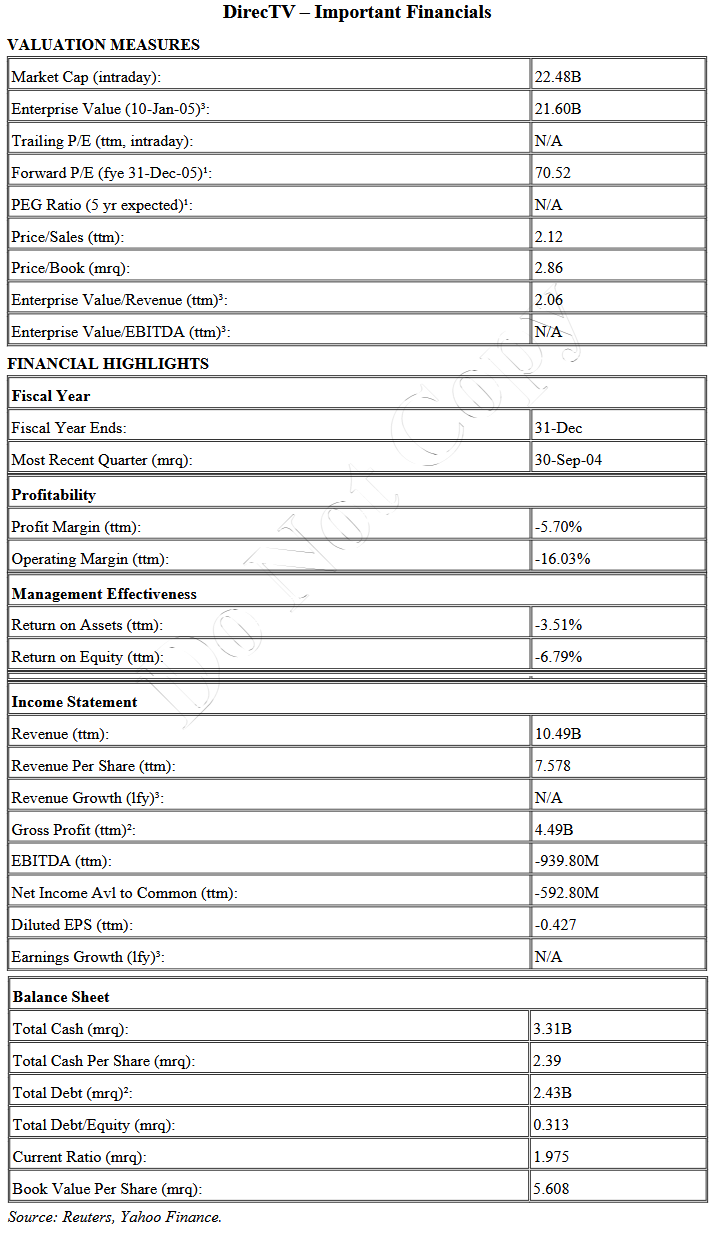
For the nine months ended 2004, revenues at DirecTV rose 21% to $8 billion. Net loss from continuing operations and before changes in accounting standards from Australian to US GAAP rose from $68 million to $768 million. These results reflected a larger subscriber base and gains on the sale of XM Satellite stock, offset by asset impairment charges.
Meanwhile, in early January 2005, DirecTV announced plans to make its own DVR by the middle of 2005. DirecTV outsourced its DVR requirements to TiVo, the industry leader. According to DirecTV, the new device would be a step-up from the current TiVo offering with a 90 minute live TV buffer, a built in TV 'bookmarking' system and other interface refinements. DirecTV did face a few concerns at the end of 2004. DirecTV Latin America had filed for Chapter 11 bankruptcy in early 2003, and withdrawn from the market in 2004. Later in the year, DirecTV announced plans to reorganize its Latin American operations.
In January 2005, DirecTV reported that the Securities and Exchange Commission (SEC) was seeking further accounting details on deals done with Pegasus Communications, the National Rural Telecommunications Cooperative and Thomson, all done in the second quarter of 2004. The SEC had also launched an investigation on the $1.47 billion write-down of its Spaceway satellites in the third quarter 2004. DirecTV reported that it might be required to change how it accounted for those transactions, which might increase its depreciation and amortization expenses.
A DirecTV spokesman commented,
"We're providing them with the information they requested. This is not an investigation, it's a routine inquiry”.
Meanwhile, Moody's, the credit rating agency had raised its bond ratings on DirecTV, citing improving operating performance and a focus on its satellite pay-TV business. Moody's raised the companyís rating to "Ba2," which was two steps below investment grade, from "Ba3." Analysts saw this as a positive reinforcement on how DirecTV was managed.
News Corp moved fast to acquire complete control in Fox Entertainment Group, which in turn held a controlling interest in DirecTV. In an effort to simplify News Corpís corporate structure, Murdoch offered to buy the remaining publicly held shares of Fox Entertainment Group in a $ 6 billion stock deal in January 2005. News Corp owned about 82% of the equity and 97% of the voting power of Fox Entertainment.
EXHIBITS
Exhibit 1
 |
Exhibit 2
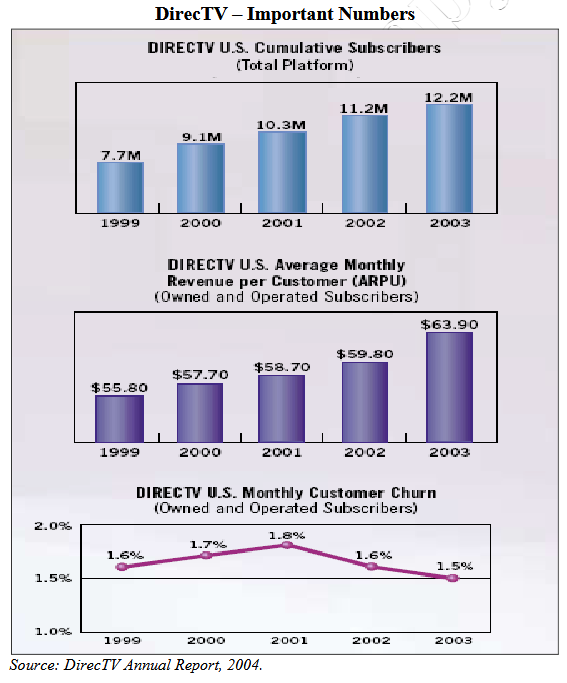 |
Exhibit 3
 |
Exhibit 4
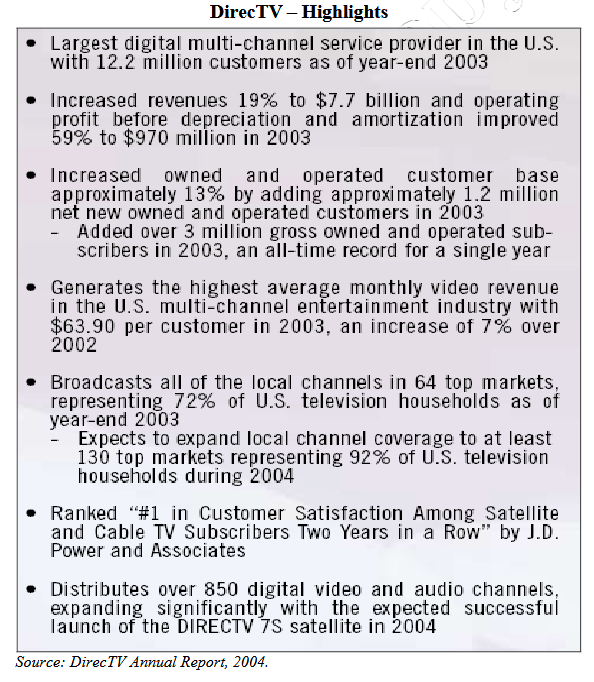 |
Exhibit 5
 |
Keywords
News Corp, DirecTV, Hughes, GM, General Motors, Comcast, Strategy, Acquisition, Rupert Murdoch, Monopoly, Media business
Related Case Studies
| Case Title | Details |
|---|---|
|
Case Title IBM in 2004: The Linux OptionCase Code: BSTA110 |
Details |
|
Case Title Oracle’s PeopleSoft Bid (Part C)Case Code: BSTA106 |
Details |
|
Case Title Oracle’s PeopleSoft Bid (Part B)Case Code: BSTA105 |
Details |
|
Case Title Oracle’s PeopleSoft Bid (Part A)Case Code: BSTA104 |
Details |
|
Case Title Ispat: Sidbec: Entering North AmericaCase Code: BSTA006 |
Details |