
Kinetic Honda: The Break-Up
Details
BSTR003
10
2002
NO
200
Kinetic Honda Motors Ltd
Automotive
India; Japan
Strategic Alliances,Growth Strategy
Abstract
The case study examines in detail the causes for the break up of the Kinetic Honda joint venture. The case also throws light on the post break-up strategies of the two companies. The case is so developed as to give students an insight into the causes that led to Kinetic and Honda parting ways. It gives them an idea of the complexities involved in managing a joint venture and of the strategic implications of a 'not-so-good' relationship between partners. At the end of the case-discussion, the students should have grasped the following issues: The nature of problems faced by the KHML joint venture. The factors that resulted in the break-up of Kinetic and Honda Motors. The strategic initiatives taken by the Kinetic group to stage a comeback. The post break-up strategies of the two companies. The case is intended for MBA/PGDBM level students as a part of their Business Strategy curriculum.
Learning Objectives
The case is structured to achieve the following Learning Objectives:
- Break-up of joint ventures, post break up strategies of joint venture partners.
Contents
BREAK-UP BLUES
“We are proud that we have set an unprecedented example, of a small Indian company, Kinetic Engineering Limited, buying out the majority stake of a multinational giant like Honda.”
- Arun Firodia, Chairman, Kinetic Group, in 1998
It was in August 1998 that the first chinks in the Kinetic Honda Motors Ltd. (Kinetic Honda) armor were reported by Business India. Both Honda and the Firodias of Kinetic were quick to deny rumors of a split, though reports of the Firodias quietly raising resources to buy out Honda's stake kept surfacing. The Firodias were even reported to have securitised the assets of their two-wheeler finance company – 20th Century Kinetic Finance (TCKF) – to raise this money.
Trouble had been brewing since the company recorded a loss of Rs. 6 crore in the first quarter of 1998 (1 crore = 10 million). Eventually Honda decided to put the matter to rest and called Arun Firodia (Firodia) to Japan in December 1998. Honda made Firodia an offer – either he buy their 51% stake or Honda would buy out his 19% stake. Analysts remarked that it was difficult for Firodia to let go of the company that he had nurtured for the best part of his life. Eventually, Firodia negotiated a deal with Honda, to acquire its stake at Rs 45 per share, (when the market price was almost double), at a total cost of Rs 35 crore. He also signed an agreement with them for continuing to manufacture and sell the existing Kinetic Honda models. Honda also agreed to continue providing technical know-how support in return for royalty and technical fees from Kinetic.
Considering the fact that Honda was the world's biggest and most successful scooter manufacturer, the pullout came as a surprise to industry observers, as it was quite uncharacteristic of Honda Motor to give up a segment. More so, as just a couple of months earlier, Honda had been reported to be planning to make further investments in Kinetic Honda1. This was seen as a major setback for the company. It was also perhaps the only instance of a Honda failure anywhere in the world.
STARTING PROBLEM!
In 2001, the Kinetic Group had two automobile companies – Kinetic Engineering Ltd and Kinetic Motor Company Ltd. After the December 1998 deal, Kinetic Honda Motor Ltd was renamed Kinetic Motor Company Ltd. Kinetic's story began in 1972 with the founder H.K.Firodia buying the 'Luna' moped's design from a foreign company. The moped, which aimed at capturing the bicycle market, went on to become such a huge success, that Luna became a generic name for mopeds.
In 1985, under Arun Firodia's (H.K.Firodia's son) leadership, Kinetic tied up with Japanese auto major Honda Motor2 to form Kinetic Honda Motors Ltd. (KHML) with both the partners holding an equal stake of 28.56%. The company's primary business was manufacturing scooters. Sales of spare parts formed a minor part of the turnover. The 'KH-100,' the first ungeared scooter in India, proved to be a huge success in the initial stages.
Throughout the 1980s, Kinetic remained India's largest moped manufacturer with a 44% market share and a 15% share3 of the overall two-wheeler market. A decade later, the company's moped market share halved to 22% and the overall market share figure reached an abysmal 5%. Also, in 1991, Kinetic, with a turnover of Rs 121 crore, was competing on an equal turf with the Rs 140 crore TVS Suzuki and the Rs 150 core Hero Honda4. But by 1999, while TVS and Hero Honda grew seven times over to Rs 1,018 crore and Rs 1,146 crore respectively, Kinetic just managed to double its turnover.
A major reason for this was the fact that Kinetic seemed to have missed the pulse of the market, which was fast moving towards motorcycles. Kinetic had no motorcycles to offer – mainly due to the Honda joint venture stipulations. (Kinetic could not make motorcycles because that meant competing with Hero Honda.) Kinetic's financial position also took a beating in the late 1990s. While sales grew slowly, compared to its competitors, its operating margin was the lowest in the industry because of the high import content of raw materials. Kinetic also had to shelve its plans to launch a small, 500cc, 2-cyclinder car after a substantial sum was spent on the project.
With Kinetic Honda's fortunes declining, Firodia agreed to let Honda increase its stake to 51% in 1993, perhaps hoping that if Honda were in control, it would bring in new products more quickly and thereby improve the company?s prospects. But Firodia soon realized that this was not to be. At a time when its competitors were spending 1-1.5% of the turnover on R&D, Kinetic Honda did not move beyond 0.31%. On advertising, Honda spent just Rs 20 crore during 1993-98. As a result, Kinetic Honda's market share declined steadily during 1996-98.
In 1997-98, Kinetic Honda?s sales grew marginally to Rs 353 crore over the previous year, but profit after tax dipped to Rs 2.16 crore from Rs 2.30 crore. This, coupled with the Rs 6 crore loss for the first quarter of 1998 made the Firodias give serious thought to parting ways with Honda. Firodia said, “There was no growth, so we decided to review the contract.” The new agreement involving the Honda stake sell-off and the technical collaboration arrangement was signed after this. Commenting on this, Firodia claimed, “It?s a win-win scheme for everybody.”
Though Firodia claimed that Honda?s equity sale decision was taken jointly by both partners, media reports had a different story to tell.
SOURING TIES
Reports claimed that right from the beginning there had been differences between Honda and the Firodias over the issue of management of Kinetic Honda. Firodia admitted that there were serious differences over issues like introduction of new models, advertising expenditure, marketing strategies, etc. As a result, the company suffered in terms of growth and profitability.
Under the joint venture agreement, Kinetic Honda manufactured scooters and Kinetic Engineering made mopeds. Both of them could not manufacture each other's products or motorcycles. Because Honda was present in the motorcycle segment with Hero Honda, the Kinetic group remained in mopeds and scooters. This was not in favor of Kinetic because the moped market had declined considerably during the 1990s. Kinetic had ambitions of becoming a full range two-wheeler company as it was strong in operations and also had a large distribution network. When Kinetic developed indigenous technology for its four-stroke step-through vehicle K400, a competitor to Hero Honda's Street model, Honda saw it as an unfriendly move.
The Firodias were unhappy about the fact that 'Kinetic,' as an umbrella brand was not being promoted. Consumers associated the name Kinetic with scooters and 'Luna' with mopeds, but did not see them as belonging to the same business house. To support the Kinetic brand as an umbrella brand with a number of products under it, the Firodias wanted to advertise heavily and bring out new products. According to Sulajja, “The tie-up with Honda was limiting our competitive capabilities.”
Kinetic Honda insiders claimed that Honda had always taken a 'half-hearted approach' towards managing the company. They also said that Honda was too preoccupied with other markets such as Indonesia and Thailand which were growing much faster and where, unlike in India, Honda was doing well. Also, Honda's margins were much higher in these markets – even a 50cc Honda scooter cost more in other parts of the world than the lead model being sold in India. Yet, Honda scooters were considered expensive in India. Industry watchers pointed out that Honda, with all its resources, could have easily engineered a product for the Indian roads, but was simply not interested.
Honda claimed that it had decided to position itself as a niche player at the upper end of the segment and that segment did not grow as much as the company had anticipated. Company sources said, “We miscalculated the purchasing power of the Indian middle class. We thought it would go up, but it didn't. Instead, the economy went into a tailspin and we couldn't grow.” However, Honda admitted that having just a single model for several years had worked to the company's disadvantage. But the investment required to develop and introduce new models was very high, rendering the end product uncompetitive and hence an unattractive proposition. Honda claimed that the Firodias did not have the marketing acumen of the Munjals of Hero Honda. Disagreements over advertising expenditure and the interference of the Firodias in the appointment of dealers widened the rift between the partners.
Kinetic wanted Honda to increase the advertising expenditure, but Honda did not agree. Being a large organization with various decision-making layers, Honda wasn't quick enough to react to the demands of the marketplace. The joint managing director, a Honda nominee, was changed every three years. Thus, by the time he understood the demands of the marketplace, it was time for him to be replaced.
Unlike the Hero Honda venture, where the Munjals and Honda showed complete faith in each other and worked together as a team right from the beginning, the Firodias and Honda reportedly never shared a good rapport. In Hero Honda, the partners had equal stakes and this made decision-making easier. Moreover, because of lack of competition for a long time, things were easier for Hero Honda. But Kinetic Honda had to compete with a giant like Bajaj. Also, while the cost of making the Kinetic scooter was higher than the cost of manufacturing a motorcycle, the selling price of the latter was Rs 10,000 more. The profitability of Hero Honda, therefore, was much more and they could afford to spend more on advertising. Also, the Munjals could take their own decisions regarding adspend. Firodia said, “If we could have done the same, it would definitely have increased Kinetic's visibility and volumes would have grown faster.”
Honda's exit raised questions about Kinetic's survival. It was thought that the Rs 35 crore the Firodias paid for acquiring the entire stake would put a great strain on their finances and weaken the company. Analysts were quick to comment that Kinetic would have problems regarding the development and induction of new products. Honda?s technical support limited to the existing range of products. And as the existing products – Kinetic Honda and Marvel – were not doing very well at that time, the withdrawal was seen as an unwelcome development.
SURVIVOR
Firodia denied that the dropping of the Honda tag from its scooters would affect the sales. The company introduced tough measures to facilitate improvements on various fronts including input costs, asset management and inventory management. Kinetic realized that gaining customer and dealer confidence would be a key task if it wanted to survive without Honda. Kinetic told its dealers about its product plans for 1999-2001 and tried to convey to them that now on they would be selling not just Kinetic Honda scooters, but promoting the umbrella 'Kinetic' brand. This meant that they would also be selling mopeds and motorcycles. This in turn, meant higher volumes and, thus, higher profits in the coming years. Kinetic conducted training programs for its dealers to help them deal with customers in a better manner. On the distribution front, Kinetic gave its dealers full range or 'pavilion' dealership. A new Kinetic logo was adopted to give the company a new corporate identity.
However, after the breakup, Firodia's immediate strategy was to push up sales by getting the group's auto-finance companies – Kinetic Leasing & Finance Ltd. (KLFL), Kinetic Fincap and Kinetic Capital Finance (later merged with Kinetic Fincap) – to offer attractive finance schemes. Those finance companies were strategically located to service the three biggest markets for two-wheelers in India –north, west, and south. They offered a wide range of finance schemes (termed as Wonder Loans) to suit various customer needs. The move paid rich dividends as sales picked up considerably. Kinetic Fincap and Kinetic Leasing & Fincap contributed 20% of Kinetic Honda's sales in 1999.
Kinetic called dealer meetings in all regions of the country to assure them of the company's strong prospects even after Honda's departure, which had a very positive feedback. Kinetic also stepped up promotion of the Kinetic brand, using both television and newspaper ad campaigns. A considerable amount was spent on an image-building campaign for the group. Adspend was increased from Rs.12 crore in 1997-98 to Rs.20 crore in 1998-99. A new public awareness campaign on road safety was launched. The company set up a direct sales division as well, which had 50 teams of people going from shop to shop and door to door, informing people about the company's products and the finance schemes offered. The response was overwhelming and around 12% of the sales came from this division in 1999. A survey conducted across nine cities showed that Kinetic had maintained its hold, despite Honda's exit.
On the customer front, Kinetic launched a new, aggressive and consumer-focused marketing strategy, with the new motto 'Closer to You.' The group launched 'Kinetic Care,' a package of post-sale and post-warranty benefits for the consumers. Several 'Kinetic Mileage Advantage' service camps were held across the country where more than 25,000 scooters were tuned for optimal mileage free of cost. Scooter service campaigns were organized, where spares and lubricants were offered at a discount and labor charges for replacing these spares were waived. For popularizing the K4-100, 'Customer Satisfaction' camps were organized across the country. These were attended by over 18,000 customers, who got free spare parts even though the warranty period had lapsed.
Kinetic's moves on the operations front, included opening of more depots around the country and a change in the credit policy. The Honda stake came with Rs.400-500 million as outstanding with dealers. Once these were recovered, interest costs came down considerably. Kinetic decentralized the distribution network and thus reduced inventory costs. Kinetic Engineering already had 20 C&F agents across the country. Kinetic used these agents to extend its reach to semi-urban and rural areas. For example, Kinetic was able to reach places like Anand and Gandhinagar from a depot in Ahmedabad within 24 hours. From its Pitampur plant, this would have taken almost three days. Kinetic also approached banks and negotiated deals to reduce its cost of borrowings. Material costs were reduced by reducing unnecessary imports. To improve the mileage of its scooters, Kinetic consulted experts from around the world and introduced a new technology in its new series of scooters, raising the mileage from 30kmpl to 50kmpl.
All these efforts soon translated into improved performance, proving the company's detractors wrong. Kinetic posted good results for both KEL (sales rose by 20%) and KMCL (sales rose by 23%) for the first half of 1999. KMCL also wiped off the previous year?s loss of Rs 6 crore and posted profits of Rs 3.69 crore for the same period. In fiscal 2000, sales increased by around 25%.
RETURN OF THE PRODIGAL
In August 1999, Honda announced that it was setting up a wholly owned subsidiary to manufacture scooters in India with an initial capacity of one lakh units per year. The company set up an independent distribution network for the new venture. Through this $ 43 million subsidiary, Honda planned to focus on scooters for a period of five years. Later, Hero Honda and the Honda subsidiary were to be free to expand the range to include all two/three wheelers. Honda's first scooter model was launched in mid-2001. Around one-third of the total proposed outlay of Rs 150 crore had already been invested by that time. Though the contract with the Firodias prevented Honda from manufacturing the same scooter through a subsidiary or a joint venture, Honda got around the clause by introducing scooters in a different range. A Honda official said, “This is an extremely important market for us and there is no question of giving up the scooter business – we never give up.”
Honda's decision sparked off debates in industry circles over guidelines regarding foreign companies being allowed to set up wholly owned subsidiaries in India, when they already had joint ventures here. The Confederation of Indian Industry (CII) expressed fears that this could develop into a trend that would adversely affect the local partners in these joint ventures.
Kinetic claimed they were not perturbed by Honda's announcement, as the group believed they were the de-facto leaders in ungeared scooters. Also, they had the exclusive rights to manufacture the 100cc and 110cc, Marvel, DX and ZX scooters. The Firodias were not really surprised by Honda's announcement, because at the time Honda was negotiating with them for the Kinetic Honda stake, such a possibility had been discussed. However, many felt that Honda could eventually enter the motorcycle segment as well – something, which seemed strategically wrong given the success of the Hero Honda venture. Sulajja said, “If Honda was serious about its scooter business in India and wanted to grow in the market by introducing new models, then why did they not do so during the 12 years that it was present in India, through its JV with us? After all, it had a majority stake and full management control. Yes, its true that Honda has said that it will start by manufacturing a 4-stroke scooter first through the new company. But what one fails to understand is why Honda should reenter a business by setting up a greenfield project at a whopping investment of over Rs.200 crore, when it has barely 10 months ago exited that market, unless it has a larger gameplan of manufacturing motorcycles too.”
QUESTIONS FOR DISCUSSION
1. Briefly discuss the Kinetic group's growth over the years in the ungeared two-wheeler market. What were the reasons for the Kinetic Honda break-up?
2. “Honda's exit raised questions about Kinetic's survival”. Discuss the post break-up performance of Kinetic, outlining the strategic initiatives it took to stage a comeback.
3. How are Indian partners in a joint venture adversely affected when the foreign partner sets up wholly owned subsidiaries in the country? Suggest some measures to counter these adverse affects.
EXHIBITS
Exhibit I
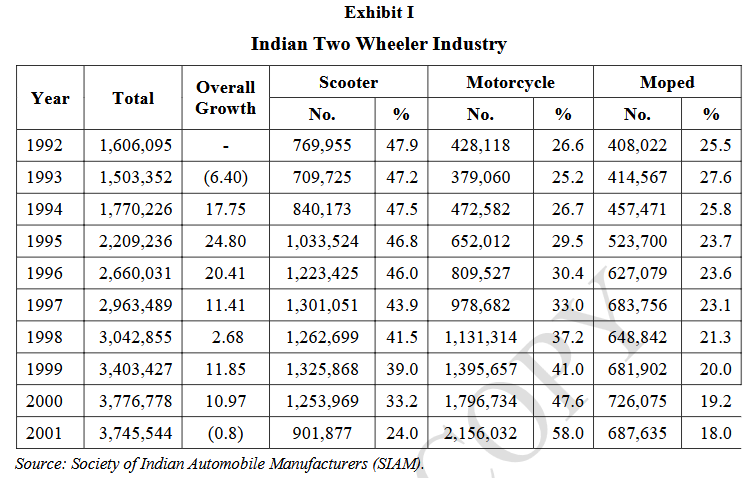
Exhibit II
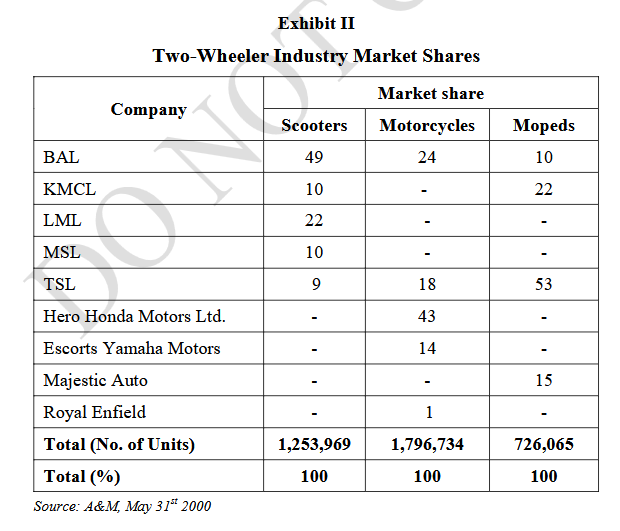
Exhibit III
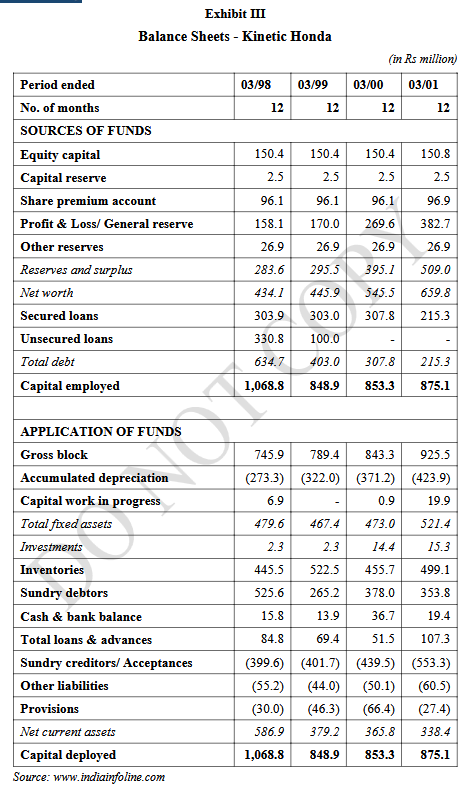
Exhibit IV
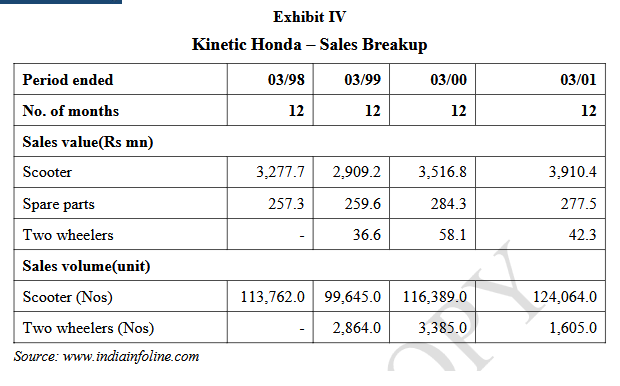
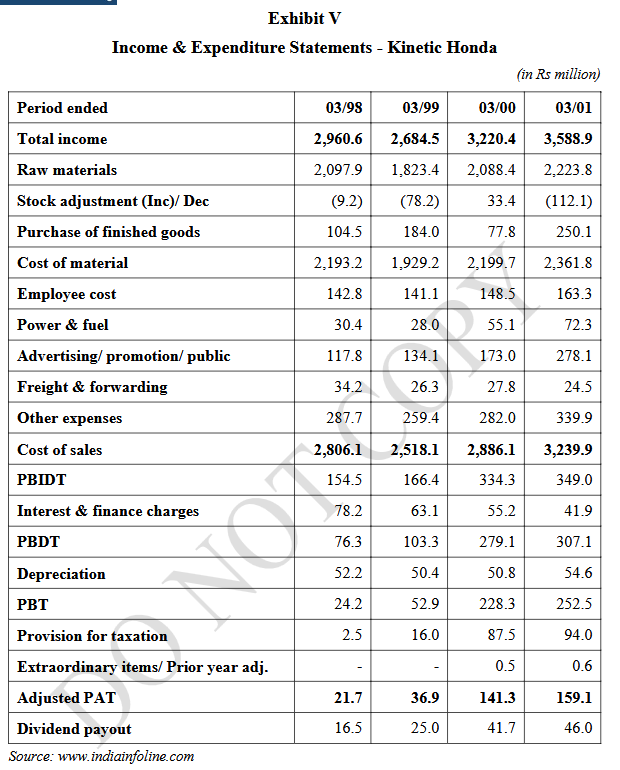
Exhibit V
Keywords
Kinetic Honda, joint venture, managing, The nature of problems, break-up, Kinetic group, Business Strategy, KHML
Related Case Studies
| Case Title | Details |
|---|---|
|
Case Title IBM in 2004: The Linux OptionCase Code: BSTA110 |
Details |
|
Case Title Oracle’s PeopleSoft Bid (Part C)Case Code: BSTA106 |
Details |
|
Case Title Oracle’s PeopleSoft Bid (Part B)Case Code: BSTA105 |
Details |
|
Case Title Oracle’s PeopleSoft Bid (Part A)Case Code: BSTA104 |
Details |
|
Case Title Ispat: Sidbec: Entering North AmericaCase Code: BSTA006 |
Details |