
Dr. Reddy’s New Corporate Identity
Details
BSTR013
9
2002
NO
300
Dr. Reddy’s Laboratories Ltd.
Pharmaceuticals & Biotech
India
Corporate Image & Identity,Branding Strategy
Abstract
The case gives an overview of the new corporate identity of Dr. Reddy's Laboratories, unveiled in April 2001. DRL restructured its corporate identity mainly because of the merger of DRL with American Remedies Ltd. and Cheminor Drugs Ltd., and the subsequent listing of DRL on NYSE. The new corporate identity also attempted to distinguish the founder Dr. Reddy, from the brand Dr. Reddy. The case is intended for MBA/PGDBM level students as part of the Business Strategy curriculum. From the case, students are expected to analyze the various reasons for restructuring the corporate identity of DRL, despite enjoying a good brand image. They are also expected to understand why DRL attempted to distinguish between Dr. Reddy, the person and the brand.
Learning Objectives
The case is structured to achieve the following Learning Objectives:
- Corporate identity
- differentiation of founder from company
- Indian Pharma Industry.
Contents
INTRODUCTION
In 1999, we got the critical mass and the feeling within the company was that we had arrived. We were close to the Rs 1,000-crore mark in turnover, which called for a new way of looking at things and taking the message to the stakeholders”
- Satish Reddy, Chief Operating Officer, Dr. Reddy’s Laboratories.
“The new identity highlights the company’s ethos – a caring organization that leverages its expertise in research for a healthier life.”
- Dr. K. Anji Reddy, Chairman, Dr. Reddy’s Laboratories.
On April 26, 2001, Dr. Reddy’s Laboratories (DRL) unveiled its new corporate identity and philosophy, reinforcing its commitment to bring hope to life through meaningful research. (Refer Exhibit I) It unveiled a new logo, new colors, (Refer Exhibit II) a code of conduct for employees, a Dr. Reddy's anthem and the new base line–Life, Research, Hope. DRL had changed its corporate identity for the second time in less than a decade.1 This was despite the fact that DRL already had a well-defined, widely recognized identity.
Analysts felt that the change in corporate identity was necessary as DRL was targeting the global market. DRL officials felt that the company needed a corporate image that was more in tune with its international profile. The new corporate identity was forged from the merger of DRL, Cheminor Drugs Ltd. (CDL) and American Remedies Ltd. (ARL)3 into a homogenous unit in 2000 and DRL’s subsequent listing on New York Stock Exchange (NYSE) in 2001.
BACKGROUND NOTE
DRL was founded in 1984 by Dr. K. Anji Reddy (Dr. Reddy) to create and deliver innovative pharmaceutical healthcare solutions. DRL became a public limited company in 1985 and had an IPO of equity linked debentures aggregating Rs.24.6 million in May 1986. During the 1990s, the company consolidated its position in the domestic formulations market through aggressive product launches as well as acquisitions. By late 1990s, DRL transformed itself into a global pharmaceutical powerhouse with research and drug development as its strengths.
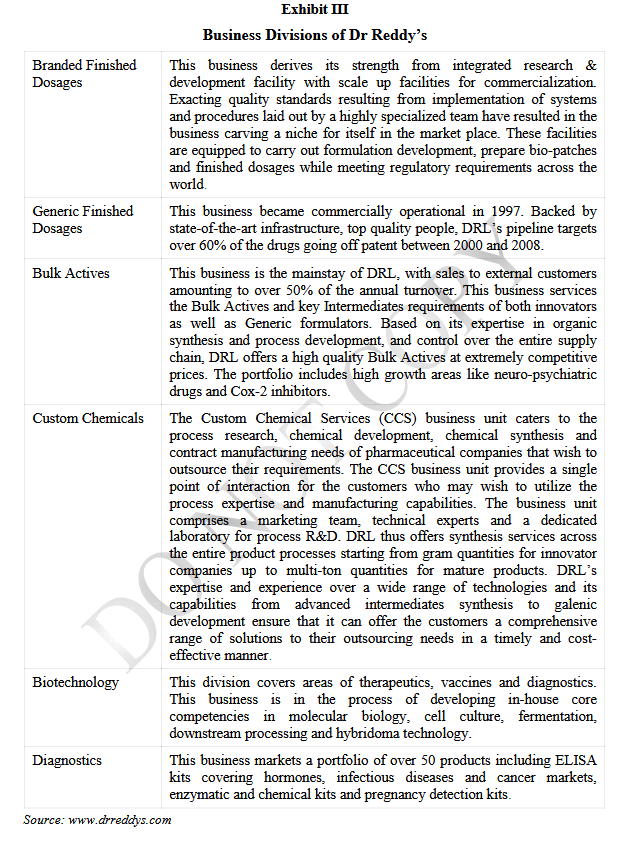
DRL's operations were divided into six divisions including branded finished dosage, generic finished dosage, bulk actives, custom chemicals, biotechnology and diagnostics (Refer Exhibit III). Analysts felt that DRL had world-class expertise in the development and manufacture of pharmaceutical intermediates, bulk actives and finished dosage forms. This expertise seemed to enable DRL to provide high quality and cost-effective pharmaceutical products to international markets including Europe, Japan and the US.
In 1999, DRL acquired a controlling stake in ARL. DRL purchased a 45% stake in ARL for about Rs.800 million at Rs. 175 per share. The acquisition brought with it, key brands like Mucolite, Antoxid, BioE, Becozine and Optisulin, which accounted for 60% of ARL's sales. ARL also owned two facilities–one at Chennai and the other at Pondicherry.
Commenting on the ARL acquisition, Dr. Reddy said, “The American Remedies acquisition is an excellent value creation opportunity for DRL, given their strong marketing thrust and innovative product portfolio. The company has strong systems and a top-class field force. We will be able to reap significant synergy gains by co-promoting their neutraceuticals4 with our mainline products. For instance, ARL's Antoxid brand which is the market leader in its category, will be an excellent supplement to our own leading position in cardio therapy.” In late 1999, ARL was merged with DRL at a swap ratio of one DRL share for every 12 shares of ARL.
In May 2000, CDL merged with DRL making DRL India’s third largest pharmaceutical company. Said Dr. Reddy, “The merger gives me a feeling of having arrived. We are in the big league now, third only to Ranbaxy and Glaxo. So far, we enjoyed the leadership for basic research, now we have the size as well.”
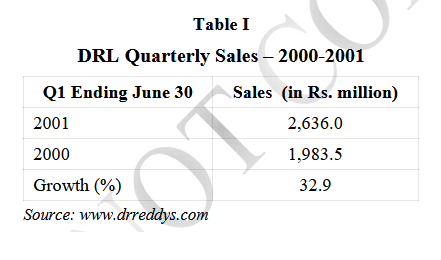
The post-merger turnover of DRL stood at about Rs.8 billion in 2000-2001. DRL also reported a sales growth of 33% for the first quarter ended June 30, 2001 compared to the first quarter ended June 30, 2000. (Refer Table I) The merger was expected to facilitate greater economies of scale for the company.
After the merger, DRL’s business included bulk actives, intermediates, finished dosages, custom chemical synthesis, diagnostics and biotechnology. The merger also gave the company entry into the value-added generics business.
On April 11, 2001, DRL became the first pharmaceutical company in the Asia-Pacific region to be listed on the NYSE. DRL offered 11.5 million American Depositary Shares (ADS) at US$10 each. DRL planned to use the money raised from the ADS issue for research and development activities, particularly to undertake clinical trials for a number of its molecules.
A NOTE ON THE INDIAN PHARMACEUTICAL INDUSTRY
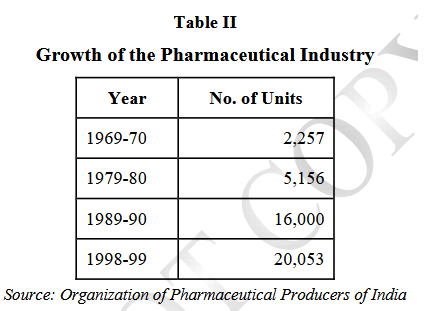
The Indian pharmaceutical industry was a highly fragmented one with more than 20,000 registered units in 1998-99. It had increased drastically between 1980 and 2000. The 250 leading pharmaceutical companies controlled 70% of the market. Glaxo-Wellcome was the market leader with 6.3% of the marketshare in 1999. The industry had become extremely competitive due to fragmentation with severe price competition and government price control. Over the years, the Indian pharmaceutical industry had evolved around the opportunities presented in the regulated environment:
• Lack of product patent: The Indian Patent Act of 1970 allowed Indian companies to reverse- engineer the patented molecules and launch them in the domestic market.
• Drugs Price Control Order (DPCO): Price ceiling under DPCO limited the margins and shifted the focus on cost control
• Foreign Exchange Regulation Act (FERA): Foreign Exchange Regulation Act reduced the MNC exposure in India.
• Small Scale Industry (SSI): Small-scale industry exemptions led to the proliferation of small formulation manufacturers and low cost drug manufacturers.
Consequently, the capital investment had also increased over years, particularly in the last two decades.
The Indian government introduced the Drugs Price Control Order (DPCO) in 1970. The DPCO effectively put price ceilings on certain widely used bulk drugs and their formulations to prevent profiteering by manufacturers. Excess profits earned had to be deposited with the government. However, companies had the freedom to decide the prices as long as the overall margin did not exceed the stipulated norm. Multinational Corporations (MNCs) found it difficult to sell their products at lower prices in India because of the global repercussions. As a result, they refrained from launching new products in India. In 1979, the DPCO was revised. The revised order stipulated price ceilings for controlled categories of bulk drugs and their formulations. The DPCO put a limit on the company's return on networth or capital employed for bulk drugs. In case of formulations, retail prices of controlled products were based on the concept of MAPE (Maximum Allowable Post-manufacturing Expenses), which was a mark-up on ex-factory costs to cover all selling and distribution costs including trade margins. The DPCO-1979 put 370 drugs under price control in three categories, having different MAPEs. The most important drugs, i.e., life saving drugs were put into Category I, which had the least MAPE of 40%. Category II had an MAPE of 55% and Category III 100%.
In 1987, the government liberalized the profitability norms of the pharmaceutical sector. The number of drugs under price control was reduced from 370 to 143. Controlled categories were reduced to two and MAPE was revised to 75% for Category I and 100% for Category II. Several drugs were decontrolled and the MAPE for many formulations was increased. The industrial licensing norms were also liberalized, which enabled MNCs to improve their product mix. However, around 75% of the pharmaceutical industry still remained under price control. In 1995, the DPCO was revised yet again. The basic structure of the order remained the same, but the number of drugs under price control was reduced from 143 to 76. The revised DPCO also stipulated a uniform MAPE of 100% for all drugs.
During the late 1990s, the pharmaceutical industry went through several policy as well as attitudinal changes. The industry was one of the major beneficiaries from the union budget proposals in late the 1990s. Some of the positive steps taken were:
• The pharmaceutical industry was recognized as a knowledge based industry. The government planned to increase the investment in R&D.
• Excise duty was rationalized and interest rates in export financing were reduced.
• There were additional deductions under Income Tax Laws for R&D expenses.
• Up to 74% Foreign Direct Investment (FDI) was permitted through automatic route.
• Two high level committees were set up to review the drug policy for strengthening R&D capabilities and reducing the price control regime.
The pharmaceutical industry was characterized by an increased focus on R&D; marketing tie-ups and production rationalization, brand and company acquisitions. Domestic players and MNCs had entered into marketing arrangements to increase market penetration and strengthen positions in respective therapeutic segments. Ranbaxy tied up with Cipla, Glaxo and Hoechst Marion for products in specific therapeutic segments. Similarly, Hoechst Marion had tied up with Nicholas Piramal. Most of the top pharma companies were consolidating their position in the domestic market either through product rationalization, brand acquisition or company acquisition.
The DPCO was again revised in 2002. Price control would be imposed on bulk drugs with a turnover exceeding Rs 250 million and a 50% marketshare. Drugs with turnover between Rs 100 million and Rs 250 million but with 90% of the marketshare would also invite control under the competitiveness clause. Any drug discovered in India and patented or any novel drug delivery system developed in India and patented will be out of the price control regime. About 30 drugs were expected to be moved out of control. Analysts felt that MNCs would profit most from the new DPCO.
As per the World Trade Organization (WTO), from the year 2005, India will have to give product patent recognition to all new chemical entities (NCEs) i.e bulk drugs. The transition phase in preparation of WTO had already commenced. Established local pharmaceutical companies were trying to corner a large part of the domestic formulations market in face of aggressive product launches by MNCs after the WTO regulations. Towards this end, established players were expediting the launch of new products and also looking at brand acquisition opportunities from other relatively smaller players. The smaller players unable to sustain stiff local competition had to close down or agree to be taken over by larger companies. Overall, the fragmented industry might consolidate.
MNCs will be able to freely introduce top of the line new products i.e. those patented after 2005 in the domestic market. However, these are expected to be priced at a significant premium in line with the MNCs’ global policy of earning returns on their R&D investment. So, within a therapeutic segment, people will continue to use the older, less efficient and cheaper medicines. Thus, new launches by MNCs will be high margin but low volume products that are most likely to be imported from overseas bases. MNCs that do not have a base in India, are likely to tie-up with local players to license their new products. Local players may also enter into research tie-ups with MNCs to leverage on their relatively low-cost, efficient skill base of trained pharmacists and chemists.
THE NEW CORPORATE IDENTITY
In 2000, DRL hired Enterprise IG (EIG), to implement its new corporate identity plan. The whole exercise was completed in a year and evolved over nine stages, beginning with an across-the-board study of the perceptions of different stakeholders and ending in a brand manual that was to be implemented by the employees. In the new corporate identity, changes were carried out at two levels—i) institutional: implemented throughout the company, and—ii) at a more individual level surrounding the persona of the founder, Dr Reddy.
The new corporate identity plan also emphasized control of the top management should be passed onto by the second generation: Dr Reddy’s son-in-law and Chief Executive Officer, GV Prasad (Prasad), and son and Chief Operating Officer, Satish Reddy (Satish). Commented Prasad, “We have almost reinvented ourselves, compared to what we did in 1994 when we only tinkered with the logo.”
The study undertaken prior to the formulation of the new corporate identity plan showed that while DRL's strengths as a research and development company were widely recognized, its other attributes like professionalism and quality consciousness, were less evident. The new corporate identity was designed to emphasize these attributes of DRL. Explained Manoj Tadepalli, Senior Consultant, EIG, “The new image was tailored to bring out these attributes that were subdued.”
Both Prasad and Satish felt that DRL's professionalism was the very basis for its success. However, the merger of the three companies, the subsequent increase in the size of DRL and the company's global ambitions called for the creation of multiple leadership levels. Prasad said, “This meant that the three of us moved away from the role of an operator to don the mantle of a strategic controller. This also means that it has to be a nose-in but hands-off approach, which was a fundamental shift from an entrepreneurial company to a professionally oriented set up.”
The new corporate identity also aimed to create a flatter organization structure and to inculcate a stronger performance ethic within the company. One of the objectives of the new identity exercise was to bring energy to the workplace and change the way people perceived work. Other objectives included retaining talent, and speeding up the process of developing products based on the research they have undertaken. However, the main aim of the entire exercise was to establish DRL as a global pharmaceutical major.
REBUILDING DRL
Analysts felt that DRL was too closely identified with its founder. It was this realization that prompted Dr.Reddy, to make way for other professionals. Said Prasad, “Dr Reddy does have an image that is larger than the company itself. And why not, as this is his life and creation. But at the same time, it is also true that the organization is larger than him in other respects and there was an impression that we were too family oriented, which is far from the truth.”
Along with the corporate brand identity exercise, a conscious effort was made to give Dr. Reddy an image that was closer to the private individual that he was. According to Satish, “There is now a need to make a distinction between Dr Reddy the person and Dr Reddy the brand.” He added, “From a spokesperson for Dr Reddy Laboratories, Dr Anji Reddy will don the mantle of a spokesperson for the entire pharma industry.” The new role meant that Dr. Reddy would be less of the technocrat-scientist presiding over routine company conferences and, would make more of industry-wide policy oriented appearances.
A conscious effort was made to highlight Dr. Reddy’s interests in art and philanthropy, his involvement with the Dr Reddy’s Foundation (DRF) and the NAANDI Foundation, and his role in the Prime Minister’s pharma task force.
TOWARDS A GLOBAL PHARMACEUTICAL COMPANY
The first phase of the new corporate identity was unveiled immediately after DRL’s listing on NYSE. Anuradha Atlekar, Brand Coordinator and Head, Corporate Communications, DRL, said, “The roll out will be enormous but the real challenge is in actually living it consistently across the company, in implementing the brand identity.”
DRL would use brand managers – 22 of them – across departments and centres to ensure consistency in the implementation of the new corporate identity. Analysts felt that, with the combined strengths of DRL, CDL, and ARL, there could be no stopping the DRL Group. Said Satish, “The new identity showcases the company’s thought process that envisions a future where DRL straddles the global market as an illustrious discovery-based entity, powered by innovative R&D. A future that continues to bring hope to life through meaningful research.”
QUESTIONS FOR DISCUSSION
1. “Corporate Identity expresses a company’s approach to business, its values and culture. It is reflected in everything from quality of the products and/or services, marketing strategies and working environment.” Explain the rationale behind DRL’s new corporate identity.
2. Analysts felt that the new identity showcased the company’s thought process that envisioned a future where DRL straddled the global market as an illustrious discovery-based entity, powered by innovative R&D. How do you think the new corporate identity is going to help DRL?
3. “Dr. Reddy had an image that is larger than the company itself.” Critically comment on the statement and do you think there is a need to distinguish between Dr. Reddy, the person and Dr. Reddy, the brand?
EXHIBITS
Exhibit I
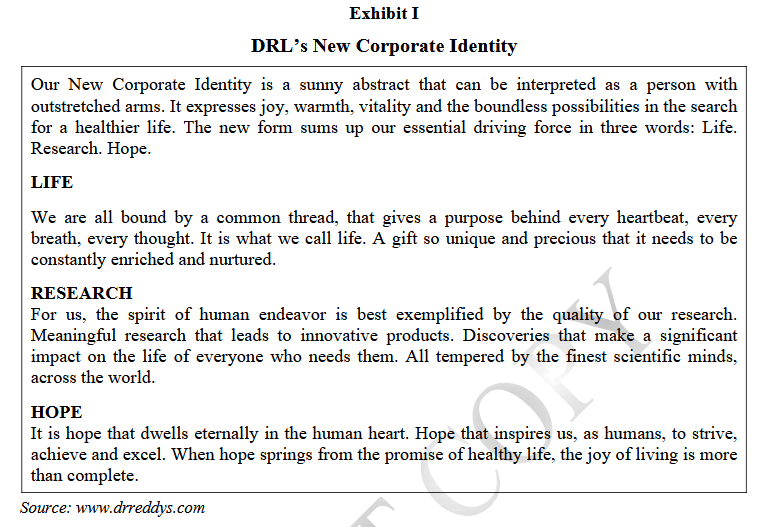
Exhibit II
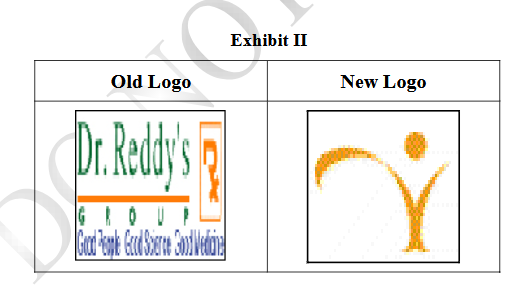
Exhibit III
Keywords
Corporate Identity, Dr. Reddy's Laboratories, April 2001,DRL,American Remedies Ltd, Cheminor Drugs Ltd., NYSE, Dr. Reddy, Business Strategy, good brand image
Related Case Studies
| Case Title | Details |
|---|---|
|
Case Title Microsoft in 2004: Shaping a New ImageCase Code: BSTA113 |
Details |
|
Case Title Wal-Mart in 2005Case Code: BSTA112 |
Details |
|
Case Title Wal-Mart in 2004: Creating a New ImageCase Code: BSTA111 |
Details |
|
Case Title Coca-Cola’s Belgian Crisis - The Public Relations FiascoCase Code: MKTG097 |
Details |
|
Case Title Marico - Managing ’Saffola’Case Code: MKTA005 |
Details |