
Hindustan Motors’ Struggle for Survival
Details
BSTR021
8
2002
NO
300
Hindustan Motors
Automotive
India
Turnaround Strategy,Branding Strategy
Abstract
The case explores the reasons behind Hindustan Motor's poor performance after the liberalization of the Indian automobile industry. It examines in detail the company's efforts to turn around and make its brands successful.
Learning Objectives
The case is structured to achieve the following Learning Objectives:
- Product development failures, human resources problems and company performance.
Contents
TROUBLED WATERS?
“Hindustan Motors is a case study of complacency.”
- A December 28, 1999, Business India report.
In October 1998, Hindustan Motors (HM), makers of one of India?s best known cars – the Ambassador – launched a new car, the Mitsubishi Lancer (Lancer). The launch of Lancer, a new car from the HM stable after nearly two decades, was reported to be very important for the company, whose market share was on the decline. HM was reportedly banking heavily on the Lancer's success to fight competition from other car companies. Lancer was positioned in the mid-size luxury car segment, which was dominated by Maruti Udyog's (MUL) Maruti Esteem and Honda's Honda City.
Lancer was received very well by automobile experts throughout the country, largely due to its technical finesse. The car?s sales reached 2,866 units by the end of the fiscal 1998-99. Much to HM's delight, Lancer was even ranked as the top vehicle in India for the three consecutive years (1999, 2000 and 2001) by J. D. Powers1 for the least number of defects and high customer satisfaction in a countrywide survey of car owners.
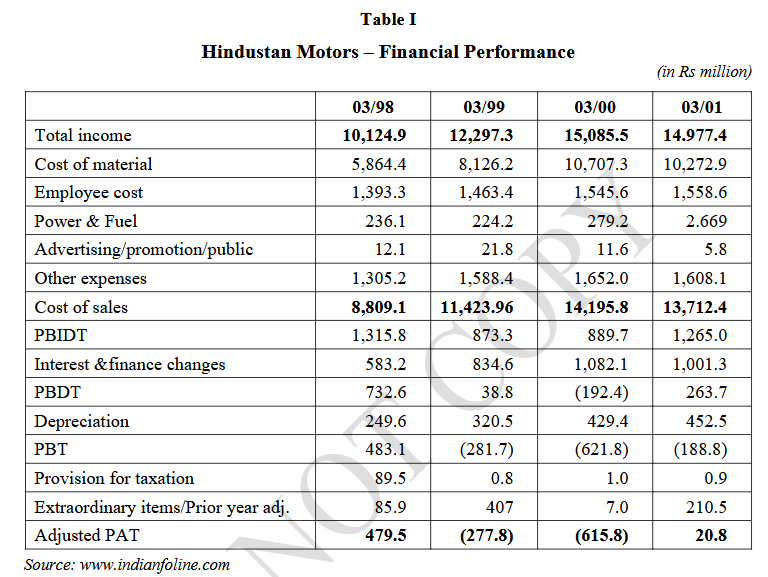
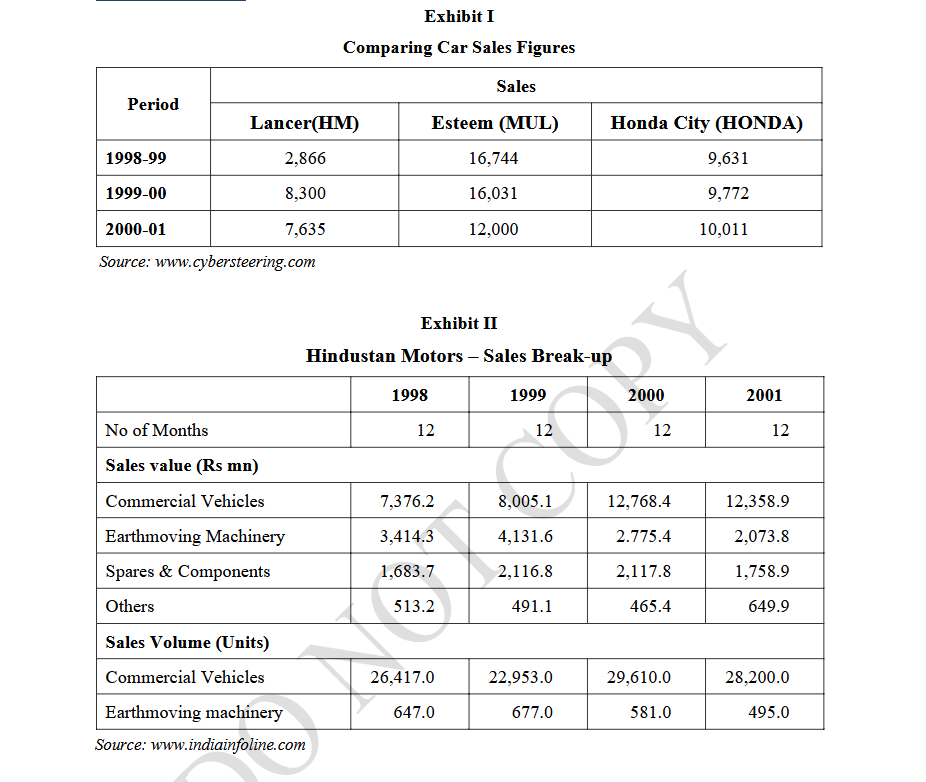
However, the company's euphoria was short-lived as Lancer's sales failed to pick up as expected. While 7,621 cars were sold in 1999, HM managed to sell only 7,635 cars in 2000-01 against a forecast of 8,0002. On the other hand, sales of Honda City increased to 10,011 in 2001 from 9631 in 1999 (Refer Exhibit I for the sales comparison). Meanwhile, HM's other offerings Ambassador and Contessa were also faring badly. In 1999, Ambassador's sales were down to 15,374 from 18,312 in 1998 and Contessa's to 285 from 575 in 1998. This poor performance took a heavy toll on the company's bottomline and HM reported a net loss of Rs 615.8 million for the fiscal 1999-00. (Refer Table I). The company had reportedly accumulated losses worth Rs 1.1 billion during 1999-20013.
In late 2001, HM announced its plans to launch another car, the Mitsubishi Pajero. The company planned to import fully assembled cars and sell them by early 2002. Analysts remarked that the Pajero could do little to revive the company's fortunes as despite many efforts to turn itself around, HM had failed to regain its 4-decade long leadership in the Indian passenger car market. Its 3.3% market share in the half-year ending September 2001, proved beyond doubt that the company was struggling to stay afloat.
BACKGROUND NOTE
HM was incorporated in 1942 by the GP-CK Birla Group of companies in collaboration with General Motors (GM), USA. The CK Birla group was one of the well known family-owned business houses in India, with 17 companies in businesses such as automobiles, engineering, paper, and auto-components. Some of them were Hyderabad Industries Ltd., Oriented Papers & Industries Ltd., National Engineering Industries Ltd., Gujarat Instruments Ltd., Hindustan Powerplus Ltd., India Gypsum Ltd., Malabar Building Products Ltd., Birla Horizons International Ltd., and Birla Techneftegas Ltd.
HM's manufacturing facilities were located at Uttarpara in West Bengal, Pithampur in Madhya Pradesh, Thiruvallur and Hosur in Tamil Nadu, and Pondicherry. Over the years, HM built up a vast dealer network comprising 115 dealers, 50 service and parts dealers and 60 additional exclusive parts dealers.
Initially, the company concentrated on its auto components business, producing its first car only in 1949. In 1954, HM started production of the Landmaster in technical collaboration with UK-based Morris Motors Ltd. (Morris). The company upgraded the Oxford model of Morris and launched it as the Ambassador in 1957 – the car went on to become the flagship brand of the company in the years to come. In 1963, HM commenced the production of Ambassador Mark 2, made available in two variants – diesel and Ambassador ISZ. HM entered the earth moving equipment business in 1971 and the power products business in 1983 (Refer Exhibit II for the sales break up of HM from various units).
Until the 1980s, HM's Ambassador and Premier Automobiles Ltd's (PAL) Padmini were the only two cars available in the Indian market. Ambassador was the vehicle of choice, Government of India, and the official car for almost every Indian Prime Minister after independence. Though there was no executive order that said that the government departments have to buy only Ambassador cars HM derived a major part of its sales from senior politicians, top civil servants, bank managers and defence personnel. Ambassador was very popular in the taxi segment as well. Even in 2001, the segment accounted for almost 65% of Ambassador?s sales. This was because of the perception that the Ambassador was better suited for the rough Indian roads and its strong structure was believed to be able to withstand the impact of accidents much better than any other car.
However in 1981, with the entry of MUL, the scenario changed drastically. MUL's small, fuel-efficient and well-designed car, Maruti 800, became a huge success. By the late 1980s, MUL became the market leader, leaving Hindustan Motors way behind in the war for market share.
During the 1980s, HM was in the news only because of its tie-ups with GM and its subsidiary Vauxhall Motors (VM). In 1984, HM launched the Contessa, which was labeled one of the first 'upmarket' cars in India, in technical collaboration with VM. In 1987, the company launched the Contessa Classic considered the most powerful car available then. The Contessa was a reasonably successful car, though it never managed to match Ambassador's success.
In 1995, HM entered into a collaboration with the Japanese automobile major Mitsubishi Motor Corporation (Mitsubishi), wherein Mitsubishi agreed to provide technical assistance to HM to manufacture its products in India. HM produced a mid-size luxury car, Opel Astra in collaboration with GM in 1996. In 1997, the Contessa GXL version with power steering was launched. HM terminated the GM joint venture in 1999, by selling off its stake to GM.
THE TURNAROUND EFFORTS – PHASE I
In the early 1990s, when the Indian economy was opened up for foreign players, many multinational automobile companies entered the country. In the 1990s, companies including Daewoo, General Motors, Daimler Benz, Hyundai and Honda entered India through joint ventures and partnerships with Indian firms.
HM was one of the worst affected companies due to this inflow of competitors. Forced to react due to the poor performance of its vehicles, HM launched the Ambassador Nova in 1990 (with better interiors) and an improved Ambassador 1800 ISZ (with better engine performance) in 1993. The company also appointed consultants McKinsey & Co for a restructuring plan to turn around its business.
McKinsey asked HM to focus on the marketing of components, refurbish the Ambassador model and upgrade other vehicles, speed up the delivery process and improve productivity through reengineering on the floor shop and reduce the workforce in its production plant at Uttarpara. The company began to implement the recommendations.
HM decided to tap new segments to ease the competitive pressures it was facing in the passenger car market. In 1995, the company collaborated with Oka Motor Co5 to develop a vehicle specifically targeted at rural markets. This led to the launch of the Trekker (also referred to as the Rural Transport Vehicle – RTV) in 1995. Launched in three northern states, the Trekker was received well in the rural markets. However, the vehicle soon came under criticism owing to a host of technical problems.
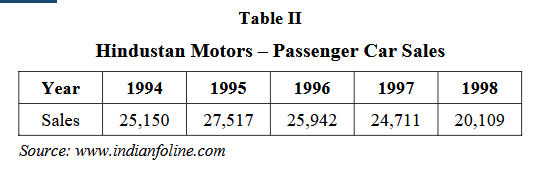
By late 1998, Trekker's sales dropped by two-thirds of its initial volumes to around 800 a year. In 1999, HM launched the redesigned Trekker and an upgraded version of the Ambassador. Despite all the product upgradations and restructuring efforts, HM could not stem the decline in sales. (Refer Table II).
Analysts opined that HM's dismal condition was a result of its lax management policies and shortsightedness. Before MUL entered the market, HM was the market leader. It was able to sell whatever it produced and therefore it did not care to upgrade the technology or production facilities.
However, pressure from competition was just one aspect of HM's problems. The company had a host of internal problems – particularly human resource troubles at the Uttarpara plant.
The Uttarpara plant had workforce of 14,000 employees and the wage bill alone constituted 22% of plant's expenditure. Against the standard output of 8-10 cars per employee per annum, the plant's output was as low as 3 cars. Analysts claimed that with the 1999 production level of 2500 cars, the plant should have been staffed with no more than 3,000 personnel. Annual production at the plant declined from 30,822 cars in 1995-96 to 26,684 cars in 1996-97. In November 1997, 2835 Ambassadors and 146 Contessas were produced. The numbers came down to 1385 and 33 respectively by October 1998.
In its bid to turn around the plant, HM invested around Rs 750 million to modernize the assembly line, build new body and paint shops and purchase new equipment. The company also embarked on a cost-cutting exercise and announced a Voluntary Retirement Scheme (VRS) for workers in April 1998 and again in November 1998, offering a Rs. 0.1 million package.
However, the VRS was not received well by the strong Center of Indian Trade Union (CITU) and the Indian National Trade Union Congress (INTUC)6 led employee unions. Commenting on a similar VRS offered by the Fiat management at its Kurla, (Maharashtra) plant, employees said “Workers at the Fiat factory at Mumbai have got an average of Rs.0.35 million per worker while we are fobbed off with such measly sums.” The strong political patronage to the employee unions made it tough for the management to convince workers about the VRS.
Both the CITU and INTUC union leaders refused to accept the VRS offered by the company. The unions were confident that the West Bengal State Government would back them on the issue. As employee protests intensified, HM approached the state government with a proposal to run the plant for only three days in a week, in an attempt to save Rs. 0.32 million every week. The company also promised that it would continue to pay the workforce full wages for an entire week.
However, the government rejected HM's proposal, following which the company decided to seek legal recourse. In January 1999, HM filed a writ petition in the Calcutta High Court, claiming that its decision was not prompted by industrial relations, but by the company?s poor financial position. It also stated that the layoff in the Uttarpara plant was temporary in nature and the company would resume normal production as soon as demand picked up. The High Court then ordered the state government to reconsider the issue.
In May 1999, instead of reconsidering the issue, the state government filed an appeal before the division bench of the Calcutta High Court, claiming that HM had suppressed facts and figures during its meeting with them to settle the issue. The division bench directed that the matter be referred to the Industrial Tribunal. In July 1999, the Industrial Tribunal dismissed the company's proposal. HM again filed a writ petition against the Tribunal?s order in the division bench of Calcutta High Court and the division bench upheld the Tribunal?s order. In response to the division bench's order, HM moved the Supreme Court in July 1999. During all this time, productivity at the plant suffered considerably, which added to company?s woes.
THE TURNAROUND EFFORTS – PHASE II
When its attempts to reorganize its operations did not pay off, HM decided to look beyond its existing product portfolio to come out of its problems. As per McKinsey's recommendations, the company explored the global auto components business in 2000 and established a unit at Indore to assemble engines and gearboxes. Analysts said that this was a wise move because HM with its expertise, could easily become a component supplier for both domestic and global car majors. HM's executive director Sarker Narayanan said, “We are open to such opportunities. It brings in extra cash and it?s an inexpensive way to upgrade our skills by working with different customers.”
In order to use its design and engineering skills to enter new businesses, HM entered into an agreement with Mahindra & Mahindra (M&M) for developing petrol engine for M&M vehicles. The company also tied up with GM to market the entire range of transmission equipment manufactured by Allison Automatics (a company owned by GM).
HM then overhauled its distribution system in order to become more market-friendly and dealer-friendly (HM was accused of offering very few dealer incentives and poor after-sales services). In 1999, the company unveiled a new distribution strategy, wherein dealers were divided into three tiers – red, blue, and green depending on their location and performance records. While the red-tier catered to the metros for selling and servicing Lancers, the blue-tier catered to the semi-urban areas for Contessas and Ambassadors and the green-tier catered to the rural markets for Trekkers.
HM also decided to explore the overseas markets for its products and began by exporting around 150 RTVs to Bangladesh in 2001. The company also managed to secure an export order for 300 petrol engines from a UK-based company, in addition to the 1,800 engines already supplied.
In February 2001, HM sold its earthmoving equipment manufacturing division to a wholly-owned Indian subsidiary of Caterpillar Inc. for Rs 3.3 billion. After the deal, HM was able to bring down its high interest debts from Rs 255.5 million in the first quarter of the 1999-00 to Rs 156.9 million in the corresponding quarter of the 2000-01 fiscal. The company used this money to repay debts worth Rs 2.25 billion from its long-term borrowings of Rs 6.2 billion. This helped reduce the gross loss in 2000-01 to Rs 152.2 million from Rs 255.5 million in the corresponding quarter of 1999-00. The remaining sum of Rs1.05 billion after the repayment of debt from the sale was used for working capital requirements and automotive business.
HM continued its customer relations enhancement initiatives with the launch of the 'click and customize' service for Lancer customers in September 2001. The company set up kiosks in six cities (New Delhi, Bangalore, Chennai, Hyderabad, Chandigarh and Pune) that had computed terminals displaying the features of the petrol and diesel versions of the Lancer. HM had invested Rs 2.5 million in the software and Rs 0.1 million on each kiosk. Customers could pick and choose the car color, the interior, accessories and the wheels, and take delivery within three weeks. HM made this facility available on the Internet also, becoming the first carmaker to offer such a service to its customers in India. The company planned to install 16 such computer kiosks at its dealers' premises across the country by the end of fiscal 2001-02. According to company sources, after the launch of the service, Lancer's market share had gone up by 4%.
In November 2001, HM announced its plans to emerge as a major player in the engine manufacturing business for other companies. The company was awaiting the outcome of its bid to make the engines for Ford's Ikon. With the second phase of the restructuring efforts in place, HM hoped to improve its growth in the automotive division and offset the losses from the passenger car segment.
THE ROAD AHEAD
The company's moves seemed to be finally bearing fruits as it was able to narrow down the losses in the first quarter of 2001-02 by around 30%.
HM was banking on the Ambassador?s niche markets (government and taxi) and hoped to retain the segment by launching new variants. The Trekker was also poised to do well after the relaunch and HM hoped to sell 3,200 vehicles in 2001-02.
Analysts however remained skeptical about HM's future prospects and its ability to make a turnaround as a passenger carmaker. They felt that the only way out of HM was to turn itself into auto-component supplier to multi-nationals producing passenger cars in the country.
HM on the other hand, seemed confident that with Pajero?s launch in early 2002, it would regain its position in the Indian car market.
QUESTIONS FOR DISCUSSION
1. "The responsibility of Hindustan Motors having failed to sustain its leadership position in the post-liberalization era was primarily the company's own." Critically comment on the above statement while analyzing the factors that led to the company's downfall.
2. Study HM's restructuring initiatives. Do you agree that despite all the turnaround efforts and new launches, HM has no chance in the Indian passenger car market? Give reasons to support your stand.
EXHIBITS
Exhibit I and Exhibit II
Keywords
Hindustan Motor's, poor performance, liberalization, Indian automobile industry, brands, successful, case study, Business strategy
Related Case Studies
| Case Title | Details |
|---|---|
|
Case Title Marico - Managing ’Saffola’Case Code: MKTA005 |
Details |
|
Case Title Unilever in India - Building and Nurturing BrandsCase Code: MKTA003 |
Details |
|
Case Title Nissan's Turnaround StoryCase Code: CLBS031 |
Details |
|
Case Title Samsung: The Making of a Global BrandCase Code: CLBS025 |
Details |
|
Case Title Cartoon Network: The Indian ExperienceCase Code: CLBS013 |
Details |