
Leaving India: The Peugeot Story
Details
BSTR023
9
2002
NO
300
Groupe PSA (Peugeot)
Automotive
India; France
Market Entry ,Growth Strategy, Strategic Alliances
Abstract
The case explores the reasons for the poor performance in, and the eventual exit of the French automobile company Peugeot from India. It discusses various problems faced by Peugeot and Premier Automobiles Ltd. (PAL), their joint venture partners, in their formative years. It played a major role in the joint venture company's failure and its eventual closure.
Learning Objectives
The case is structured to achieve the following Learning Objectives:
- Indian passenger car market
- joint ventures
- problems in JVs.
Contents
CLOSING DOWN
We .. burnt our fingers there.”
- Paul Alvarez, Peugeot spokesperson, commenting on the company’s Indian experience, in September 1999.
In October 1994, Europe's 4th largest automobile major, Peugeot of France (Peugeot), entered the Indian automobile market through a joint venture with Premier Automobiles Ltd. (PAL), christened as PAL-Peugeot Ltd. As Peugeot was one of the first automobile MNCs to enter India, the early mover advantage was expected to help the company make its mark in the Indian automobile market. According to reports, Peugeot was set to achieve cash breakeven within two years and to begin generating profits by 1998.
Peugeot decided to enter the Indian market with its passenger car model, Peugeot 309, as the car was believed to be the best suited for Indian terrain. Production began at the Kalyan plant and the car was launched in 1995, positioned in the mid-size segment, against Daewoo's Cielo and Maruti's Esteem. The initial response to the car was positive, with the company selling around 10,000 units in the first year of the launch.
However, Peugeot's ambitious plans soon went haywire when production at the Kalyan plant was disrupted due to labour unrest in mid 1996. Production of the Peugeot 309 had to be halted resulting in mounting losses and a severe cash crunch. Problems surfaced with PAL regarding certain strategic issues including infusion of fresh funds and violation of the PAL-Peugeot MoU. By 1997, the company's accumulated losses touched over Rs 3 billion. In November 1997, Peugeot announced its decision to exit from the joint venture and leave the Indian market. The news came as no surprise, as there had been several media reports about how Peugeot was finding it difficult to survive in the Indian market. Peugeot of course claimed that it was moving out of India only because of a policy decision by its parent company to concentrate only on European markets. Pegueot's exit from the Indian market opened up a debate on a host of issues including the company’s blunders, and more importantly, the survival prospects of MNC players in the newly-liberalized Indian economy.
BACKGROUND NOTE
The history of Peugeot dates back to the early 1800s, with the France-based Peugeot family setting up a milling business. In 1810, the family converted its grain mill into a steel foundry, which began supplying springs to the clock industry. Over the next few decades, the company soon diversified into producing coffee grinders, razors for hairdressers, sewing machines, roasting spits, clocks, garden furniture, bicycles, tricycles, and gramophones, through the company Les Fils de Peugeot Freres (LFdePF). In 1896, a new company, 'Automobiles Peugeot Company' (APC) was formed which began producing cars and trucks. By 1913, it was credited with having produced half the cars in France. The initial models of the company included Type 15, Bebe Peugeot and Peugeot Lion. In 1910, LFdePF and APC were merged to create Automobiles et Cycles Peugeot (ACP). In 1921, Peugeto acquired a carmaker De Dion Bouton. Five years later, ACP was separated into two companies, Cycles Peugeot and Societe des Automobiles Peugeot.
In 1929, the Peugeot 201 was launched, becoming the first model whose name included a '0' for the second digit. The next few decades saw the company expanding significantly on a global scale. In 1974, Peugeot acquired 38.2% stake in Citroen, with each company maintaining its model range and sales network. Peugeot took over the management of the combined organization and shared operations such as research, purchasing and investments. In 1976, Citroen was merged with Peugeot. By 2001, Peugeot Citroen was present in over 142 countries (Refer Exhibit I) and had diversified into an automotive equipment, transportation and finance businesses with sales of over 27,025 million euros.
Peugeot's partner, PAL, was one of India’s first automobile manufacturing companies, established in 1944 by the Walchand Hirachand family. The family owned many other businesses, including Hindustan Shipyard, Hindustan Aeronautics, Hindustan Construction, Rayalgaon Sugar and Walchandnagar Industries. In the early 1950s, PAL entered into a technical agreement with the Italian automobile major Fiat for manufacturing Fiat 500 in India. PAL began manufacturing the car in 1951, followed by the Millicento in 1954, and the Fiat 1100 Delite (commonly known as the Premier Padmini) in 1964. In the absence of any serious competition, except from Hindustan Motors4. PAL attained a significant market share by mid 1970s.
Until the 1980s, the Ambassador and the Padmini were the only well-known models in the Indian automobile market. The situation however changed drastically in 1981 with the setting up of Maruti Udyog Limited (MUL), a joint venture between the Indian government and the Japanese automobile major Suzuki Motor Corporation. MUL’s small, fuel-efficient and well-designed car, Maruti 800, soon became a huge success. Consumers, whose choice had been restricted to the 'old-fashioned' Fiat and Ambassador cars, rushed to buy the vehicle. By the late 1980s, MUL became the market leader, leaving PAL & HML way behind.
After the Indian economy was opened up to foreign players in the early 1990s, many multinational auto manufacturers entered the country. The industry scenario changed forever, with many companies entering India and setting up joint ventures or subsidiaries. Lured by the prospects of a booming automobile market, Peugeot too decided to enter India through a joint venture with PAL.
Both promoters held equal stakes of 31.7% and the financial institutions – Industrial Development Bank of India (IDBI), Industrial Credit & Investment Corporation of India (ICICI) and Unit Trust of India (UTI) – held 12%. The remaining 24.6% was held by the public, following PAL-Peugeot’s December 1995 public issue.
STARTING PROBLEMS
Despite the impressive 10,000 unit sales in its first year, Peugeot recorded a loss of Rs 920 million for the year 1995-96 (12 months). The company’s problems could by and large be traced back to PAL's association with Fiat. After having partnered Fiat in India for a significant time, PAL entered into a new technical agreement to assemble the Fiat Uno at its Kurla plant and the technical agreement was changed into a joint venture in 1997. The June 1996 production slowdown at the Kalyan plant had its roots in the problems at PAL's Kurla plant where the workers had gone on strike over issues related to wages, incentives and VRS. PAL was manufacturing the Premier Padmini and the Premier 118NE at the Kurla plant (later the Uno and Siena models as well) and the Peugeot 309 and the 118NE at the Kalyan plant. The Kurla and Kalyan plants were dependent on each other as the Kurla unit was the sole supplier of components such as gearboxes and rear axles to the Kalyan plant. Any industrial unrest at the Kurla plant thus had an impact on production at the Kalyan plant.
The PAL management reportedly asked workers at the Kalyan plant to increase the production of Peugeot 309s to 20 cars per day from 16 cars a day. This was reportedly done to meet the increasing demand for 309s and to cover the loss due to the stopped production of the Premier 118NE at the Kurla plant.
This angered the Kalyan plant workers' union. They alleged that management had acted unilaterally, violating the wage agreement between workers and management, which stated that management had to consult the union before enhancing the production target. The union alleged that when workers refused to comply with these orders, management stopped all incentives to workers and sacked 160 temporary workers. The management however refuted these allegations, stating that the workmen's demand for higher incentives to produce 20 Peugeot 309s per day was unjustified, and that it had already agreed to protect the earnings of the workmen by extending incentive concessions, though it was not obliged to do so under the wage agreement.
Due to the labour unrest, the delivery of Peugeot 309s was delayed and soon, of the 1,08,000 bookings, around 60,000 bookings were cancelled, with customers demanding a refund of the booking amount. According to a clause in the booking application, the booking amount would be returned to the consumer within 60 days of the cancellation. When consumers failed to receive the money after the stipulated period, they filed complaints with the Monopolies Restrictive Trade Practices Commission (MRTPC). Later MRTPC ordered the company to repay the booking amount, along with 9% interest.
While the management wanted the production of 309s to be increased, the workers allegedly stopped its production altogether from July 1996, and also restricted the production of the 118NEs to 20 per day. Though the then Maharashtra State labour minister, Shabbir Shaikh met the union representatives and the management, the deadlock continued. In August 1996, the management declared a lockout at the Kalyan factory. The lockout was eventually lifted in October 1996 with a new union being established and new workers being employed.
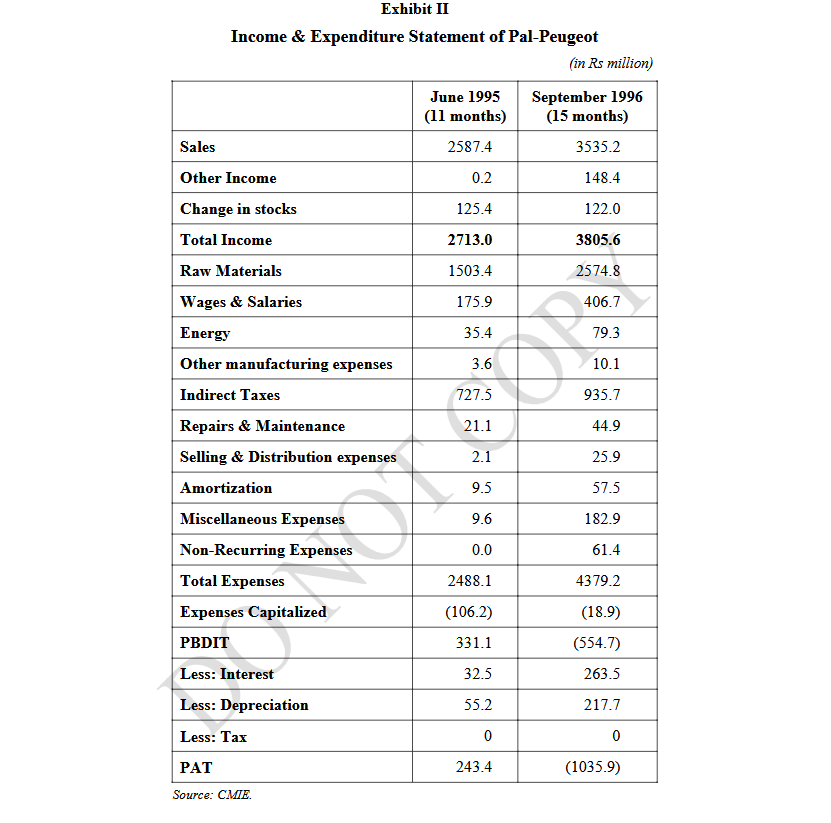
While Peugeot's vehicles were absent from the markets, General Motors’ Opel Astra, Daewoo's Cielo and Ford’s Escort had firmly established themselves in the market. Things looked extremely bleak for Peugeot as its losses (for the 15-month period ending September 1996) reached Rs 1.03 billion. (Refer Exhibit II). In early 1997, Peugeot wanted to infuse fresh capital into the venture to capitalize the losses and asked PAL to bring in its share of funds. However, PAL was against the idea of capitalizing the losses, stating that it would project an unrealistic picture of the company’s financial health. It argued that showing nominal profits while the company had actually incurred losses would be against the shareholders' interest. Other differences soon cropped up between the two partners and frequent allegations and counter-allegations were made in the media.
THE FINAL COUNTDOWN
PAL was reportedly unhappy with Peugeot over the indigenisation of the 309. The 309 was only 24% indigenised. This made the spare parts very expensive and the company was unable to reduce the price of the car. PAL claimed that Peugeot was just not interested in increasing the indigenization level of the vehicle.
There were reports of disagreements over the high price of the CKD from Peugeot as well. Due to the 1996 labor problems, the company had to bear heavy inventory carrying costs. To compensate for this, PAL reportedly asked Peugeot to cut down the CKD prices and release funds as loan to the joint venture. PAL sources said that Peugeot could have advanced loans to the company by treating CKD and other equipment with the venture as security for the loan. PAL even requested Peugeot to use its name to raise bank loans abroad for the joint venture, where the cost of funds was much lower than in India. PAL sources felt that Peugeot could have raised the loans abroad at a 4.5-6 % interest rates as compared to the 18-20% charged in India at that time. Peugeot reportedly did not heed any of PAL’s suggestions.
PAL later agreed to Peugeot’s proposal of capitalizing the losses, but as it was facing a severe liquidity crunch, it expressed its inability to bring in fresh funds. The company instead proposed to sell its stake in the joint venture to Peugeot. Howver, the two parties could not agree on the terms of the sale with PAL asking for Rs 15 per share and Peugeot willing to offer only Rs 10. After a few rounds of negotiations, PAL agreed to sell at a price of Rs 10 per share. This time Peugeot added another clause to the deal stating that it would only buy the shares required to increase its stake from 32% to 51%. This was unacceptable to PAL, and it said that it would sell the full stake or nothing at all.
Peugeot sources now claimed that PAL's resistance was only due to its unwillingness to continue in the venture with only a 22% stake, as it would then be unable to block any special resolutions passed by the board6. Peugeot reportedly began lobbying with the financial institutions to gain their support for increasing its stake in the venture and even offered to bring in Rs 920 million as equity to capitalize the losses.
In February 1997, the PAL-Peugeot board held a meeting to discuss the issues of loss- capitalization, indigenisation and reduction in the price of the CKD kit price. However, it failed to reach any agreement and the stalemate continued. By March 1997, the company’s accumulated losses reached Rs 1.47 billion, against the total net worth of Rs 2.61 billion.
The PAL-Peugeot venture received another setback in July 1997, when the Commerce ministry refused to renew its license to import the CKD kits for the 309. This was because the company had failed to meet the export targets it had agreed to in its MoU with the Directorate General of Foreign Trade. The company had only 200 kits in stock and it had to slow down the production significantly.
Meanwhile, in a move that proved to be the proverbial 'final nail in the coffin,' PAL upgraded its technical agreement with Fiat into a joint venture in August 1997. The ties between Peugeot and PAL worsened considerably and soon, Peugeot served a legal notice on PAL for alleged violation of a non-compete clause in the agreement7 signed between them. PAL made the counter-allegation that it was Peugeot that had violated the agreement first, when it signed a contract to provide diesel engines for the mid-size and compact cars of Maruti.
In September 1997, Peugeot filed a case with the Mumbai High court asking for a stay on the proposed PAL-Peugeot's EGM, called to obtain the shareholders' consent for the proposed joint venture with Fiat Auto. Peugeot alleged, that while on the one-hand, PAL claimed liquidity crunch as an excuse for not bringing in fresh funds for PAL-Peugeot, on the other, it had embarked on a Rs 2.75 billion modernization plan for the Kurla plant. PAL did not refute these allegations, but insisted that Peugeot’s moves were solely aimed at pressurizing it into selling its stake in PAL-Peugeot at a below-par price. PAL also contended that Fiat’s Uno model was not in direct competition with the Peugeot 309. In the meantime, the Mumbai High Court issued an interim order restraining PAL from seeking shareholders’ consent for the Fiat joint venture.
Following this, Peugeot and PAL started negotiations to reach an out-of-court settlement. As a result of the discussions, PAL agreed to allow Peugeot to infuse fresh capital and it also agreed to forego its stake in the joint venture in favour of Peugeot. In return, it was reported that Peugeot would be dropping its suit against PAL.
PAL & Peugeot finally seemed to be sorting out their problems. However, in a sudden development in November 1997, Peugeot announced its pullout from the joint venture and made it clear that it was leaving the Indian market for good. Peugeot also withdrew its court case against PAL in the Mumbai High Court and reportedly asked PAL to buy out its 32% stake in the venture. Peugeot gave PAL one month to explore various restructuring options while placing its stake with PAL for disposal. Given the history of PAL-Peugeot enmity, Peugeot’s low-key departure was rather surprising.
By February 1998, Peugeot withdrew the 309 from India, leading to panic among the owners of the car in India. Though Peugeot assured the customers that supply of spare parts would be maintained, the May 1998 closure of production at the Kalyan plant seemed to indicate otherwise. Peugeot had left the Indian market with many unresolved issues such as the amounts it owned to the FI’s, the vendors and the customers (booking amount refund).
GONE FOREVER?
Peugeot’s announcement in August 1999 that it had agreed to license its diesel engines to PAL for 5 years took observers by surprise. Peugeot also decided to write off claims on PAL amounting to Rs 850 million on account of license and technical fees. The fact that the deal did not involve any royalty payments and that Peugeot had agreed to transfer its stake in the joint venture to PAL added to the mystery.
In January 2001, Peugeot Citroen and Telco began discussions for introducing a luxury car in India. There were also reports of Peugeot planning a tie-up with the Indian two-wheeler major Hero Honda to enter the motorcycle segment in India. Interestingly enough, the FI’s were reported to be planning to use their clout in the Foreign Investment Promotion Board (FIPB) to protest against the re-entry of Peugeot.
However, in July 2001, after the completion of various feasibility studies, Telco and Peugeot decided against going ahead with the project for the time being. The high logistics cost and the limited volumes in the luxury car market were reported to be the reasons behind the decision. Peugeot also announced that it had no plans to enter the motorcycle market.
QUESTIONS FOR DISCUSSION
1. Most of the MNC automobile companies that entered India in the 1990s were present in the market in late 2001. Why do you think Peugeot was the only company, which had to close down its business?
2. 'The association with PAL was responsible to a large extent for Peugeot's exit from the Indian market.' Do you agree? Examine the problems arising out of PAL's association with Fiat.
EXHIBITS
Exhibit I
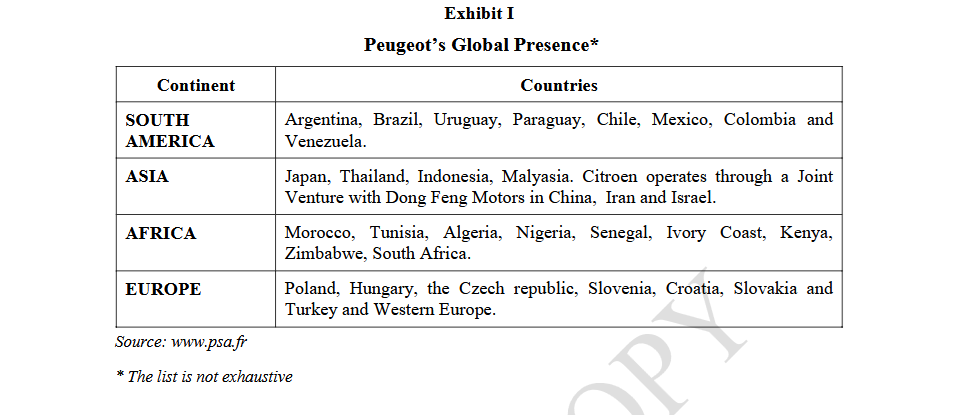
Exhibit II
Keywords
Poor performance, French automobile, Peugeot, India, Peugeot ,Premier Automobiles Ltd., PAL, joint venture partners, formative years
Related Case Studies
| Case Title | Details |
|---|---|
|
Case Title IBM in 2004: The Linux OptionCase Code: BSTA110 |
Details |
|
Case Title Oracle’s PeopleSoft Bid (Part C)Case Code: BSTA106 |
Details |
|
Case Title Oracle’s PeopleSoft Bid (Part B)Case Code: BSTA105 |
Details |
|
Case Title Oracle’s PeopleSoft Bid (Part A)Case Code: BSTA104 |
Details |
|
Case Title Ispat: Sidbec: Entering North AmericaCase Code: BSTA006 |
Details |