
The US-64 Controversy
Details
FINC003
8
2002
YES
200
Unit Trust of India
Wealth Management
India
Regulatory Environment,Capital Markets & Investments, Risk Management
Abstract
The case ‘The US-64 Controversy’ provides insight into the problems faced by the Indian mutual fund major UTI’s flagship scheme US-64. The case discusses in detail the problems that led to the fund’s poor performance and steps taken by UTI to restore the investor confidence and the efficacy of these steps. The case intends to highlight the importance of portfolio management for a mutual fund. The case explores in details the reasons behind the US-64 controversy and its implication on the stock markets. The students are expected to understand how the nexus between the various governments and UTI resulted in reckless investment decisions. Finally, the importance of having an adequate regulatory mechanism for the financial institutions is highlighted.
Learning Objectives
The case is structured to achieve the following Learning Objectives:
- Mismanagement of US-64 portfolio
- Efforts to revive US-64
- functioning of UTI.
Contents
The US-64 Controversy
“They have cheated us. I am telling everyone to sell. If they are stupid and offering Rs 14.25 for paper worth Rs 9, why should I let go of the opportunity?”
- An unhappy US-64 investor in 1998.
CAN OF WORMS
In 1998, investors of Unit Trust of India’s (UTI) Unit Scheme-1964 (US-64) were shaken by media reports claiming that things were seriously wrong with the mutual fund1 major. For the first time in its 32 years of existence, US-64 faced depleting funds and redemptions exceeding the sales. Between July 1995 and March 1996, funds declined by Rs 3,104 crore (1 crore = 10 million). Analysts remarked that the depleting corpus coupled with the redemptions could soon result in a liquidity crisis.
Soon, reports regarding the lack of proper fund management and internal control systems at UTI added to the growing investor frenzy. By October 1998, US-64’s equity component’s market value had come down to Rs 4200 crore from its acquisition price of Rs 8200 crore. The net asset value (NAV) of US-64 also declined significantly during 1993-1996 due to turbulent stock market conditions. A Business Today survey cited US-64’s NAV at Rs 9.68 3. The US-64 units, which were sold at Rs 14.55 and repurchased at Rs 14.25 in October 1998, thus were around 50% and 47%, above their estimated NAV.
Amidst growing concerns over the fate of US-64 investors, it became necessary for UTI to take immediate steps to put rest to the controversy.
CREATING TRUST
UTI was established through a Parliament Act in 1964, to channelise the nation’s savings via mutual fund schemes. This was done as in the earlier days, raising the capital from markets was very difficult for the companies due to the public being very conservative and risk averse.
By February 2001, UTI was managing funds worth Rs 64,250 crore through over 92 saving schemes such as US-64, Unit Linked Insurance Plan, Monthly Income Plan etc. UTI’s distribution network was well spread out with 54 branch offices, 295 district representatives and about 75,000 agents across the country.
The first scheme introduced by UTI was the Unit Scheme-1964, popularly known as US-64. The fund’s initial capital of Rs 5 crore was contributed by Reserve Bank of India (RBI), Financial Institutions, Life Insurance Corporation (LIC), State Bank of India (SBI) and other scheduled banks including few foreign banks. It was an open-ended scheme4, promising an attractive income, ready liquidity and tax benefits. In the first year of its launch, US-64 mobilized Rs 19 crore and offered a 6.1% dividend as compared to the prevailing bank deposit interest rates of 3.75 - 6%. This impressed the average Indian investor who until then considered bank deposits to be the
safest and best investment opportunity. By October 2000, US-64 increased its capital base to Rs 15993 crore, spread over 2 crore unit holders all over the world.
However by the late 1990s, US-64 had emerged as an example for portfolio mismanagement. In 1998, UTI chairman P.S.Subramanyam revealed that the reserves of US-64 had turned negative by Rs 1098 crore. Immediately after the announcement, the Sensex fell by 224 points. A few days later, the Sensex went down further by 40 points, reaching a 22-month low under selling pressure by Foreign Institutional Investors (FIIs). This was widely believed to have reflected the adverse market sentiments about US-64. Nervous investors soon redeemed US-64 units worth Rs 580 crore. There was widespread panic across the country with intensive media coverage adding fuel to the controversy.
DISTRUST IN TRUST
Unlike the usual practice for mutual funds, UTI never declared the NAV of US-64 - only the purchase and sale prices for the units were announced. Analysts remarked that the practise of not declaring US-64’s NAV in the initial years was justified as the scheme was formulated to attract the small investors into capital markets. The declaration of NAV at that time would not have been advisable, as heavy stock market fluctuations resulting in low NAV figures would have discouraged the investors. This seemed to have led to a mistaken feeling that the UTI and US-64 were somehow immune to the volatility of the Sensex.
Following the heavy redemption wave, it soon became public knowledge that the erosion of US-64’s reserves was gradual. Internal audit reports of SEBI regarding US-64 established that there were serious flaws in the management of funds.
Till the 1980s, the equity component of US-64 never went beyond 30%. UTI acquired public sector unit (PSU) stocks under the 1992-97 disinvestment program of the union government. Around Rs 6000-7000 crore was invested in scrips such as MTNL, ONGC, IOC, HPCL & SAIL. A former UTI executive said, “Every chairman of the UTI wanted to prove himself by collecting increasingly larger amounts of money to US-64, and declaring high dividends.” This seemed to have resulted in US-64 forgetting its identity as an income scheme, supposed to provide fixed, regular returns by primarily investing in debt instruments. Even a typical balanced fund (equal debt and equity) usually did not put more than 30% of its corpus into equity. A Business Today report claimed that eager to capitalise on the 1994 stock market boom, US-64 had recklessly increased its equity holdings. By the late 1990s the fund’s portfolio comprised around 70% equity. While the equity investments increased by 40%, UTI seemed to have ignored the risk factor involved with it. Most of the above investments fared very badly on the bourses, causing huge losses to US- 64. The management failed to offload the equities when the market started declining. While the book value of US-64’s equity portfolio went up from Rs 7,943 crore (June 1994) to Rs 13,627 (June 1998), the market value had actually declined in the same period from Rs 18,334 crore to Rs 10,029 crore. Analysts remarked that UTI had been pumping money into scrips whose market value kept falling. Raising further questions about the fund management practices was the fact that there were hardly any ‘growth scrips’ from the IT and pharma sectors in the equity portfolio.
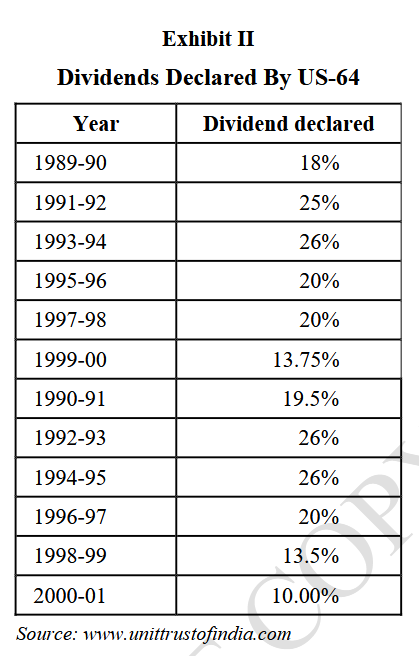
In spite of all this, UTI was able to declare dividends as it was paying them out of its yearly income, its reserves and by selling the stocks that had appreciated. This kept the problem under wraps till the reserves turned negative and UTI could no longer afford to keep the sale and purchase prices artificially inflated.
Following the public outrage against the whole issue, UTI in collaboration with the government of India began the task of controlling the damage to US-64’s image.
RESTORING THE TRUST
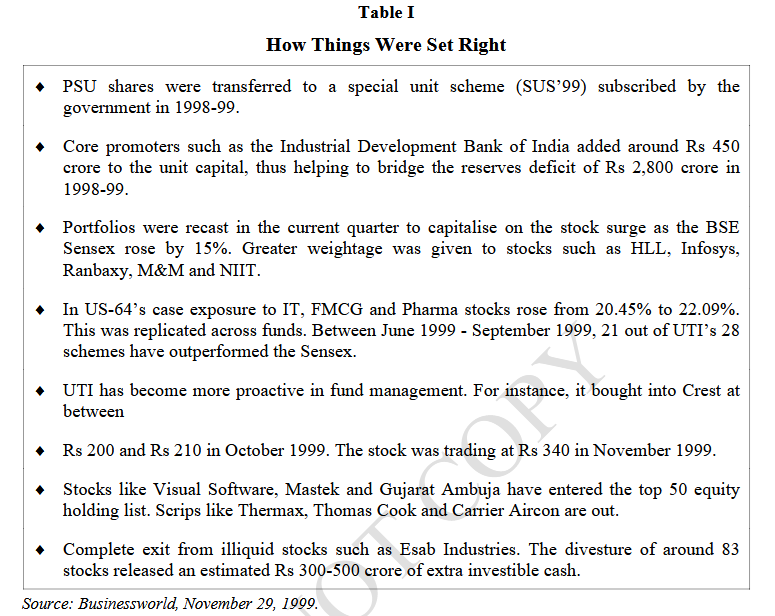
UTI realised that it had become compulsory to restructure US-64’s portfolio and review its asset allocation policy. In October 1998, UTI constituted a committee under the chairmanship of Deepak Parekh, chairman, HDFC bank, to review the working of scheme and to recommend measures for bringing in more transparency and accountability in working of the scheme.
US-64’s portfolio restructuring however was not as easy as market watchers deemed it to be. UTI could not freely offload the poor performing PSU stocks bought under the GoI disinvestment program, due to the fear of massive price erosions after such offloading. After much deliberation, a new scheme called SUS-99 was launched. The scheme was formulated to help US-64 improve its NAV by an amount, which was the difference between the book value and the market value of those PSU holdings. The government bought the units of SUS-99 at a face value of Rs 4810 crore.
For the other PSU stocks held prior to the disinvestment acquisitions, UTI decided to sell them through negotiations to the highest bidder. UTI also began working on the committee’s recommendation to strengthen the capital base of the scheme by infusing fresh funds of Rs 500 crore. This was to be on a proportionate basis linked to the promoter’s holding pattern in the fund. The inclusion of the growth stocks in the portfolio was another step towards restoring US-64’s image. Sen, Executive Director, UTI, said, “The US-64 equity portfolio has been revamped since June. During the last nine months the new ones that have come to occupy a place among the Top
20 stocks from the (Satyam Computers, NIIT and Infosys) and FMCG (HLL, SmithKline Beecham and Reckitt & Colman) sectors. US-64 has reduced its weightage in the commodity stocks (Indian Rayon, GSFC, Tisco, ACC and Hindalco.)”
To control the redemptions and to attract further investments, the income distributed under US-64 was made tax-free for three years from 1999. To strengthen the focus on small investors and to reduce the tilt towards corporate investors, UTI decided that retail investors should be concentrated upon and their number should be increased in the scheme.
UTI also decided to have five additional trustees on its board. To enable trustees to assume higher degree of responsibility and exercise greater authority UTI decided to give emphasis on a proper system of performance evaluation of all schemes, marked-to-market valuation5 of assets and evaluation of performance benchmarked to a market index. The management of US-64 was entrusted to an independent fund management group headed by an Executive Director. UTI made plans to ensure that full responsibility and accountability was achieved with support of a strong research team. Two independent sub-groups were formed to manage the equity and debt portion of US-64. An independent equity research cell was formed to provide market analysis and research reports.
UTI constituted an ad-hoc Asset Management Committee6 with 7 members comprising 5 outside professionals and 2 senior UTI officials. The committee’s role was clearly defined and its scope covered the following areas:
• To ensure that US-64 complied with the regulations and guidelines and the prudential investment norms laid down by the UTI board of trustees from time to time.
• To review the scheme’s performance regularly and guide fund managers on the future course of action to be adopted.
• To oversee the key issues such as product designing, marketing and investor servicing along with the recommendations to Board of Trustees
One of the most important steps taken was the initiative to make US-64 scheme NAV driven by February 2002 and to increase gradually the spread between sale and repurchase price. The gap between sale and repurchase price of US-64 was to be maintained within a SEBI specified range. UTI announced that dividend policy of US-64 would be made more realistic and it would reflect the performance of the fund in the market. US-64 was to be fully SEBI regulated scheme with appropriate amendment to the UTI Act.
The real estate investments made by UTI for the US-64 portfolio were also a part of the controversy as they were against the SEBI guidelines for mutual funds. UTI had Rs 386 crore worth investments in real estate. UTI claimed that since its investments were made in real estate, it was safe and it could sell the assets whenever required. However, the value of the real estate in US-64’s portfolio had gone down considerably over the years. The real estate investments were hence revalued and later transferred to the Development Reserve Fund of the trust according to the recommendations of the Deepak Parekh committee.
By December 1999, the investible funds of US-64 had increased by 60% to Rs 19,923 crore from Rs 12,433 crore in December 1998. The NAV had recovered from Rs 9.57 to Rs 16 by February 2000 after the committee recommendations were implemented.
DEAD END SCHEME?
Though UTI started announcing the dividends according to the market conditions, this was not received well by the investors. They felt that though the dividend was tax-free, it was not appealing as most of the investors were senior citizens and they did not come under the tax bracket.
The statement in media by UTI chairman that trust would try to attract the corporate investors into the scheme was against the recommendation by the committee, which had adviced the trust to attract the retail investors into the scheme. This led to doubts about UTI’s commitment towards the revival of the scheme.
However, led by improving NAV figures and image-building exercises on UTI’s part, by 2000, US-64 was again termed as one of the best investment avenues by analysts and market researchers. UTI had become more proactive in fund management with its scrips rising in value, restoring the confidence of the small investor in the scheme. The National Council of Applied Economic Research (NCAER) and SEBI surveys mentioned that US-64 was once again perceived as a safe investment by the middle class income groups.
However, the euphoria seemed to be short lived as in 2001, US-64 was involved in yet another scam due to its investments in the K-10 stocks. Talks of a drastically low NAV, inflated prices, increasing redemption and GoI bailouts appeared once again in the media. An Economic Times report claimed that there was a difference of over Rs 6000 crore between the NAV and the sale prices. Doubts were raised as to US-64 being an inherently weak scheme, which coupled with its mismanagement had led to its downfall once again. This however, was yet another story.
QUESTIONS FOR DISCUSSION
1. Explain in detail the reasons behind the problems faced by US-64 in the mid 1990s. Were these problems the sole responsibility of UTI? Give reasons to support your answer.
2. Analyse the steps taken by UTI to restore investor confidence in US-64. Comment briefly on the efficacy of these steps.
3. As a market analyst, would you term US-64 a safe mode of investment? Justify your stand with reasons.
4. US-64 should have been NAV driven from the very beginning like other mutual funds. Comment.
EXHIBITS
Exhibit I
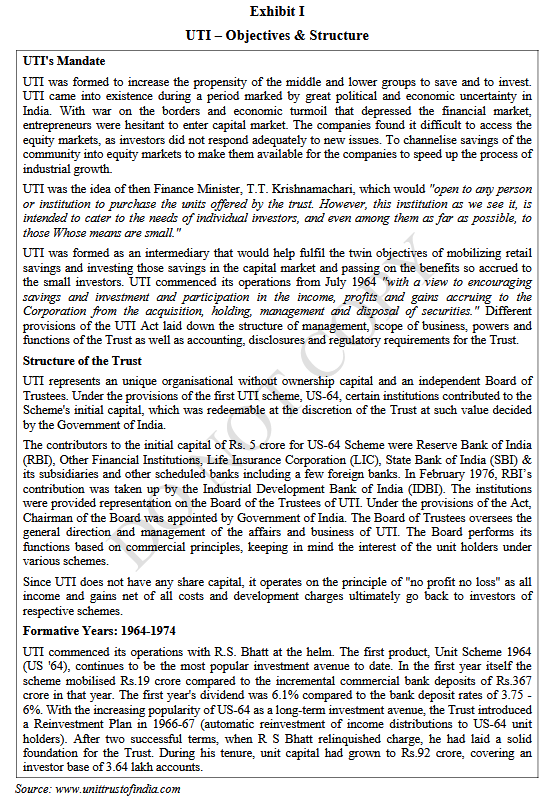
Exhibit II
Keywords
US-64 Controversy, Indian mutual fund, UTI, US-64, problems, fund, poor performance, restore, investor confidence, highlight, importance, portfolio management, mutual fund, stock markets, nexus, governments, UTI, investment, decisions, regulatory mechanism, financial institutions, highlighted
Related Case Studies
| Case Title | Details |
|---|---|
|
Case Title Financial Risk Management at BPCase Code: ERMT029 |
Details |
|
Case Title Enterprise Risk Management at Deutsche Post DHLCase Code: ERMT028 |
Details |
|
Case Title Oracle’s PeopleSoft Bid (Part C)Case Code: BSTA106 |
Details |
|
Case Title Oracle’s PeopleSoft Bid (Part B)Case Code: BSTA105 |
Details |
|
Case Title Oracle’s PeopleSoft Bid (Part A)Case Code: BSTA104 |
Details |