
Daiwa Bank - Lessons in Risk Management
Details
FINC033
8
2004
YES
300
Daiwa Bank
Banking
Japan
Credit Risk Management
Abstract
The case discusses how Toshihide Iguchi (Iguchi), the Executive Vice-President of Daiwa’s New York branch caused a major loss to the bank through his trading activities in US Treasury bonds. It describes the complete sequence of events leading to the revelation of the forgery and fraud committed by Iguchi. The case also highlights the reasons that led to the scam and its aftermath.
Learning Objectives
The case is structured to achieve the following Learning Objectives:
- Risk Management in Banks
- Financial Scams.
Contents
Daiwa Bank – Lessons in Risk Management
“Sound internal controls are a source of competitive advantage for the entire system. The industry should encourage all banks, both domestic and foreign, to toe the line.”
- Edward P. Rogers III, Deputy Superintendent and Counsel, New York State Banking Department.
“It’s the ABC of risk control that you don’t let your traders do the back-office work.”
- Hal Scott, Banking Expert, Harvard Business School.
INTRODUCTION
Daiwa Bank (Daiwa), Japan's 12th largest commercial bank, announced on September 26, 1995 that its New York branch had lost more than $1 billion (bn) over a 11-year period. These losses were the result of forgery and fraud committed by Toshihide Iguchi (Iguchi), the Executive Vice- President of Daiwa's New York branch. Daiwa was one of the top 20 banks in the world in terms of asset size. The New York branch was managing the custody of the US treasury bonds that it had bought on its own account, and those that it had bought on behalf of its customers, via a sub- custody account held at the Bankers Trust New York Corporation (BTNYC).
The scam was exposed soon after another major banking scam involving Barings Bank was exposed on February 26, 1995. These scams raised serious doubts about the risk management policies followed by the banks. Moreover, industry experts and the media were shocked at the way the loss had been first covered up by Iguchi over a period of 11 years and then by the senior managers at Daiwa after Iguchi had confessed his crimes to the president of Daiwa in a letter on July 13, 1995.
Analysts commented that Daiwa would not go bankrupt as Barings had because Daiwa's $200 bn of assets and $8 bn of reserves meant that it had enough cushion to bear the losses. However, the scam gave a massive blow to Daiwa's reputation as US regulatory authorities ordered Daiwa to put an end to most of its trading activities in the US. This proved to be a major setback for Daiwa, which wanted to become a global player.
Blaming lack of control in trading rooms, Marc Cohen, managing director of Hermes Capital, a hedge-fund firm said, “This scandal brings to light a culture on Wall Street. In all trading rooms – in banks, in securities firms – when people make money, you leave them alone. No one wants to upset the apple cart.”
BACKGROUND NOTE
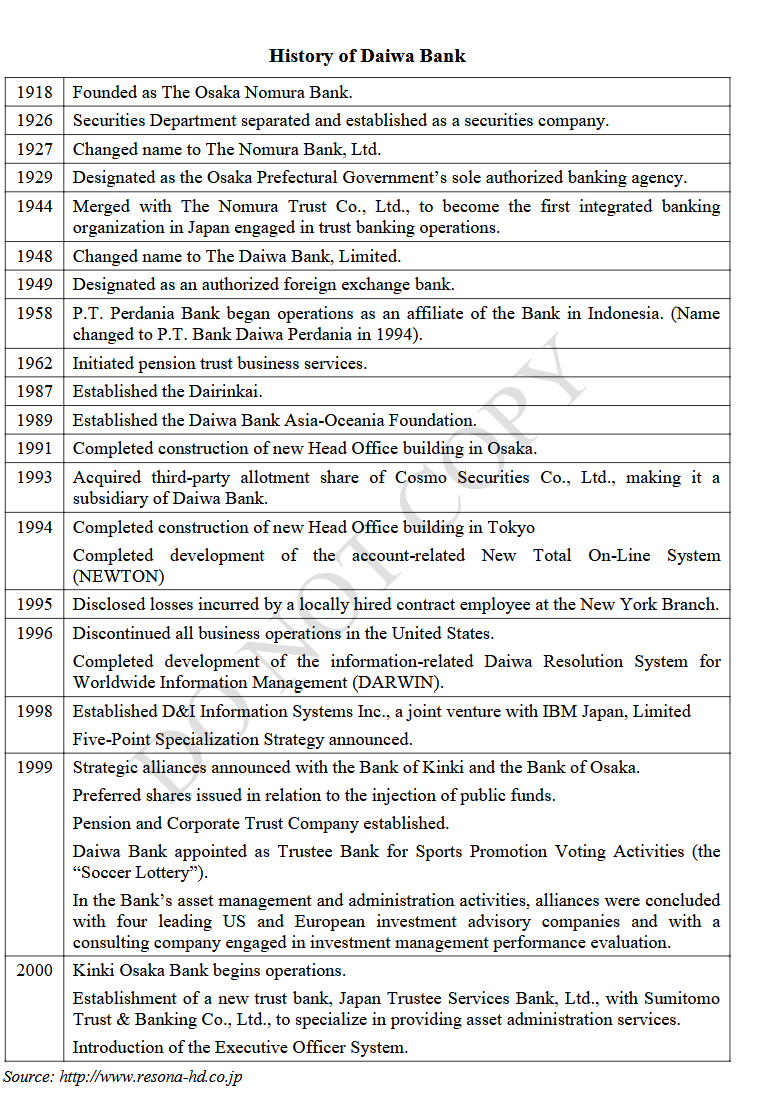
Daiwa was founded by Tokushichi Nomura (Nomura) in May 1918. It launched its operations in Osaka in August 1918. Though Nomura was mainly engaged in the securities business in Osaka, he decided to establish a bank with the objective of providing support to small and medium-sized enterprises. In 1926, the securities division was separated and established as a securities company. The banking division was named The Nomura Bank Limited, in 1927.
The Wall Street financial crash in 1929 proved to be a blessing in disguise for the bank. The bank was designated as the Osaka Prefectural Government's sole authorized banking agency. While other banks were unwilling to accept the responsibility of administration of government operations requiring numerous complex procedures, Daiwa valued the public aspects of managing the main depository. This helped in promoting Daiwa's credibility.
In 1944, following a merger with Nomura Trust Company Limited, Daiwa became the first financial institution in Japan to undertake both ordinary banking and trust7 businesses. Following the dissolution of large financial conglomerates, in the postwar period, the bank changed its name to Daiwa Bank Limited in October 1948.
In 1949, Daiwa was designated as an authorized foreign exchange bank. It had emerged as one of the top financial institutions in Japan, engaged in commercial banking, trust and foreign exchange business. Recognizing the need to ensure a quality life for senior citizens in Japan, Daiwa launched its pension trust8 business in 1962. In the next couple of decades, the bank emerged as a leader in the corporate pension business. In 1993, Daiwa acquired a majority stake in one of the leading security companies in Japan, Cosmo Securities Limited.
Iguchi9 joined the securities deposit department at Daiwa's New York branch as a clerk in 1976. As a part of its services to the pension fund customers, the branch in New York dealt in US treasury securities. It managed the custody of the US Treasury bonds that it bought on its own account, and those that it bought on behalf of its customers, via a sub-custody account held at Bankers Trust. The interest on the bonds were collected and dispersed through this account. The bonds were transferred or sold according to the wishes of either the customers or the bank's managers. Customers kept track of the account through the transaction reports sent by the Bankers Trust.
EVENTS LEADING TO THE LOSS
During the 1980s, Diawa's New York branch gradually increased its presence in the US government debt market. It became a primary market dealer10 in 1986, emerging as one of the leading players in the US debt market. The branch was also trading in bonds placing short-term bets on interest rate movements.
Iguchi was entrusted with back-office work and there he learnt how to handle back-office paperwork for government-bond trading. In addition to his back-office duties, he was also promoted to the post of trader in 1984. Thus, Iguchi was simultaneously in charge of making trades and recording them in the department's back office.
In his early trading days, Iguchi lost $200,000 betting in the American government-bond market. Instead of reporting the loss to his supervisors, Iguchi tried to cover it up by selling some bonds from the Bankers Trust sub-custody account. Iguchi also started taking large trading positions to recover previous losses. However, he continued to incur more losses.
To raise cash to pay the brokers, Iguchi sold bonds from Daiwa's own account and from Daiwa's customer accounts. He ordered Bankers Trust New York Corporation to sell bonds held in Daiwa's account. Since he was the head of back-office operations, he received the statements from the Bankers Trust. He forged the sale documents to make it look as if the Bankers Trust still held the bonds that he had sold.
Whenever customers intended to sell the securities which Iguchi had sold off or when the customers needed to be paid interest on their securities, Iguchi would raise funds by selling more securities and falsifying more records. During a period of 11 years, from 1984 to 1995, Iguchi forged around 30,000 trading slips, among other documents. He sold around $377 mn of Daiwa's customers' securities and around $733 mn of Daiwa's own investment securities during this period.
Iguchi succeeded in concealing his trading losses from his superiors by maintaining separate books. The internal auditors of Daiwa also did not cross-verify the custody account statements independently. In fact, Iguchi falsified the books to show steady profits, which enabled him to secure promotions from time to time and rise to the position of Executive Vice-President of the New York branch.
As the years passed by, it became increasingly difficult for Iguchi to hide the trading losses incurred. The regulation of foreign banks had increased after the 1991 collapse of the Bank of Credit and Commerce International11. In 1992, the Federal Reserve Board12 asked Daiwa to separate trading and back-office duties and relieve Iguchi from any one of the two duties. As a result, Daiwa decided in 1993 to split-up some of its trading and back-office functions. Iguchi had to become more vigilant in order to prevent the detection of the fraud.
While Iguchi's losses continued to rise over the years, nobody at Daiwa had the slightest inkling of these losses. The employees of Showa Ota, the company, which audited the accounts of Daiwa Bank in Japan, also failed in performing their duties. There was no attempt to have a separate audit of the New York branch. Hence, Iguchi succeeded in carrying out fraudulent activities till mid 1995 when he succumbed to the fear that auditors may uncover his fraud.
In a letter to Daiwa's President Aldra Fujita, Iguchi on July 13, 1995, confessed to the fraud committed by him. Iguchi also promised to co-operate with senior executives in detecting the amount of loss. However, Daiwa's top management did not disclose the matter for two months to the regulatory authorities and investors because of the fear of major deposit withdrawals by them. After ascertaining the amount of loss and making arrangements to recover the losses by selling stocks, properties, and other assets, Daiwa decided to inform the authorities. Iguchi was relieved of his duties on September 25, 1995, after the completion of an internal investigation.
WHY DID IT HAPPEN?
Industry analysts said that a combination of blunders had led to the major losses at Daiwa. The bank's failure in implementing a proper risk management and internal control system was the biggest blunder. The fact that Iguchi was able to conceal the losses for a period of 11 years showed that there was inadequate control and supervision of Iguchi's trading activities. Analysts felt that the scam had occurred due to the following reasons:
OVERLAPPING OF FRONT AND BACK-OFFICE DUTIES
The main objective of the back-office was to record and settle trades transacted by the front-office and reconcile them with the statements sent by the Bankers Trust for assessing the accuracy of prices. Iguchi was given charge of both trading and back-office duties and consequently, was well placed to manipulate the statements received from the Bankers Trust. He constantly forged documents and misled the management into believing that there were no losses.
The senior management had ignored the Federal Reserve recommendations in 1992, to separate trading and back-office duties. As a result, Iguchi continued to be in charge of both offices. Daiwa's rotation policy was applicable to only Japanese managerial employees. These employees were supposed to return to Japan within three to five years of their posting outside Japan. Since Daiwa had hired Iguchi in the US, it treated him as a local hire and did not subject him to the rotation policy. He was also considered to be an expert in the trading of US government bonds, which prevented his transfer. The frequent transfer of managers who were supposed to supervise him, back to Japan meant that he gained virtual autonomy on his trading activities.
Finally, due to the pressure from US regulators on Daiwa to end his dual role, Iguchi choose to give up the better-paid and more prestigious position of head of trading to retain the position of head of settlements, which enabled him to further conceal his losses.
RISK MANAGEMENT AND CONTROL SYSTEM DEFICIENCY
Analysts claimed that Daiwa's risk control system had numerous deficiencies. They said that it was unbelievable that Daiwa had not been able to detect that one of its traders had been losing, on an average, an amount of $400,000 every business day for the past 11 years. Iguchi's trading deals were not complicated compared to derivatives trading. He dealt in plain-vanilla financial instruments US government bonds, which were simple to understand and value. He lost money because he bought the bonds at high prices and later sold them at low prices. Treasury dealers claimed that it would not have been possible for him to hide losses for such a long period if the internal control system had been effective. The internal auditors failed in their duty of verifying the statements of trading deals. Even after Daiwa had separated the trading and back-office activities in 1993, Iguchi was able to carry on his fraudulent activities and conceal the losses for two more years. Analysts felt that this would not have been possible without the help of other staff members. The scam had been exposed only because Iguchi had confessed his crimes. This showed the defects in Diawa's internal control system. Moreover, the top executives at the New York branch were quick in pleading forgiveness for the lapse in internal control. Masahiro Tsuda, General Manager of the New York branch said, “We are deeply embarrassed that our internal controls and procedures were not sufficient.”
The Daiwa headquarters at Japan did not effectively monitor the activities at its New York branch, and gave it high autonomy. Showa Ota, the auditor of Daiwa Bank in Japan, also did not do a detailed audit of the New York branch. The inspection conducted by the New York state banking authorities in 1989 failed to detect the fraud. Two other inspections, one in 1992, by New York Federal examiners and the other in 1994, by auditors from Japan's Ministry of Finance (MOF) also failed to detect the losses.
FAULTY MANAGEMENT POLICIES
Analysts said that Daiwa's management policies were flawed and covering up of losses was a part of its culture. When some of its Japanese traders incurred huge losses during the period 1984-87, Daiwa had concealed the losses by shifting them to its overseas affiliates. In the late 1980s, US regulators had asked Daiwa to consolidate its trading operations. Daiwa falsely claimed to have complied by shifting all trading operations to midtown Manhattan. When regulators visited its downtown office for inspection, Daiwa reportedly sent all its traders to the midtown office and quickly converted the trading floor into a storeroom. Daiwa was accused of having operated an unauthorized trading area for securities between 1986 and 1993.
Accepting the management fault for Iguchi's action, Daiwa deputy president Kenji Yasui said, “We had great expectations for him, and so he felt obliged to keep going instead of coming clean.”
THE AFTERMATH
After Iguchi's confession, Daiwa did not report the matter immediately to US regulators in spite of a legal requirement to do so. Daiwa informed Japan's Ministry of Finance about the scam on August 8, 1995. Daiwa's senior managers along with Iguchi prevented the losses from being discovered by the US regulators. In early September 1995, a scheduled audit was postponed on the pretext that Iguchi was on leave. The managers tried to transfer the loss to Japan to avoid scrutiny by US regulators.
When they were unable to do so, Daiwa reported the loss to the US Federal Reserve Board on September 15, 1995. Daiwa claimed that it had informed the Federal Reserve late to prevent any threat to its financial viability due to sudden disclosure of the loss amount. Finally, on September 26, 1995, the loss was made public. Daiwa's management claimed that no depositor or customer would be financially affected due to the loss. They said that even after accounting for the losses, the bank would still post a profit of $95 mn for the first half of the fiscal year.
US regulators indicted Daiwa on charges of conspiring to hide the losses and asked it to stop all its trading activities in the US. Japan's finance minister apologized to his US counterpart on October 11, 1995, for failing to inform US authorities about the scam earlier. In December 1996, Iguchi was sentenced to four years in prison, as he was found guilty for the losses incurred by Daiwa. He was asked to pay a penalty of $2.6 mn. Iguchi was also found guilty of stealing $500,000 from Daiwa for his personal use. Daiwa sold most of its assets and closed down its offices in the US. It was also forced to pay a fine of $340 mn to avoid legal battles over its role in the Iguchi affair. The Osaka court in Japan, on September 20, 2000, ordered some current and former board members and executives of Daiwa to pay the bank $775 mn as restitution to Daiwa's shareholders. After a long drawn legal battle, on December 11, 2001, the former executives of Daiwa Bank entered into an out-of-court settlement and agreed to pay 250 mn yen to settle the lawsuit filed by the bank's shareholders.
Exhibit I
 |
Keywords
Daiwa Bank, Risk Management in Banks, Value at Risk, VAR Model, US Treasury Bonds, Hedge-fund, Internal Control, Financial Scams
Related Case Studies
| Case Title | Details |
|---|---|
|
Case Title MRPL & RPL: Analyzing Risk and ReturnsCase Code: FINC027 |
Details |