
GE And Jack Welch
Details
LDEN002
14
2002
YES
300
General Electric Company
General Business
US
Leadership & Values,Organizational Design
Abstract
The case ‘GE and Jack Welch’ talks about the leadership style of Jack Welch, ex-Chairman and CEO of General Electric. Jack Welch joined GE in 1960, and was named the CEO in 1981. In the initial years as CEO, Jack Welch initiated a restructuring plan, which included massive job cuts, positioning the various businesses as number one or number two in the respective segments, and selling off unprofitable ones. He dismantled the 29 layers of hierarchy and made GE an informal company. The case also throws light on some of the other important aspects of Jack Welch’s strategies like six sigma, globalization, boundaryless organization etc.
Learning Objectives
The case is structured to achieve the following Learning Objectives:
- Strategies that transformed GE into the most valuable company in the world.
Contents
GE and Jack Welch
If leadership is an art, then surely Welch has proved himself a master painter.”
- BusinessWeek, May 28, 1998.
“The two greatest corporate leaders of this century are Alfred Sloan of General Motors and Jack Welch of GE. And Welch would be the greater of the two because he set a new, contemporary paradigm for the corporation that is the model of the 21st Century.”
- Noel Tichy, Professor of Management, University of Michigan, and a longtime GE observer.
INTRODUCTION
On September 6, 2001, John Francis Welch Jr. (Jack Welch), Chairman and Chief Executive Officer of General Electric Co. (GE)1, retired after spending 41 years with GE. During the period, he made GE the most valuable company in the world. Analysts felt that, with his innovative, breakthrough leadership style as CEO, Jack Welch transformed GE into a highly productive and efficient company.
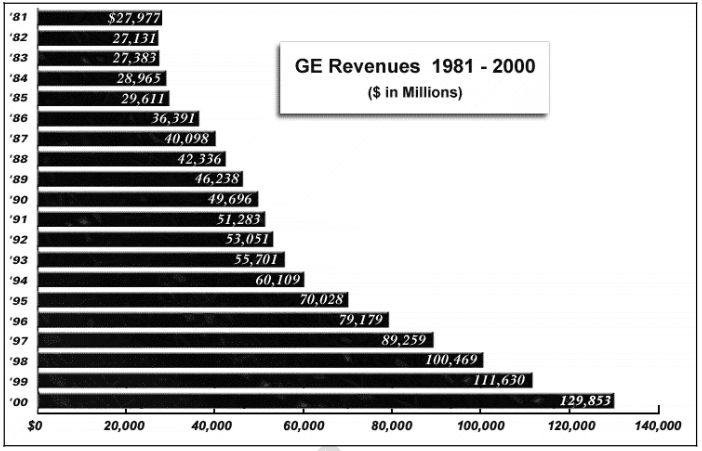
During Jack Welch's two decades as CEO, GE had grown from a US$13 billion manufacturer of light bulbs and appliances in 1981, into a US$480 billion industrial conglomerate by 2000. Analysts felt that Jack Welch had become a 'deal-making' machine, supervising 993 acquisitions worth US$13 billion and selling 408 businesses for a total of about US$10.6 billion.
Jack Welch was in fact described as 'the most important and influential business leaders of the 20th Century' by some Wall Street analysts and academics alike. Management experts felt that Jack Welch's reputation as a leader could be attributed to four key qualities: he was an intuitive strategist; he was willing to change the rules if necessary; he was highly competitive; and he was a great communicator.
THE MAKING OF A CEO
Jack Welch graduated in chemistry from the University of Massachusetts and in 1959 got a PhD in chemical engineering from the University of Illinois. In 1960, he started his career at GE as a Junior Engineer. However, in 1961, Jack Welch decided to quit the US$10,500 job as he was unhappy with the company's bureaucracy. He was offended that he was given a raise of only US$1000, the same amount given to all his colleagues. He had even accepted a job offer from International Minerals and Chemicals in Skokie, III.
However, Reuben Gutoff, an executive at GE convinced Jack Welch to stay back. Reuben Gutoff promised that he would prevent him from getting entangled in GE red tape and would create a small-company environment with big-company resources for him. This theme of 'small-company environment' with 'big-company resources' came to dominate Jack Welch's own thinking as the leader of GE. Jack Welch quickly rose to become the head of the plastics division in 1968. He became a group executive for the US$1.5 billion components and materials group in 1973. This included plastics and GE Medical Systems.
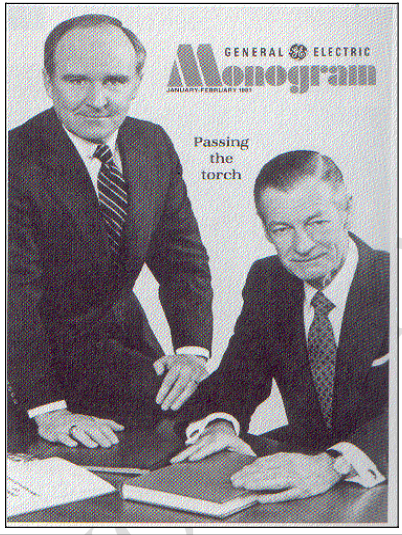
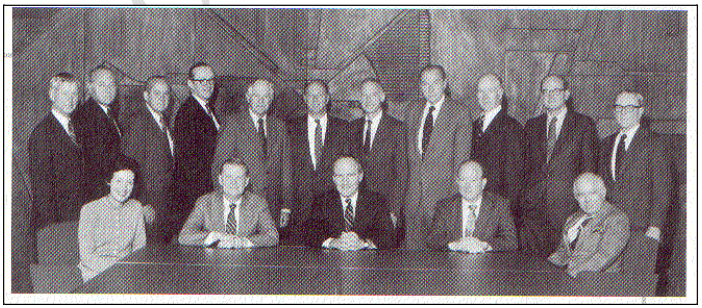
In 1981, Jack Welch became GE's youngest CEO ever (Refer Exhibits I & II). His predecessor, Reg Jones said, “We need entrepreneurs who are willing to take well-considered business risks –and at the same time know how to work in harmony with a larger business entity…The intellectual requirements are light-years beyond the requirements of less complex organizations.”
THE WELCH ERA AT GE: 1981-2001
During the first five years as CEO, Jack Welch emphasized that GE should be No.1 or No.2 in all businesses or get out of them. He disposed off the businesses with low-growth prospects, like TVs and toaster ovens. He expanded the financial-service provider GE Capital into a powerhouse. He also entered
the broadcasting industry with the acquisition of RCA Corp., the owner of NBC TV network.
At the same time, he shed more than 100,000 jobs – a fourth of GE's work force – through mass layoffs. Tens of thousands of other high paying manufacturing jobs were moved to cheaper, union-free locations overseas. Following this, Jack Welch was nick named 'Neutron Jack' after the nuclear weapon that killed people but left buildings largely intact. The number of employees at GE dropped from 402,000 at the end of 1980 to as low as 220,000 in mid-1990s. Jack Welch felt that making GE a leaner company was necessary to ensure healthy profits in the wake of high inflation and stiff Japanese competition. By 2000, the number of employees went up to 314,000, mostly as a result of acquisitions.
Analysts felt that GE under Jack Welch had performed very well (Refer Exhibits III and IV). The company's 2000 earnings of US$12.7 billion were 8 times more than the profit it reported in 1980 (US$1.5 billion). By 2000, its shares had risen about 5,096% (inclusive of dividends) or about 21.3% p.a. from the day Jack Welch took over.
Analysts felt that where most top executives lost their effectiveness in 10 years or less, Jack Welch was an exception, staying on the job and driving GE to elevated levels of accomplishment for 20 years. Like the seasons in the year, there were rhythms and rituals to how Jack Welch managed GE. Besides his monthly teaching sessions at the Crotonville3 academy, Jack Welch clearly laid out his monthly programs (Refer Exhibit V).
However, analysts felt that the Welch Era was not without flaws. GE had suffered major setbacks, in the form of criminal indictments relating to military contracts and battles with environmental groups. GE was blamed for the Poly-Chlorinated Biphenyls (PCB)4 contamination in the Hudson River. In early 2001, the U.S. Environmental Protection Agency endorsed a $460 million dredging plan to clean the river.
Analysts also observed that Jack Welch relied too much on GE Capital, the financial services division for GE's growth. However, by 2000, the division had accounted for half of the company's profits. Others pointed out that GE did not encourage women and minorities to take up top managerial positions. According to a few, Jack Welch's biggest shortcoming was his handling of growing political and social pressures, as evidenced by the European Union's veto of the proposed GE-Honeywell5 merger and the Bush Administration's order asking GE to clean up the Hudson River at a cost of US$460 million.
JACK WELCH’S MANAGEMENT STYLE
Analysts felt that Jack Welch's profound grasp on GE stemmed from knowing the company and those who worked for it. More than half of his time was devoted to “people issues”. Most importantly, he had created something unique at a big company – Informality. The hierarchy that Jack Welch inherited with 29 layers of management was completely changed during his tenure. Everyone, from secretaries, to chauffeurs to factory workers, called him 'Jack'. Everyone could expect – at one time or another – to see him. Analysts felt that Jack Welch gave employees a sense that he knew them. Commenting on the informality at GE, Jack Welch said, “The story about GE that hasn't been told is the value of an informal place. I think it's a big thought. I don't think people have ever figured out that being informal is a big deal.”
Making the company “informal” meant violating the chain of command, and communicating across layers. Analysts felt that it had to do with Jack Welch's charisma and the way he used company's meetings and review sessions to great advantage. When he became the CEO, Jack Welch inherited a series of obligatory corporate events, which he had transformed into meaningful levels of leadership. There were meetings in early January with GE's top 500 executives in Boca Ration, Fla., and monthly teaching sessions at Crotonville. These meetings allowed Jack Welch to set and change the corporation's agenda, to challenge and test strategies and people. They also helped him to make his presence and opinion known to all.
Analysts felt that Jack Welch knew the value of surprise. Every week, he made unexpected visits to plants and offices. There were luncheons with managers several layers below him, and many handwritten notes. Said a marketing manager of industrial products, “We're pebbles in an ocean, but he knows about us.”
In April every year, Jack Welch undertook an annual review of personnel of the executive level and above, called the Session C meetings. The meetings ran for 20 days. This process started every February when every employee filled a self-assessment review, which was later discussed with the review manager. The manager sent the assessment up the management chain. Jack Welch with his vice chairpersons and senior human resources personnel, met with the business leaders at their respective headquarters. Salaries were not discussed at these meetings. Only questions like – who is retiring? Who do you want to promote? Who should attend executive classes at Crotonville? – were discussed. At these meetings that Jack Welch and his senior colleagues devoted full attention to the human resources side of the business (Refer Box for purpose of Session C Meetings).
|
Objectives of Session C Meetings
|
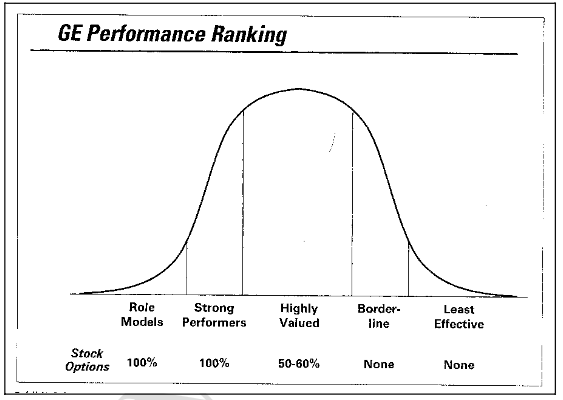
Analysts felt that one of the best ingredients of GE's people issues was the reward system. Jack Welch made sure that the best business leaders were rewarded properly. To identify the best, Jack Welch relied on the Vitality chart (Refer Figure I). Using the chart, the employees were sorted as As, Bs, and Cs. The chart was used by senior GE executives during Session C process to make sure that GE' s best performing employees were being rewarded and recognized. In some cases, the reward was a stock option. In his early days as the CEO, GE had granted stock options to only 200 employees. Eventually Jack Welch made a point of spreading those options throughout large segments of the company –including thousands of employees. By March 1999, the figure rose to 27,000.
Figure I
| The Vitality Chart |
 |
Source: “The GE WayFieldbook” by Robert Slater
Jack Welch had actually become a 'teacher' within GE. At Crotonville, Jack Welch led more than 250 class sessions and trained more than 15,000 GE managers and executives. He went to the academy every two weeks, for 17 years to interact with new employees, middle managers, and senior managers. Each session at the academy lasted for about four hours. Jack Welch asked questions and then challenged the employees to answer.
However, Jack Welch realized that his message was not getting across to the entire company and he was not as convincing as he hoped to be. He said, “I was intellectualizing the issues with a couple of hundred people at the top of the company, but clearly I wasnft reaching hundreds of thousands of people.” To reach those people, Jack Welch initiated a powerful-in-house communication system. After Jack Welch gave a leadership speech at GE's January management meeting, the next day, 750 video copies of the speech were dispatched to GE locations around the world. The tapes were prepared in eight different languages.
Jack Welch identified four qualities of leadership, all starting with letter E, and named it E4. (Refer Box) He connected the four E's with one P – Passion. According to him, it was the passion that separated the A's from B's. The B's were very important to the company and were encouraged to search every day for what they were missing to become A's.
|
Key GE Leadership Ingredients Energy Enormous Personal Energy – Strong Bias for Action |
Source: “The GE Way Fieldbook”, by Robert Slater
JACK WELCH – THE STRATEGIST
Analysts felt that Jack Welch was focused and analytical. He restructured GE's portfolio from 350 businesses during 1980s down to two-dozen core activities by late 1990s. During his initial years as CEO, he either expanded internally or made acquisitions to position all GE's businesses as either number one or number two in their fields. The planned acquisition of Honeywell, Inc., which didn't materialize, was expected to redefine GE for the years to come.
GE under Jack Welch transformed Six Sigma, which was originally intended to serve as a quality control for manufacturing, to focus on virtually all service-related transactions. GE learned and developed the complex Six Sigma program through internal and external benchmarking research. Jack Welch said, 'The methodologies of Six Sigma were learned from other companies, but the cultural obsessiveness and all-encompassing passion for it is pure GE.'9 The Six Sigma program increased the company's operating profit margins from 13.6% in 1995 to 16.7 % in the third quarter of 1999.
Jack Welch attributed three factors to the success of Six Sigma at GE: aligning employee benefits and promotions with Six Sigma programs; demanding high degree of senior management support to define objectives and facilitate implementation; and working to demonstrate the impact of Six Sigma initiatives to customers. The employees engaged in the Six Sigma discipline were categorized as Green Belts and Black Belt champions. No employee was considered for a management position unless they had some Green Belt training and completed at least one Six Sigma program. GE took a top-down approach to ensure that the best employees became Black Belts. Jack Welch personally supervised the progress that business units made in their Six Sigma programs. Furthermore, Black Belts and Master Black Belts had a high degree of visibility to the company's senior management team and were responsible for mentoring and coaching Green Belts. GE reinforced the importance of the Six Sigma program by linking it with managerial compensation. About 40 percent of each GE executive's bonus was linked to Six Sigma implementation, which applied to the top 7,000 executives.
Analysts felt that Jack Welch was the primary driver of the Six Sigma program at GE. He constantly defined and adjusted the specific objectives for the program. He spoke frequently to the organization regarding the program's development and continually emphasized its value during conferences, meetings and through publications such as annual reports. Almost every GE division leader combined the Six Sigma methodology with company culture and goals. Each division implemented Six Sigma with project teams overseen by senior management. Analysts felt that the high level of senior management support was one of the vital factors in GE's Six Sigma success.
Jack Welch was determined to turn the Six Sigma company vision 'outside in' to make 'the customer's profitability the number one priority in any process improvement.' In 1998, GE Capital generated over US$300,000 million as net income from Six Sigma quality improvements. This division emphasized that customers needed to experience the productivity improvements the company had enjoyed. It was essential to understand the customer's particular quality demands in order to determine what should be categorized as a 'defect.' Customer satisfaction and loyalty were vital elements of the Six Sigma program at GE at all levels. Technical support was also an important aspect of Six Sigma implementation. Customers had immediate access to GE's vast resources and technical expertise at all times.
Jack Welch's vision of 'the boundary less corporation' was to make GE into a company without bureaucracy, where people were curious, open, cooperative and always breaking down barriers. Jack Welch said, 'It's how open you are about information, how open you are to ideas from other companies…You'll see charts in GE on the 'Wal-Mart Method' or the 'Lopez Three-Step' process (from former General Motors purchasing chief J. Ignacio Lopez de Arriortua). You are not a hero at GE for being a Lone Ranger with only your own ideas.'10 GE adopted many ideas and techniques from other companies (Refer Box).
Jack Welch and other senior executives popularized the line 'Best Practices has legitimized plagiarism,' at GE, where the study of other high-performing organizations was institutionalized. At GE, employees were encouraged to borrow and implant excellent ideas that were not trademarked, patented or proprietary.
Analysts felt that by 1995, boundary less behavior, an awkward phrase in the past, was increasingly becoming a way of life at GE. Jack Welch said, 'It has led to an obsession for finding a better way -- a better idea -- be its source a colleague, another GE business, or another company across the street or on the other side of the globe that will share its ideas and practices with us.'
|
IDEAS AND TECHNIQUES ADOPTED BY GE FROM OTHER COMPANIES 1. American Standard, a customer of GE's Motors and Industrial Systems business, had been using a technique called "Demand Flow Technology" to double and triple inventory turnover rates and move toward a goal of zero working capital. GE teams successfully adopted it and obtained dramatic results in the Power Systems, Plastics and Medical 2. Yokogawa, GE's partner in the Medical Systems business, had been using "Bullet Train Thinking" to take 30-50% out of product costs over a two-year period. This technique, which employed "out-of-the-box" thinking and cross-functional teams to remove obstacles to cost reduction, was fully operational in GE's Aircraft Engines business. 3. Quick Market Intelligence - the weekly direct customer feedback technique, was originally learned from Wal-Mart and implemented with great success in GE's Appliances business to improve asset turnover. “QMI” was adopted by GE Capital's Retailer Financial Services to drive the quality of customer service in its credit card operations. 4. Caterpillar reduced its service cost structure and new product introduction time through part standardization disciplines. The implementation of these disciplines was the key to the rapid new product introduction successes in GE's Appliances and Power Systems businesses, where product introduction cycle times were cut by more than half. 5. From Toshiba GE learned “Half Movement” -- half the parts, half the weight, in half the time -- and it was expected to become a key element of engineering design philosophy at each of GE's businesses. |
Source: www.ge.com, Annual Report 1994
Jack Welch felt that boundary less behavior became the 'right' behavior at GE. He said, “…and aligned with this behavior is a rewards system that recognizes the adapter or implementer of an idea as much as its originator. Creating this open, sharing climate magnifies the enormous and unique advantage of a multi-business GE, as our wide diversity of service and industrial businesses exchange an endless stream of new ideas and best practices.”
To promote strategic thinking and planning at GE, Jack Welch required operations executives to prepare a few simple slides describing the essence of their business situations. Benchmarking helped them address questions about competitive dynamics:
- What does your global competitive environment look like?
- In the last three years, what have your competitors done?
- In the same period, what have you done to them?
- How might they attack you in the future?
- What are your plans to leapfrog them?
When Jack Welch returned from a visit to Wal-Mart after studying the practices of the world's largest retailer, he communicated his experiences in his annual letter to shareholders in GE's annual report: “In 1991, we shared best practices with a number of great companies. We learned something everywhere, but nowhere did we learn as much as at Wal-Mart. Sam Walton and his strong team are something very special. Many of our management teams spent time there observing the speed, the bias for action, the utter customer fixation that drives Wal-Mart; and despite our progress, we came back feeling a bit plodding and ponderous, a little envious, but,
ultimately, fiercely determined that we're going to do whatever it takes to get that fast.”
Jack Welch felt that one of his important jobs was to transfer best practices across all the businesses, with lightning speed and with the help of business leaders. To achieve this, every Corporate Executive Council (CEC) meeting dealt in part with a generic business issue – a new pay plan, a drug-testing program, and stock options. Every business was free to propose its own plan or program and present it at the CEC. However, the details of the plan were not approved immediately. Jack Welch wanted to know what the details were so that he could see which programs were working and immediately alert the other businesses to the successful ones.
GE had always been a global company. In mid 1960s, Reuben Gutoff and Jack Welch formed two joint ventures in plastics – one with Mitsui Petrochemical of Japan and the other with AKU of Holland, a chemical and fiber company. Under Jack Welch, GE further expanded into Europe with the purchase of a majority stake in Tungsram, Hungary's largest and oldest lighting business. GE became the No.1 light bulb maker in the world following the acquisition of Thorn Lighting in the UK,. In September 1989, Jack Welch visited India, and formed a 50-50 medical venture with Wipro.
The early 1990s saw GE push its globalization efforts through acquisitions and alliances and by moving its best people onto global assignments. Analysts felt that GE focused its attention on countries that were either in transition or out of favor. For instance, during mid-1990s, when European economy was sluggish, GE saw many opportunities, particularly for financial services. Around the same time, when Mexico devalued the peso and its economy was in turmoil, GE made over 20 acquisitions and joint ventures. This significantly increased GE's production base.
JACK WELCH – THE LEADERSHIP GURU
After stepping down as the CEO, Jack Welch became an advisor to William Harrison, CEO, JP Morgan Chase. He also entered into an agreement to become a leadership guru to several other clients. He was also named the special partner at New York investment firm, Clayton, Dubilier & Rice. Jack Welch also authored his autobiography, 'Jack: Straight from the Gut', which was at the top of the best-sellers list in 2001.
Analysts felt that Jack Welch's influence did not end at GE. Many executives who had worked under Jack Welch went on to head more than a dozen U.S. companies. Hundreds more held senior corporate posts across the globe. Workers and employees who had never been near GE were also familiar with Jack Welch's management style including his employee ranking systems.
It remained to be seen how well Jeffrey Immelt, the new CEO,15 who was groomed by Jack Welch, could carry the legacy of Jack Welch at GE.
QUESTIONS FOR DISCUSSION
1. Some Wall Street analysts and academics described Jack Welch as 'the most important and influential business leaders of the 20th Century.' Analyze the various aspects of Jack Welch's leadership style.
2. Analysts felt that where most top executives lost their effectiveness in ten years or less, Jack Welch was an exception, staying on the job and driving GE to elevated levels of accomplishment for 20 years. Analyze the strategies used by Jack Welch, which made GE the most valuable company in the world.
EXHIBITS
Exhibit I
| REG Jones Introducing Jack Welch as The CEO in 1981 |
 |
Source: 'Jack: Straight from the Gut', by Jack Welch with John A Bryne
Exhibit II
| Jack Welch at his First Board Meeting as Chairman |
 |
Source: 'Jack: Straight from the Gut', by Jack Welch with John A Bryn
Exhibit III
| The Welch Era at GE |
 |
Source: www.ge.com
Exhibit IV
| GE under Jack Welch |
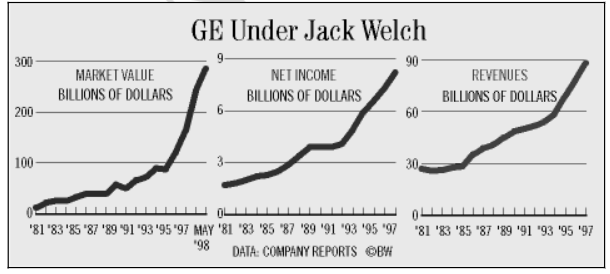 |
Exhibit V
Jack Welch’s Monthly Program
| Early January Sets agenda for the year with top 500 executives at a session in Boca Raton, Fla. March Tracks progress and swaps ideas with top 30 executives at quarterly Corporate Executive Council in Crotonville April/May Goes into the field to each of GE?s 12 businesses for full-day Session C meetings to personally review performance and developmental plans for GE's top 3000 managers. Also sends out a survey to thousands of employees to find out what they're thinking. June Quarterly CEC meeting at Crotonville June/July Spends full day with the leaders of each of GE's businesses to review their three-year strategic plans at headquarters in Fairfield. September Quarterly CEC meeting at Crotonville October Convenes top 140 executives in Crotonville at corporate officers? meeting to set the stage for the upcoming Boca meeting. October/November Invests full day with the leaders of each of GE?s businesses to review budgets. December Quarterly CEC meeting at Crotonville |
Source: BusinessWeek, May 1998
Keywords
Case, GE, Jack Welch, leadership, style, Jack Welch, Chairman, CEO, General Electric, Jack Welch, GE, 1960, 1981, restructuring plan, job cuts, positioning, number one, number two, respective segments, selling off, unprofitable ones, 29 layers, hierarchy, informal company, six sigma, globalization, boundaryless organization