
The Coke Pepsi Rivalry
Details
MKTG002
9
2001
YES
300
The Coca-Cola Company
Food & Beverage
US; India
Marketing Strategy,Advertising & Promotion
Abstract
When the cola giants, Pepsi and Coke, entered the Indian market, they brought with them the cola wars that had become part of global folklore. This case study details the various battles fought in India by the two rivals with its focus on the publicity campaigns where the two sought to steal each other’s fizz. The case also outlines battles fought on other fronts - conflicts with bottles, product modifications, attempts to steal the rival’s employees and other mini wars. On the whole, the case attem-pts to provide a comprehensive perspective regarding the dimensions of the cola wars and the direction in which they are heading.
Learning Objectives
The case is structured to achieve the following Learning Objectives:
- Marketing warfare, Comparative advertising.
Contents
PEPSI VS. COKE
Our real competition is water, tea, nimbupani and Pepsi... in that order.”
- Coke sources in 1996.
“When you’re No 2 and you’re struggling, you have to be more innovative, work better, and be more resilient. If we became No 1, we would redefine the market so we became No 2! The fact is that our competition with the Coca-Cola company is the single most important reason we’ve accomplished what we have. And if they were honest, they would say the same thing.”
- Pepsi sources in 1998.
“Both companies did not really concentrate on the fundamentals of marketing like building strong brand equity in the market, and thus had to resort to such tactics to garner market shares.”
- Business India in 1998.
The cola wars had become a part of global folklore - something all of us took for granted. However, for the companies involved, it was a matter of „fight or succumb.? Both print and electronic media served as battlefields, with the most bitter of the cola wars often seen in form of comparative advertisements.
In the early 1970s, the US soft-drinks market was on the verge of maturity, and as the major players, Coke and Pepsi offered products that looked the same and tasted the same, substantial market share growth seemed unlikely. However, Coke and Pepsi kept rejuvenating the market through product modifications and pricing/promotion/distribution tactics. As the competition was intense, the companies had to frequently implement strategic changes in order to gain competitive advantage. The only way to do this, apart from introducing cosmetic product innovations, was to fight it out in the marketplace.
This modus operandi was followed in the Indian markets as well, with Coke and Pepsi resorting to more innovative tactics to generate consumer interest. The companies were trying to increase the whole market pie, as the market-shares war seemed to get nowhere. This was because both the companies came out with contradictory market share figures as per surveys conducted by their respective agencies - ORG for (Coke) and IMRB for (Pepsi). For instance, in August 2000, Pepsi claimed to have increased its market share for the first five months of calendar year 2000 to 49% from 47.3%, while Coke claimed to have increased its share in the market to 57%, in the same period, from 55%.
Media reports claimed that the rivalry between Coke and Pepsi no longer generated the kind of interest it used to in the initial years of the cola brawls worldwide. They dismissed the brawls as just a lot of noise to hardsell a product that had no inherent merit.
THE PLAYERS
Coke had entered the Indian soft drinks market in the 1970s. The company was the market leader till 1977, when it had to exit the country following policy changes regarding MNCs operating in India. Over the next few years, a host of local brands emerged such as Campa Cola, Thumps Up, Gold Spot and Limca. However, with the entry of Pepsi and Coke in the 1990s, almost the entire market came under their control.
Making billions from selling carbonated/colored/sweetened water for over 100 years, Coke and Pepsi had emerged as truly global brands. Coke was born 11 years before Pepsi in 1887 and, a century later it still maintained its lead in the global cola market. Pepsi, having always been number two, kept trying harder and harder to beat Coke at its own game. In this never-ending duel, there was always a new battlefront opening up somewhere. In India the battle was more intense, as India was one of the very few areas where Pepsi was the leader in the cola segment. Coke re-entered India in 1993 and soon entered into a deal with Parle, which had a 60% market share in the soft drinks segment with its brands Limca, Thums Up and Gold Spot. Following this, Coke turned into the absolute market leader overnight. The company also acquired Cadbury Schweppes' soft drink brands Crush, Canada Dry and Sport Cola in early 1999.
Coke was mainly a franchisee-driven operation with the company supplying its soft drink concentrate to its bottlers around the world. Pepsi took the more capital-intensive route of owning and running its own bottling factories alongside those of its franchisees. Over half of Pepsi's sales were made by its own bottling units.
Though Pepsi had a lead over Coke, having come in before the era of economic liberalization in India, it had to spend the early years fighting the bureaucracy and Parle's Ramesh Chuahan every step of the way. But its strategy of targeting the youth seemed to have paid off. Its performance was praiseworthy, while Coke had to struggle to a certain extent to get its act together. In the 7 years of its operations in the county, Coke changed its CEO four times. There were media reports aplenty about the troubles faced by Coke and the corrective measures it adopted.
THE RIVALRY ON VARIOUS FRONTS
I – BOTTLING:
Bottling was the biggest area of conflict between Pepsi and Coke. This was because, bottling operations held the key to distribution, an extremely important feature for soft-drink marketing. As the wars intensified, both companies took pains to maintain good relationships with bottlers, in order to avoid defections to the other camp.
A major stumbling block for Coke was the conflict with its strategic bottling partner, Ramesh Chauhan of the Parle group of companies. Coke alleged that Chauhan had secretly manufactured Coke's concentrate. Chauhan, in turn, accused coke of backtracking on commitments to grant him bottling rights in Pune and Bangalore and threatened legal action. The matter almost reached the courts and the strategic alliance showed signs of coming apart. Industry observers commented that for a company like Coke that was so heavily franchisee driven, antagonizing its chief bottler was suicidal.
While all this was going on, Pepsi wasted no time in moving in for the kill. It made huge inroads in the north, particularly in Delhi where Chauhan had the franchise, and also snapped up the opportunity to buy up Coke?s bottler Pinakin Shah in Gujarat. Ironically, the Gujarat Bottling Company owned by Shah, also belonged in part to Chauhan for whom the sell-out was a strategic counter-move in his battle with Coke. Coke moved court and obtained an order enforcing its bottler's agreement with the Gujarat company, effectively freezing Pepsi?s right to use the acquired capacity for a year. Later, Coke made a settlement of $10 million in exchange for Chauhan foregoing bottling rights in Pune and Bangalore.
Towards the end of 1997, bottling agreements between Coke and many of its bottlers were expiring. Coke began pressurizing its bottlers to sell out and threatened not to renew their agreements. Media reports claimed that Coke?s bottlers were not averse to joining hands with Pepsi. They said they would rather offer their services to Pepsi than sell out to Coke and discontinue a profitable business. In November 1997, Pepsi made a bid to gain from the feud between Coke and its franchised bottlers. It declared that it was ready to join hands with 'any disgruntled Coke bottler, provided the latter's operations enhanced Pepsi's market in areas where Coke was dominant. ' Pepsi was even willing to shift to a franchisee-owned bottling system from its usual practice of focusing on company-owned bottling systems supplemented by a few franchisee-owned bottling companies, provided it found bottlers who would enhance both the quantity and quality of the bottles, especially in areas where Coke had a substantial marketshare. Pepsi won over Goa Bottling Company, Coke's bottler in Goa and became the market leader in that city
II – ADVERTISING
When Coke re-entered India, it found Pepsi had already established itself in the soft drinks market. The global advertisement wars between the cola giants quickly spread to India as well. Internationally, Pepsi had always been seen as the more aggressive and offensive of the two, and its advertisements the world over were believed to be more popular than Coke's. It was rumored that at any given point of time, both the companies had their spies in the other camp. The advertising agencies of both the companies (Chaitra Leo Burnett for Coke and HTA for Pepsi) were also reported to have insiders in each other?s offices who reported to their respective heads on a daily basis. Based on these inputs, the rival agencies formulated their own plans. These hostilities kept the rivalry alive and healthy. However, the tussle took a serious turn at times with complaints to the Advertising Standards Council of India, and threats of lawsuits.
While Pepsi always relied on advertisements featuring films stars, pop stars and cricket players, Coke had initially decided to focus on Indian culture and use jingles based on Indian classical music. Coke also used aired advertisements that were popular in the West. Somehow, Coke's advertisements missed the Indian pulse by a wide margin. Pepsi soon came to be seen as a 'defender' who had humiliated the 'invader' with its superior creative strengths. When Coke bagged the official sponsorship rights to the 1997 Cricket World Cup, Pepsi created media history by unleashing one of the country's most successful advertisement campaigns - the 'Nothing Official About It' campaign. Pepsi took on Coke, even when the latter sponsored the replays of the matches, through the campaign, 'Uncork a Cola.' Media coverage of the war even hinted that the exclusion of Rahul Dravid (Pepsi's model) from the Indian team had something to do with the war. However, Coke had its revenge when it bagged the television sponsorship rights for the 1997 Pepsi Asia Cup. Consequently, Pepsi was not able to sponsor it.
The severe damage caused by the 'Nothing Official About It' campaign prompted Coke to shift its advertising account from McCann Erickson to Chaitra Leo Burnett in 1997.
The 'Eat-Sleep-Drink' series of ads was born soon after. Pepsi responded with ads where cricket stars 'ate a bat' and 'slept on a batting pad' and 'drank only Pepsi.' To counter this, Coke released a print advertisement in March 1998, in which cricketers declared, 'Chalo Kha Liya!' Another Thums Up ad showed two apes copying Pepsi's Azhar and Ajay Jadeja, with the line, 'Don't be a bunder (monkey), Taste the thunder.' For once, it was Pepsi?s turn to be at the receiving end. A Pepsi official commented, “We're used to competitive advertising, but we don?t make fun of the cricketers, just the ad.” Though Pepsi decided against suing Coke, the ad vanished soon after the dissent was made public. Commenting on this, a Pepsi official said, “Pepsi is basically fun. It is irreverent and whacky. Our rival is serious and has a 'don't mess with me' attitude. We tend to get away with fun but they have not taken it nicely. They don't find it funny.'
The 1998 Football World Cup was another event the cola majors fought over. Pepsi organized local or 'para' football matches in Calcutta and roped in Indian football celebrity Bhaichung Bhutia to endorse Pepsi. Pepsi claimed it was the first to start and popularize 'para' football at the local level. However, Coke claimed that it, and not Pepsi, was the first to arrange such local games, which Coke referred to as 'pada.' While Pepsi advertisements claimed, 'More football, More Pepsi,' Coke utilized the line, 'Eat football, Sleep football, Drink only Coca-Cola,' later replaced by 'Live football, dream football and drink only Coca-Cola.' Media reports termed Pepsi's promos as a 'me-too' effort to cash in on the World Cup craze, while Coke's activities were deemed to be in line with its commitment to and long-term association with the game.
Coke's first offering in the lemon segment (not counting the market leads acquired from Parle) came in the form of Sprite, launched in early 1999. From the very beginning, Sprite went on the offensive with its tongue-in-cheek advertisements. The line 'Baki Sab Bakwas? (All the rest is nonsense) was clearly targeted at Pepsi's claims in its ads. The advertisement made fun of almost all the Pepsi and Mirinda advertisements launched during 1998. Pepsi termed this as Coke's folly, claiming it was giving Sprite a 'wrong positioning,' and that it was a case of an ant trying to fight a tiger. Sprite received an encouraging response in the market, aided by the high-decibel promotions and pop music concerts held across the country. But Pepsi was confident that 7 Up would hold its own and that its ads featuring film stars would work wonders for Mirinda Lemon in the lemon segment.
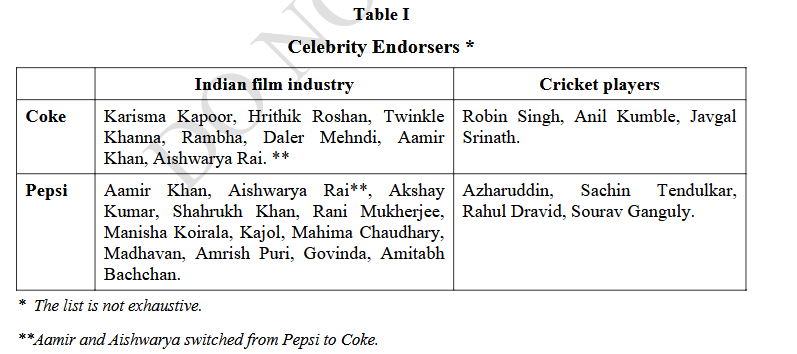
Coke and Pepsi were always engaged in the race to sign the most popular Bollywood and cricket celebrities for their advertisements. More often than not, the companies pitched arch-rivals in their respective fields against each other in the cola wars as well. (Refer Table I). When Pepsi launched an advertisement featuring Sachin Tendulkar with a modified Hindi movie song, 'Sachin Ala Re,' Coke responded with an advertisement using the song, 'Coke Ala Re.' Pepsi moved the Advertising Standards Council of India and the Advertising Agencies Association of India, alleging plagarisation of its 'Sachin Ala Re' creation by Coke's advertising agency, Chaitra Leo Burnett.
In October 2000, following Coke's 'Jo Chaaho Ho Jaaye' campaign, the brand's 'branded cut-through mark,' reached an all-time high of 69.5% as against Pepsi's 26.2%. In terms of stochastic share, Coke had a 3% lead over Pepsi with a 25.5% share. Pepsi retaliated with a campaign making fun of Coke's advertisements. The advertisement had a mixed response amongst the masses with fans of both the celebrities defending their idols. In May 2000, Coke threatened to sue Pepsi over the advertisements that ridiculed its own commercials. Amidst wide media coverage, Pepsi eventually stopped airing the controversial advertisement. In February 2001, Coke went on the offensive with the 'Grow up to the Thums Up Challenge' campaign. Pepsi immediately issued a legal notice on Coke for using the 'Yeh Dil Maange More' phrase used in their commercial. Coke officials, however, declined to comment on the issue and the advertisement continued to be aired.
III – PRODUCT LAUNCHES
Pepsi beat Coke in the Diet-Cola segment, as it managed to launch Diet Pepsi much before Coke could launch Diet Coke. After the Government gave clearance for the use of Aspertame and Acesulfame-K (potassium) in combination (ASK), for use in low-calorie soft drinks, Pepsi officials lost no time in rolling out Diet Pepsi at its Roha plant and sending it to retail outlets in Mumbai. Advertisements and press releases followed in quick succession. It was a major victory for Pepsi, as in certain parts of the world, Coke?s Diet Coke sold more than Pepsi Cola itself. Brand visibility and taste being extremely important in the soft drink market, Pepsi was glad to have become the first-mover once again.
Coke claimed that Pepsi's one-upmanship was nothing to worry about as Coke already had a brand advantage. Diet Coke was readily available in the market through import channels, while Diet Pepsi was rarely seen. Hence, Diet Coke had a brand advantage. Later of course Coke came up with a high-profile launch of Diet Coke. However, as expected, diet drinks, as a percentage of the total cola demand, did not emerge as a major area of focus in the years to come. Though the price of the cans was reduced from Rs 18 to Rs 15 in July 2000, the diet colas failed to catch the fancy of the buyers. In September 2000, both the companies again slashed the price of their diet cans by over 33% per cent to Rs 10. Both the companies were losing Rs 5-6 per can by selling it at Rs 10, but expected the other products to absorb these losses. A Pepsi official said that as the diet cola constituted only about 0.4% of the total market, its contribution to revenue was considered insignificant. However, both companies viewed this segment as having immense potential and the price-cuts were part of a long-term strategy.
Coke claimed that it was passing on the benefit of the 5% cut in excise duty to the consumer. Industry experts, however, believed that the price cut had more to do with piling up inventories. Diet drinks in cans had a rather short shelf life (about two months) and the cola majors were simply clearing stocks through this price cut. However, by 2001, the diet-cola war had almost died out with the segment posting extremely low growth rates
IV – POACHING
Pepsi and Coke fought the war on a new turf in the late 1990s. In May 1998, Pepsi filed a petition against Coke alleging that Coke had „entered into a conspiracy? to disrupt its business operations. Coke was accused of luring away three of Pepsi?s key sales personnel from Kanpur, going as far as to offer Rs 1 mn a year in pay and perks to one of them. This was almost five times what Pepsi was paying him. Sales personnel who were earning Rs 48,000 per annum were offered Rs 0.18 mn a year. Many truck drivers in the Goa bottling plant who were getting Rs 2,500 a month, moved to Coke who gave them Rs 10,000 a month. While new recruits in the soft drinks industry averaged a pay hike of between 40-60%, Coke had offered a 300-400% hike. Coke, in its reply filed with the Delhi High Court, strongly denied the allegations and asked for the charges to be dropped, since Pepsi had not quantified any damages. Pepsi claimed that Coke?s poaching of its staff was causing immense damage as the employees who switched over were carried with them sensitive trade-related information. After some intense bickering, the issue died a natural death with Coke emerging the winner in another round of the battle.
Pepsi also claimed that its celebrity endorsers were lured into breaking their contracts with Pepsi. It alleged that Coke had tried to pressure the Board of Control for Cricket in India (BCCI) to break a sponsorship deal it had signed for the Pepsi Triangular Series. According to Pepsi's deal with BCCI, Pepsi had the first right of refusal to sponsor all cricket matches played in India where up to three teams participated. The BCCI, however, was reported to have tried to break this contract in favor of Coke. Pepsi went to court protesting against this and won. Pepsi also alleged that, Coke's Marketing Director Sanjiv Gupta who was to join Pepsi in 1997 had been lured away by Coke who had made a counter offer.
V – OTHER FRONTS
- Till the late 1980s, the standard SKU4 for a soft drink was 200 ml. Around 1989, Pepsi launched 250 ml bottles and the market also moved on to the new standard size. When Coke re-entered India in 1993, it introduced the 300ml bottle as the smallest bottle size. Pepsi followed suit and 300 ml became the standard. But around 1996, the excise component led to an increase in prices and a single 300 ml purchase became expensive. Both the companies thus decided to bring back the 200 ml bottle. In early 1996, Coke launched its 200 ml bottles in Meerut and gradually extended them to Kanpur, Varanasi, Punjab and Gujarat, and later to the south. Pepsi first tried the 200 ml size in Calcutta around 1997, but withdrew it soon after. Neither company put in any marketing effort behind the 200 ml, as the 300 ml meant higher per-unit intake and more profits for the company, bottler and the retailer. This worked well till 1999 when the growth of the soft drinks market was a mere 5% as compared to the 1998 figure of 20%. Reasoning that the Rs 9 price-point for the 300 ml bottle was hampering growth, Coke and Pepsi re-introduced 200 ml bottles on a grand scale in July (Mini Coke) and December (Chhota Pepsi) 1999 respectively. While Coke invested huge sums on local and regional advertising, (which included POP, cable TV and the regional press) aiming to capture the semi-urban and rural markets, Pepsi?s advertisements were more city-centric.
Based on its previous experience with lower price points, Coke launched Coke Mini in Karnataka at a price of Rs 5, and accompanied this with an extensive billboard campaign across Bangalore. Pepsi hit back with the introduction of „Chhota Pepsi? at Rs 4.50. Though the initial campaign said „Offer till stocks last,? Pepsi later decided to continue with the offer to retain its customer base, till the price war was over. Company sources revealed that it was purely a competition driven move. A Pepsi official commented, 'The 200 ml bottles are unviable even at Rs 6. It is a good price point, but will definitely hurt the bottler and the industry. Perhaps, a 200 ml bottle will be viable at Rs 7. But who will pay Rs 7 for 200 ml, when 300 ml is available at Rs 9?'
By 2001, the 'minis' were retailing at Rs 7 and the 300 ml at Rs 10. As a variant, the 'minis' did prove to be a good venture for the warriors, though they inevitably came with added chances of keeping the companies on red-alert.
- In May 1996, Coke launched Thums Up in blue cans, with four different pictures depicting 'macho sports' such as sky diving, surfing, wind-surfing and snow-boarding. Much to Pepsi's chagrin, the cans were colored blue - the color Pepsi had chosen for its identity a month earlier, in response to Coke's 'red' identity. The move came as a surprise because even Coke executives had started referring to Pepsi as the blue brand and the Pepsi employees as 'the blue guys.' Media reports said this was Coke's move to 'steal Pepsi's thunder.' However, Coke officials denied this and said that they had not adopted the blue color for Thums Up cans on purpose. Also, the Thums Up blue was quite different from the Pepsi blue. Pepsi sources, on the other hand, claimed it as a victory of the blues over the reds.'
- There were frequent complaints from both the players about their bottlers and retailers being hijacked. Pepsi's blue painted retail outlets being painted in Coke's red color overnight and vice-versa was a common phenomena in the 1990s. Even suppliers of Visicoolers, the glass door refrigerators, were aligning themselves with either of the cola players. While Norcool was selling only to Coke, Pepsi was the only customer of Carrier. Norcool, the Norway-based glass door freezer manufacturer owned by the Frigoglass group, admitted that it had started manufacturing operations in India only at the instance of Coke. Over half its global production of Visicoolers was consumed by Coke. Even the choice of the site for its plant at Manesar was driven by the fact that it would be close to the Coke headquarters in Gurgaon. Similarly, though Carrier Commercial Refrigeration, suppliers to Pepsi, had the option of selling to 'other kinds? of consumers, it was a strict 'no-no' for Coke.
- Coke also turned its attention to Pepsi?s stronghold - the retail outlets. Between 1996-98, Coke doubled its reach to a reported 0.5 mn outlets, when Pepsi was present at only 0.35 mn outlets. To reach out to smaller markets, interceptor units in the form of mobile vans were also launched by Coke in 1998 in Andhra Pradesh, Tamil Nadu and West Bengal. However, in its rush to beat Pepsi at the retail game, Coke seemed to have faltered on the service front. For instance, many shops in Uttar Pradesh frequently ran out of stock and there was no servicing for Coke's coolers. Though Coke began servicing retail outlets on a daily basis like Pepsi, it had to wait for a while before it was able to match Pepsi's retailing strengths. One of Coke's victories on the retail front was its tie up with Indian Oil to set up dispensing units at its petrol pumps. Pepsi responded by striking a deal with Bharat Petroleum, whose network was far smaller than Indian Oil?s. Of the estimated 2,50,000 retail outlets in the country that sold soft drinks, Pepsi was stocked only at 2,00,000.
In the late 1990s, Pepsi and Coke kept trying to outdo each other in sponsoring music concerts by leading artists, in order to reach out to the youth. Pepsi tied up with MTV to hold a series of pop concerts across the country, while Coke tied-up with MTV's rival, Channel V for a similar venture. There were frequent skirmishes regarding movie sponsorships and vending rights at leading cinema halls.
In May 1999, the companies were involved in a „freebies war? - promotional schemes designed to expand the cola market, apart from increasing the market share of each. Coke was running as many as 12 volume-building, national-level consumer promotions, while Pepsi had 8 schemes for its brands. Coke's schemes ranged from crown exchanges to under the crown prizes, which included toys, cars, free travel, consumer durables etc. Pepsi had crown exchanges and under the crown prizes as well. It also offered free gifts like cards and tattoos. A huge outlay was involved in promoting these schemes, with frequent media splashes.
IS THE RIVALRY HEALTHY?
In a market where the product and tastes remained virtually indistinguishable and fairly constant, brand recognition was a crucial factor for the cola companies. The quest for better brand recognition was the guiding force for Coke and Pepsi to a large extent. Colorful images, lively words, beautiful people and places, interesting storylines, innovative/attractive packaging and catchy jingles made sure that the cola wars, though often scoffed at, rarely went unnoticed. And that's what it has all been about till now. The management of both the companies have had to constantly adapt to the changing attitudes and demands of their consumers, or lose market share.
The wars seemed to have settled down into a pattern. Pepsi typically won a market, maintained its hold over the market for a few years, and then lost out to a very determined Coke. In the early years, Coke was content with advertising its product to build a strategic positioning for its product. With Pepsi's offensive moves getting stronger and stronger, Coke had no option but to adopt the same modus operandi. Though the market share debates would not have any conclusions, it would be safe to infer that the cola wars were a major factor in keeping customer interest alive in the segment. However, in the late 1990s, questions were raised about the necessity, and more importantly, the efficacy of these wars. Answers for this would be too difficult to ascertain and too shaky to confirm.
QUESTIONS FOR DISCUSSION
1. Analyze the development of the Indian soft drinks market over the years and comment on the emergence of the MNC players as the leaders within a few years of their entry.
2. Comment on the advertising strategies of Coke and Pepsi with specific reference to the comparative and 'spoof' advertisements. Do you think that competition justifies such moves? Give reasons for your answer.
3. Write a brief note on the cola wars waged in areas, other than advertising. Briefly comment on the ethical issues involved in such wars.
4. What shape do you think the cola wars will take in a couple of years from now? Is the consumer becoming indifferent towards them? In such a scenario, is there any other way in which Coke and Pepsi could enhance brand recognition? Elaboratev.
Keywords
Pepsi, Coke, Indian market, cola wars, global folklore, India, publicity campaigns, fizz, conflicts, bottles, product modifications, comprehensive perspective, cola wars, comparative advertising, merits, demerits, marketing warfare, competitive market