
The Siyaram Celebrity Endorsement Experience
Details
MKTG018
7
2001
YES
200
Siyaram Silk Mills Ltd
Textiles & Apparel
India
Advertising & Promotion
Abstract
The case, ‘The Siyaram Celebrity Endorse-ment Experience’ examines how and why the cricket match-fixing scandal in 2000 forced textile company Siyaram Silk Mills to with-draw an advertisement campaign for its suiting brand J.Hampstead. The case also provides a brief introduction to the concept of celebrity endorsement. The case is so structured as to enable students to see how celebrity endorsement created problems for Siyaram. Students can get an idea of the advantages and disadvantages of celebrity endorsement.
Learning Objectives
The case is structured to achieve the following Learning Objectives:
- Celebrity endorsements, Marketing communication strategy.
Contents
THE CRONJE SCANDAL
“We have enough of film stock for a whole year. Unfortunately we can’t use them anymore.”
- N Gangadhar, General Manager (Marketing), Siyaram Silk Mills, commenting on the withdrawal of the J Hampstead advertisement campaign, in April 2000.
In April 2000, the New Delhi police unearthed one of the biggest scandals ever to hit the world of cricket. While investigating a local corruption case, officials recorded phone conversations between Hansie Cronje (Cronje), the captain of the South African cricket team, and Sanjeev Chawla, a London-based Indian businessman. The conversation in the tapes seemed to implicate both men in illegal betting on a match played in February 2000 in India. After initial denials, Cronje conceded that he had accepted $ 15,000 to fix the match1. The news shocked both cricket fans and the media alike - Cronje's face was smeared with black paint on posters across the country.
Siyaram Silk Mills Ltd. (Siyaram), one of India's leading textile companies, was also affected badly by this controversy. Hansie Cronje was one of the key celebrity endorsers for Siyaram's J.Hampstead brand of clothing. The campaign featuring Cronje had been running on the print, electronic and outdoor media from March 2000. Siyaram and its advertising agency, Percept, watched in dismay as their celebrity endorser turned into an internationally hated sportsman overnight. The issue raised a heated debate in corporate and media circles regarding the perils of using celebrity endorsement. Percept sources commented, “This mess is horrible.”
Siyaram pulled down all the billboards featuring the entire South African team across the country. The J.Hampstead campaign was completely withdrawn, almost 20 days before it completed its scheduled run on hoardings and television. The „match-fixing? scandal seemed all set to force Siyaram – and other Indian companies – to rewrite the rules of using celebrity endorsement as an integral part of their media plans.
BACKGROUND NOTE
Siyaram was a part of the Siyaram Poddar Group of companies, which had a turnover of $ 209 billion in 2000-01. The group, founded in 1954, was into the textile (yarns, fabrics and garments), paper/paperboards and tyre (rubber tyres and tubes) businesses. While Govind Rubber Ltd. (GRL) was into the auto and bicycle tyres and tubes business, Balkrishna Industries Ltd. (BIL) was into the manufacturing of paperboards, tyres/tubes and synthetics. Siyaram's businesses comprised fabrics and readymade garments. Its popular brands included Oxemberg (shirts, trousers and jeans) and J.Hampstead (wool fabric).
Siyaram was incorporated in June 1978 as a private limited company and was converted into a public limited company in 1980. Siyaram Finance, its subsidiary, was into the financial services business. Siyaram manufactured and marketed textiles, cotton, woollen synthetics and synthetic blends – the main product being polyester blended worsted2 fabrics. In July 1993, Siyaram came out with a Rs 153 million rights issue to part-finance a Rs 165 million expansion-cum-modernization project. While the family held 23% of the Rs 51 million equity, foreign collaborators, FIs and the public held 26%, 22% and 8% respectively.
Siyaram had a strong presence in the lower and medium segment of the domestic suitings market. The company had three manufacturing plants situated at Thane and Raigad in Maharashtra and Silvassa in the union territory of Dadra & Nagar Haveli, producing over 27.5 million meters of fabrics annually. Siyaram had a 4% market share in the Rs 50 billion suitings and shirtings market. The other players included Vimal, Mayur, Raymond, Digjam, Gwalior and Reid & Taylor etc.
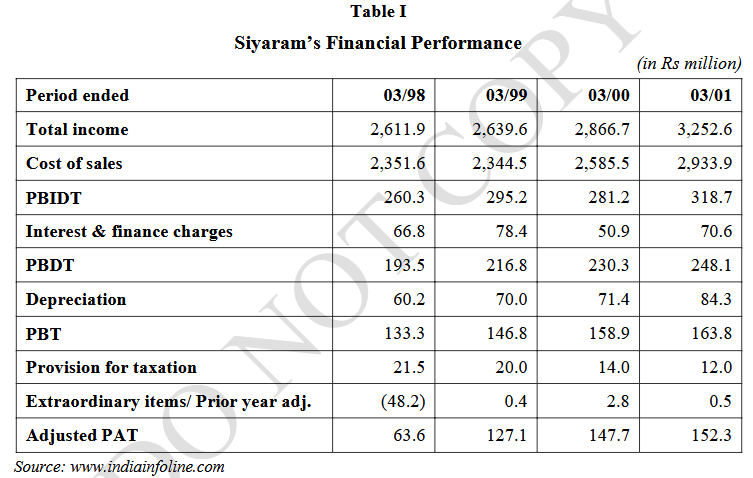
Siyaram retailed its products through 25 exclusive showrooms, besides its distributor network of about 400 wholesale dealers and 50,000 retailers across the country. (The number of exclusive showrooms was to be increased to 75 by August, 2002.) The company also exported its products to Europe, South America, South Africa, the Far East and the Gulf countries. Siyaram's sales increased from Rs 20 million in 1978 to Rs 3252.6 million in 2000-01. Table I provides a summary of the company's financial performance.
Siyaram was one of the few non-FMCG companies in India that was known for its lavish advertisements. The 'Coming Home To Siyaram' campaign was reported to be one of Indian advertising's costliest campaigns. The 'Coming Home To Siyaram' advertisements were much talked about for being of much longer duration than the usual advertisements, and also for the huge budgets Siyaram set aside for them. The company believed that good commercials helped it to effectively position its suitings on a global platform. Siyaram officials said the company's focus on marketing was responsible to a great extent for its growth over the years.
Percept had conceptualized the 'Coming Home to Siyaram' campaign in the early 1990s. Over the years, the campaign established the brand's association with 'true love for the motherland,' by showing successful men maintaining lasting, strong ties with their families. Analysts commented that the campaign was largely responsible for Siyaram?s high brand recall and positive consumer feedback.
As part of its brand-building initiatives, Siyaram also organized major sporting events like the triangular cricket series – Siyaram's Cup, 1997 and Siyaram's Celebrity Soccer 1998. The company also held Siyaram fabric shows, aimed at increasing awareness among its target audience about the company's range of products. For 2001-02, Siyaram had increased its advertising and promotion budget to Rs 300 million from the 2000-01 level of Rs 200 million.
THE J.HAMPSTEAD STORY
J.Hampstead was a very popular suiting brand in Europe, renowned for its premium 100% wool suitings woven from rich natural fibers like merino wool, cashmere and woolsilk. In 1995, Siyaram tied up with J.Hampstead for marketing its suitings in India. The company imported the fabric from Italy. It was priced in the range of Rs 1,500-1,600 per meter. In September 1997, Siyaram decided to begin manufacturing the brand at its plants with technical assistance from J.Hampstead. The product was slightly different from the imported version and was priced in the range of Rs 275-1000 per meter. Explaining the reason for the decision, Gangadhar said, "The imported J Hampstead faced two problems: that of maintenance and price. The imported product had to be dry-cleaned and steam-ironed. The Indian fabric can be hand washed."
Siyaram earmarked around Rs 50 million for the marketing, sales and promotion of J Hampstead. The first phase of this promotion was in the form of commercials featuring Indian tennis superstars Leander Paes and Mahesh Bhupati. These commercials with the positioning line, 'The finest fabric in the world,' were aimed at positioning the brand in the premium segment.
In September 1999, Siyaram held a tennis carnival to promote J.Hampstead, where several Hindi film stars were invited to play tennis with the brand ambassadors. Soon after, Siyaram faced problems with the tennis duo when they decided to break their partnership, reportedly due to personal problems. However, the company continued running the advertisements. Company officials justified this, claiming that the 'sport was bigger than the players.'
In February 2000, Siyaram signed the South African cricket team for promoting the brand. The multi-media promotion was spread over television, satellite channels, print, outdoor and point of purchase advertising. Gangadhar said, “We have taken this opportunity to associate ourselves with the number one ranked cricket team as they will be popular in the coming series of cricket matches. And this will enable the brand to be globally focused. The idea of such a campaign is also to send the message that the product is of international quality. In India where cricket is almost a religion, these models can be easily identified by both the masses as well the classes.”
Siyaram had decided to use the South African team on the recommendation of Percept. Gangadhar said, “All along, the South African team had a clean image. So we had signed up the entire team and not just one individual. When they were coming to Bombay (for the match), we thought it was a very good opportunity and so decided to shoot with them for the ads.” Shailendra Singh, Joint Managing Director, Percept, said, “Our brief is to project J Hampstead as a global fashion brand. It is a high fashion brand that is successful and sincere. Consciously, we thought that Hansie Cronje has a 82% success rate and nine years? experience as a captain.” The advertisements featured the entire South African team wearing the J Hampstead premium suitings.
Within a month of the campaign being released in the national media, the Cronje controversy surfaced. Siyaram continued to run the advertisements in newspapers for a few days after the scandal broke. However, the company decided to withdraw the campaign completely soon after. Gangadhar denied that the Hampstead brand image had been affected. He said, “I have had calls from well-wishers who say that no one could have anticipated this. We do things right and in the right spirit. And if something goes wrong all we can do is make amends for it. The brand is bigger than any individual.”
A Percept official said, “Thankfully, the campaign was not centered on one single player but the entire team. Hence it is not so bad after all. We are also recovering from the incident.” He added, “We have used multiple personalities for the ad. We have not focussed just on Cronje. It is the entire 14-member South African team that we have signed up. So, we never let the personality become the brand itself.”
Siyaram's strategy of opting for multiple brand endorsements seemed to have diluted the impact of the scandal on the brand. The company began working on a new series of commercials featuring the Leander/Mahesh duo, but dropped them as the brand ambassadors in October, 2000. Though company sources denied that they had given up the celebrity endorsement route for J.Hampstead, the perils of celebrity endorsement began to be seriously examined by Indian companies and advertising agencies.
THE CELEBRITY ENDORSEMENT ISSUE
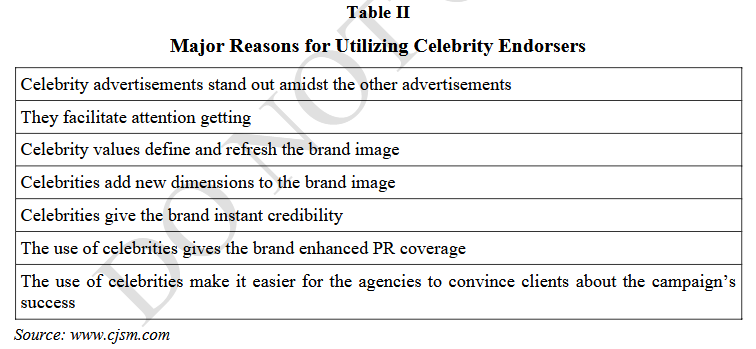
Celebrity endorsements began way back in the 19th century with UK's Queen Victoria endorsing Cadbury's Cocoa. Using celebrities for promotion has been a common marketing communications strategy, practiced globally. Marketers believe celebrity endorsers are more effective than non-celebrity endorsers in generating actual sales from the customers, and positively influence the consumption of the products they are associated with. The fact that celebrities remain in constant media focus helps create high recall rates for the commercials that feature them. Their attractive qualities are transferred to the product being promoted. Some of the main reasons for companies using celebrity endorsers are given in Table II.
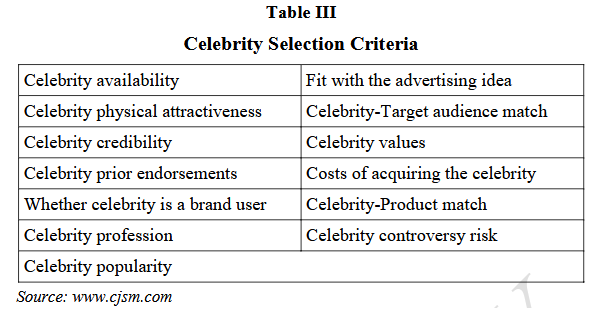
However, selecting the right celebrity endorsers is usually a tough task. A wrong choice can ruin the image of a brand. (Table III gives the criteria used for selecting a celebrity.) The acceptance of an advertisement message is largely determined by the attractiveness of the celebrity presenting the message. Also, the message conveyed by the celebrity must match the product message. Relevance is a very important factor in celebrity endorsements. If there is very little fit between the celebrity and the brand personae, the advertisement could prove counter-productive. Interestingly, the selection of Hansie Cronje for J.Hampstead was criticized on these very grounds by an executive from the advertising agency Ogilvy & Mather. He said, “Cronje is such a casual chap and he looks so awkward and uncomfortable in a suit.” The man behind the popular Pepsi ads, filmmaker Prahlad Kakkar said, “J Hampstead is a perfect example of using a celebrity without a script.”
In India, celebrity endorsements are believed to be particularly useful as the average consumer reportedly identifies more strongly with celebrities than in other countries. Film stars and sports personalities (especially cricket players) are immensely popular among the masses. This has encouraged the widespread use of celebrities in advertisements over the decades.
However, celebrity endorsements could become a 'double-edged sword' for most companies. A popular star can help immensely in improving brand image and recall. But the same star can cause major problems for the brand if he or she lands in trouble – either in their careers or in their personal lives. Pepsi faced this problem with two of its most popular celebrity endorsers – pop singers Michael Jackson and Madonna. In 1989, right after Pepsi aired the first Madonna commercial, the singer released her sexually explicit and reportedly anti-Christianity music video 'Like A Prayer' on Music Television. The video led to widespread protests against the singer and Pepsi had to pull out the advertisement after airing it just twice. Michael Jackson was signed by Pepsi in 1983 in what was the largest individual sponsorship deal in history. In 1993, Michael Jackson was charged with child abuse. Though the charges were not proved, Pepsi had to pull out of the contract after unprecedented media outrage against the brand's association with the singer.
Another peril associated with celebrity endorsement is the 'vampire effect,' when the celebrity overshadows the brand. Also, whether the celebrity endorsing a brand actually uses the brand or not is an issue of concern. For instance, if a celebrity endorsing Pepsi is seen drinking Coke, it can reflect very badly on the brand being endorsed.
THE AFTERMATH
Cronje had to resign from the South African team and was barred from playing cricket ever again. In South Africa, the Spur Restaurant Chain in Johannesburg ended a multi-million rand-advertising contract with Cronje. The controversy heated up in the next few weeks, with many more Indian and international cricket players being named as parties to illegal match fixing. It was reported that the Board of Control for Cricket in India (BCCI) and the Mumbai/Dubai underworld were also involved in the scandal. There were even rumors of South Africa and India suspending diplomatic ties.
The Indian companies who sponsored cricket matches and utilized cricket players as endorsers were however, reported to be unfazed by the developments. Asserting that the J.Hampstead association with sports (and cricket) would continue, Singh commented, “Let's not kill the sport for one moronic guy.” By the end of the year, the Cronje scandal seemed to have died a natural death and cricket sponsorship by Indian corporates continued.
Siyaram meanwhile, revealed its plans to achieve a turnover of Rs 4 billion for the fiscal 2001-02. J.Hampstead's contribution to the turnover was expected to rise from Rs 400 million in 1999-00 to Rs 750 million. In September 2001, the company launched a new campaign for J.Hampstead, with the new baseline 'One World One Fabric.' The campaign did not feature any sport or celebrity. Instead, international models were featured to reinforce the fabric's global appeal.
Media analysts were quick to point out that having learnt its lessons from the Leander/Bhupati and Cronje issues, Siyaram was deliberately trying to 'play it safe' this time around by avoiding celebrity endorsements for J.Hampstead.
QUESTIONS FOR DISCUSSION
1. Why do you think Siyaram did not opt for the celebrity endorsement route for its September 2001 J.Hampstead campaign? Do you think the company had made a mistake in its choice of celebrities earlier? Give reasons to justify your stand.
2. As a media planner, comment on the efficacy of celebrity endorsements in general and about their effectiveness in India in particular. Do you think advertisement agencies use these campaigns because they are an easy way of attracting attention?
Keywords
The Siyaram Celebrity Endorsement Experience, cricket match-fixing, 2000, textile company, Siyaram Silk Mills, advertisement campaign, J.Hampstead, celebrity endorsement, advantages, disadvantages, celebrity endorsement