
The McDonald’s ‘Beef Fries’ Controversy
🌐 International Buyers — Pay via PayPal
Details
BECG017
13
2002
YES
0
McDonald's Corporation
Foodservice
US
Accountability,Reputation Management
Abstract
The case examines the controversy involving the global fast food major McDonald’s, which was accused of wrongfully selling its French fries as 100% vegetarian products when they contained beef flavoring. It explores in detail the events that led to the controversy and the company’s reactions to the allegations. The case also discusses the eventual settlement of the lawsuit with the company paying damages to vegetarian groups and accepting that it had gone wrong.
Learning Objectives
The case is structured to achieve the following Learning Objectives:
- Social responsibility
- Truth in advertising
- Consumer interest groups.
Contents
“Hindus and vegetarians all over the world feel shocked and betrayed by McDonald's deception and ultimate greed.”
- Attorney Harish Bharti, on filing the lawsuit against McDonald’s, in May 2001.
“These are the ways the fries are made in the US, and we don’t have any plans to change.”
- Walt Riker, McDonald’s spokesperson, in May 2001.
In May 2001, a class action lawsuit1 was filed against the world‘s largest fast-food chain McDonald‘s, in Seattle, US. The lawsuit alleged that the company had, for over a decade, duped vegetarian customers into eating French fries that contained beef extracts. The lawsuit followed a spate of media reports detailing how the French fries served at McDonald‘s were falsely promoted as being '100% vegetarian.'
Although McDonald‘s initially declined to comment on the issue, the company issued a 'conditional apology,' admitting to using beef flavoring in the fries. The furore over the matter seemed to be settling down, when to McDonald‘s horror, some of its restaurants in India were vandalized. Activists of Hindu fundamentalist groups – the Shiv Sena, the Vishwa Hindu Parishad (VHP) and the Bajrang Dal, staged a demonstration in front of the McDonald's head office in Delhi protesting the alleged use of beef flavouring. They submitted a memorandum to the Prime Minister, demanding the closure of all McDonald‘s outlets in the country.
Activists also staged protests in front of McDonald's restaurants in south Mumbai and Thane. Mobs ransacked the outlet at Thane, broke the glass panes and smeared the McDonald's mascot Ronald with cow dung. About 30 people were arrested and later let off on bail. Company officials estimated the loss to the outlet at Rs 2 million.
Officials at McDonald‘s India quickly announced that the vegetarian products served in India did not have any non-vegetarian content (Refer Exhibit I for details). However, despite this reassurance, the anti-McDonald‘s wave refused to die down.
Meanwhile, more cases were being filed against McDonald‘s – this time in California, US and Canada. It seemed certain that the company would have to shell out millions of dollars to settle the class action lawsuit representing the 1 million US based Hindus and 15 million other vegetarians.
McDonald's was started as a drive-in restaurant by two brothers, Richard and Maurice McDonald in California, US in the year 1937. The business, which was generating $ 200,000 per annum in the 1940s, got a further boost with the emergence of a revolutionary new concept called 'self-service.' The brothers designed their kitchen for mass production with assembly line procedures. Prices were kept low. Speed, service and cleanliness became the critical success factors of the business. By mid-1950s, the restaurant‘s revenues reached $ 350,000. As word of their success spread, franchisees started showing interest. However, the franchising system failed because the McDonald brothers observed very transparent business practices. As a consequence, they encouraged imitators who copied their business practices and emerged as competitors. The franchisees also did not maintain the same standards for cleanliness, customer service and product uniformity.
At this point, Ray Kroc (Kroc), an exclusive distributor for milkshake machines expressed interest in the McDonald brothers' business. Kroc finalized a deal with the McDonald brothers in 1954. He established a franchising company, the McDonald System Inc. and appointed franchisees. In 1961, he bought out the McDonald brothers‘ share for $2.7 million, and changed the name of the company to McDonald's Corporation. In 1965, McDonald‘s went public.
By the end of the 1960s, Kroc had established over 400 franchising outlets. McDonald's began leasing/buying potential store sites and then subleased them to franchisees initially at a 20% markup and later at a 40% markup. To execute this, Kroc set up the Franchise Realty Corporation. The real estate operations improved McDonald's profitability. By the end of the 1970s, McDonald‘s had over 5000 restaurants with sales exceeding $3 billion.
However, in the early 1990s, McDonald‘s was facing problems due to changing customer preferences and increasing competition. Customers were becoming increasingly health conscious and they wanted to avoid red meat and fried food. They also preferred to eat at other fast food joints that offered discounts. During this time, McDonald‘s also faced increased competition from supermarkets, convenience stores, mom and dad delicacies, gas stations and other outlets selling reheatable packaged food. McDonald‘s added only 195 restaurants during 1991-92.
In 1993, McDonald's finalized an arrangement for setting up restaurants inside Wal-Mart retail stores. The company also opened restaurants in gas stations owned by Amoco and Chevron. In 1996, McDonald's entered into a $1 billion 10-year agreement with Disney. McDonald‘s agreed to promote Disney through its restaurants and opened restaurants in Disney‘s theme parks. In 1998, McDonald‘s took a minority stake in Chipotle Mexican Grill – an 18-restaurant chain in the US. In October 1996, McDonald‘s opened its first restaurant in India.
By 1998, McDonald‘s was operating 25,000 restaurants in 116 countries, serving more than 15 billion customers annually. During the same year, the company recorded sales of $36 billion, and net income of $1.5 billion. McDonald‘s overseas restaurants accounted for nearly 60% of its total sales. Franchisees owned and operated 80% of McDonald‘s restaurants across the globe. However, much to the company's chagrin, in 1998, a survey in the US revealed that customers rated McDonald's menu as one of the worst-tasting ever.
Undeterred by these developments, the company continued with its expansion plans and by 2001, it had 30,093 restaurants all over the world with sales of $ 24 billion (Refer Exhibit I for key statistics of McDonald‘s). By mid 2001, the company had 28 outlets in India, spread across New Delhi, Bombay, Pune, Jaipur and on the Delhi-Agra highway.
McDonald's has had a long history of lawsuits being filed against it. It had been frequently accused of resorting to unfair and unethical business practices – October 16th is even observed as a 'World anti-McDonald's day.' In the late 1990s, the company had to settle over 700 incidents of scalding coffee burns. Reportedly, McDonald's kept the coffee at 185 – approximately 20 hotter than the standard temperature at other restaurants – which could cause third degree burns in just 2-7 seconds. An 81-year old woman suffered third degree burns on her lower body that required skin grafts and hospitalisation for a week. After McDonald‘s dismissed her request for compensation for medical bills, she filed a lawsuit against the company.
A McDonald's quality assurance manager testified in the case that the company was aware of the risk of serving dangerously hot coffee, but it had no plans to lower the temperature or to post a warning on the coffee cups about the possibility of severe burns. In 1994, the court declared McDonald‘s guilty of serving 'unreasonably dangerous' hot coffee. The court awarded punitive damages of $ 2.7 million dollars, which was later lowered to $ 480,000.
The company also had to settle multi-million dollar lawsuits in many other cases such as the one filed by a woman who was permanently scarred by an extremely hot pickle slice in a hamburger and a customer who found the crushed head of a rat inside his hamburger. There were a host of other allegations against the company (Refer Table I for some notable allegations).
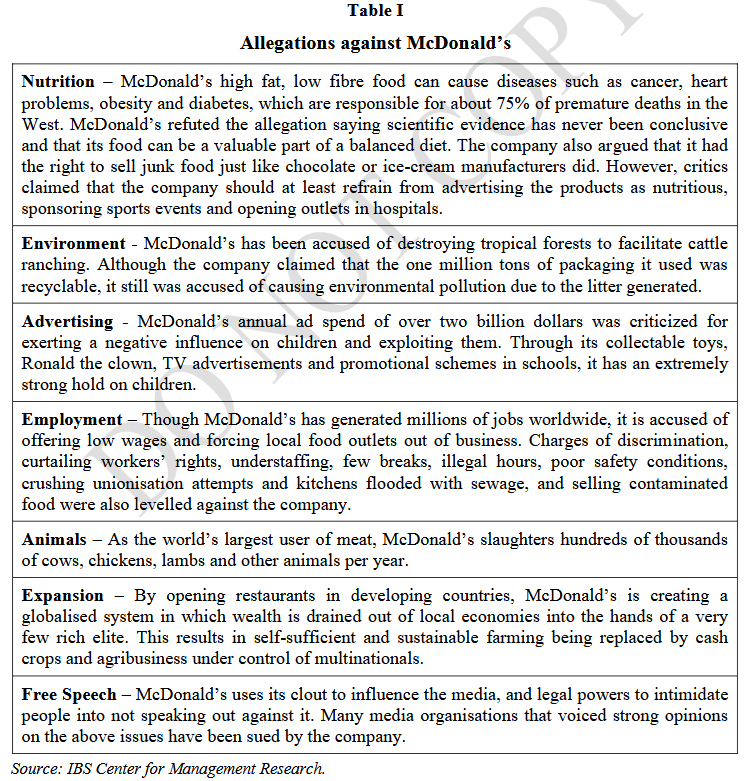
Most of these allegations were made way back in the early 1980s in a movement spearheaded by two London Greenpeace activists Helen Steel (Steel) and Dave Morris (Morris). They started their protests by distributing leaflets containing allegations against the company. Soon, the issue snowballed into a bitter £ 10 million courtroom battle against the activists.
The company was severely criticized for hiring detective agencies to break into the activist group. According to an analyst, 'The company had employed at least seven undercover agents to spy on Greenpeace. During some London Greenpeace meetings, about half the people in attendance were corporate spies. One spy broke into the London Greenpeace office, took photographs, and stole documents. Another had a six-month affair with a member of London Greenpeace while informing on his activities.'
Steel and Morris were later found to have libelled McDonald‘s by a British court. However, the company was also found guilty of endangering the health of its customers and paying workers unreasonably low wages. The case, chronicled completely at www.mcspotlight.org, has become a classic example of a corporate giant's struggle to uphold its image amidst allegations of unethical practices.
In the light of the company's chequered history of legal problems, the French fries controversy seemed 'run-of-the-mill.' However, when McDonald's issued a conditional apology, the matter acquired serious undertones. This was because it was one of the very few instances where the company seemed to have publicly acknowledged any kind of wrong-doing.
With an overwhelming majority of the people in the West being non-vegetarian, products often contain hidden animal-based ingredients. Incidents of vegetarians finding non-vegetarian food items in their food abound throughout the world. Whether a person has chosen to be a vegetarian for religious, health, ethical or philosophical reasons, it is not easy to get vegetarian food in public restaurants. According to the manager of a Thai food cafe in the US, 'We have a lot of customers already. We don‘t need to have any vegetarian food.' Commenting on this dilemma, a US based Hindu vegetarian said, 'We can‘t blame anybody. You have to find out for yourself. If you have any doubts, try to avoid it. Otherwise, you just have to close your eyes and try to eat.'
The French fries controversy began in 2000, when a Hindu Jain software engineer Hitesh Shah (Shah) working in the US happened to read a news article, which mentioned that the French fries at McDonald's contained beef. Shah sent an e-mail to McDonald's customer service department, asking whether the French fries contained beef or not and if they did, why this was not mentioned in the ingredient list. Shah soon got a reply from Megan Magee, the company‘s Home Office Customer Satisfaction Department.
The reply stated, 'Thank you for taking time to contact McDonald's with your questions regarding the ingredients in our French fries. For flavor enhancement, McDonald's French fry suppliers use a miniscule amount of beef flavoring as an ingredient in the raw product. The reason beef is not listed as an ingredient is because McDonald's voluntarily (restaurants are not required to list ingredients) follow the 'Code of Federal Regulations‘ (required for packaged goods) for labeling its products. As such, like food labels you would read on packaged goods, the ingredients in 'natural flavors' are not broken down. Again, we are sorry if this has caused any confusion.'
A popular Indian-American newspaper 'West India' carried Shah's story. The news created widespread outrage among Hindus and vegetarians in the US. In May 2001, Harish Bharti (Bharti), a US based Indian attorney filed the class action lawsuit against McDonald's.
McDonald's immediately released a statement saying it never claimed the fries sold in the US were vegetarian. A spokesperson said that though the fries were cooked in pure vegetable oil, the company never explicitly stated that the fries were appropriate for vegetarians and customers were always told that the flavor came partly from beef. He added that it was upto the customer to ask about the flavor and its source. This enraged the vegetarian customers further. Bharti said, 'Not only did they deceive millions of people who may not want to have any beef extraction in their food for religious, ethical and health reasons, now McDonald‘s is suggesting that these people are at fault, that they are stupid. This adds insult to injury.'
Interestingly enough, McDonald's statement that it never claimed its French fries were vegetarian was proved completely wrong after Bharti found a 1993 letter sent by the company's corporate headquarters to a consumer in response to an inquiry about vegetarian menu items. The letter clearly bundled the fries along with garden salads, whole grain cereals and English muffins as a completely vegetarian item.
The letter stated, 'At McDonald's, we are always reviewing our menu, developing new products and looking for ways to satisfy the diverse tastes of our customers. We feel it is important to offer a variety of menu items that can be enjoyed and fit into any well-balanced diet. With that in mind, we presently serve several items that vegetarians can enjoy at McDonald‘s – garden salads, French fries and hash browns (cooked in 100% vegetable oil), hotcakes, scrambled eggs, whole grain cereals and English muffins to name a few.' Further, it was reported that many McDonald's employees repeatedly told customers that there was absolutely no meat product in the fries.
The whole controversy rested on a decision McDonald's had taken in 1990 regarding the way French fries were prepared. Prior to 1990, the company made the fries using tallow. However, to address the increasing customer concern about cholesterol control,5 McDonald‘s declared that it would use only pure vegetable oil to make the fries in the future. However, after the decision to change from tallow to pure vegetable oil, the company realized that it could have difficulty in retaining customers who were accustomed to beef flavored fries.
According to Eric Scholsser, author of the best-selling book 'Fast Food Nation: The Dark Side of the All-American Meal,' "For decades, McDonald's cooked its French fries in a mixture of about 7% cottonseed oil and 93% beef tallow. The mix gave the fries their unique flavor." This unique flavor was lost when tallow was replaced by vegetable oil. To address this issue, McDonald's decided to add the 'natural flavor,' i.e. the beef extract, which was added to the water while the potatoes were being partially cooked.
The 'beef fries' controversy attained greater dimensions in India as 85% of the country's population was vegetarian. Non-vegetarians also usually did not consume beef because Hindus consider cows to be holy and sacred. Eating beef thus a sacrilege. A US based Hindu plaintiff in one of the lawsuits said, "I feel sick in the morning every day, like I want to vomit. Now it is always there in my mind that I have done this sin."
Experts commented that the issue was not of adding beef extract to a supposedly vegetarian food item – it was more to do with the moral and ethical responsibility of a company to be honest about the products and services it offered. According to James Pizzirusso, founder of the Vegetarian Legal Action Network at George Washington University, "Corporates need to pay attention to consumers who avoid certain food products for religious or health reasons, or because they have allergies. They say they are complying with the law in terms of disclosing their ingredients, but they should go beyond the law."
While it was true that McDonald's complied with the Federal Food and Drug Administration (FDA) guidelines by classifying beef extract as 'natural flavor,' critics claimed that the company was trying to 'play with words' to brush off the allegations. This prompted analysts to remark that a large part of the blame was with the weak guidelines stipulated by the FDA. The guidelines did not require the flavor companies or the restaurants buying these flavors to disclose the ingredients in their additives as long as they were generally regarded as safe (GRAS). Analysts added that as long as the FDA did not make the guidelines more specific, companies could legally get away with serving dishes containing animal-based products.
Meanwhile in June 2001, another class-action lawsuit was filed in the District Court in Travis County, Austin, Texas on behalf of all Hindus in Texas, alleging that Hindu moral and religious principles had been violated by their unintentional consumption of French fries that were flavored with beef. As public outrage intensified, McDonald's released its conditional apology on its website, admitting that the recipe for the fries used a 'a miniscule trace of beef flavoring, not tallow' (Refer Table II for McDonald‘s response to the allegations).
McDonald‘s said that it issued an apology only to provide more details about its products to customers. A company spokesperson said, 'Customers responded to the news about the lawsuit. In the end, we are responding to those customers. We took a fresh look at how we could help customers get more information about natural flavors."
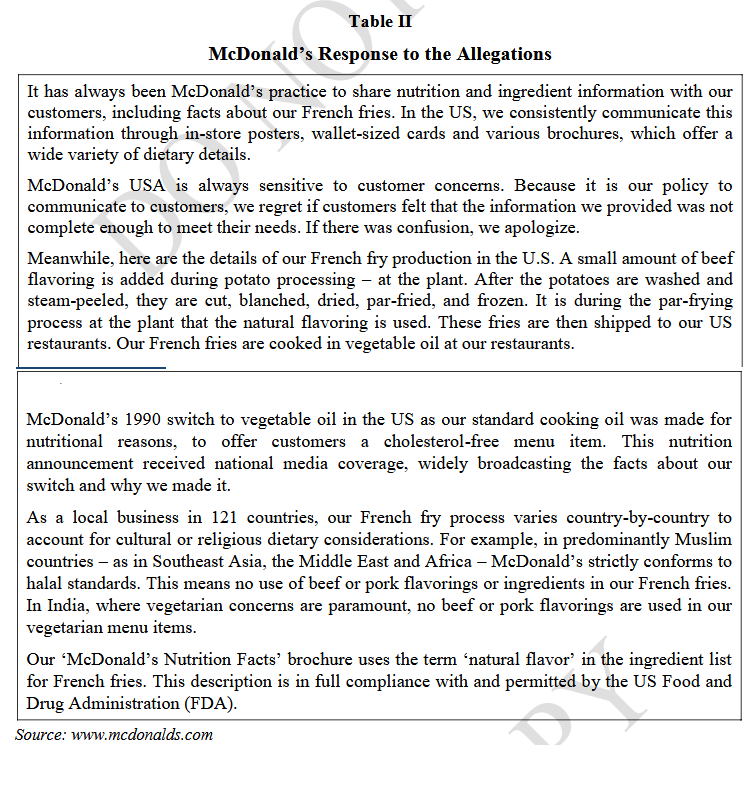
Unsatisfied by the apology, Bharti said, "Apology is good for the soul if it comes from the heart. It is not an unconditional apology. Why do they go around using words like 'if there was any confusion' in their apology?" Further, news reports quoting company sources said that the apology did not mean McDonald‘s was admitting to claims that it misled million of customers by adding beef extract to its fries. Bharti said that the legal battle would continue and that McDonald‘s would have to issue an unconditional apology and pay a substantial amount of money. By this time, two more lawsuits were filed in Illinois and New Jersey, taking the total number cases of five.
The courtroom battle had entered the 11th month when McDonald's announced that it would issue a new apology and pay $ 10 million to vegetarians and religious groups in a proposed settlement of all the lawsuits in March 2002. Around 60% of this payment went to vegetarian organizations and the rest to various groups devoted to Hindus and Sikhs, children‘s nutrition and assistance and kosher dietary practices.
The company also decided to pay $ 4,000 each to the 12 plaintiffs in the five lawsuits and post a new and more detailed apology on the company website and in various other publications. McDonald's also decided to convene an advisory board to advise on vegetarian matters.
In April 2002, McDonald's planned to insert advertisements in newspapers apologizing for its mistakes, "We acknowledge that, upon our switch to vegetable oil in the early 1990s for the purpose of reducing cholesterol, mistakes were made in communicating to the public and customers about the ingredients in our French fries and hash browns. Those mistakes included instances in which French fries and hash browns sold at US restaurants were improperly identified as vegetarian. We regret we did not provide these customers with complete information, and we sincerely apologize for any hardship that these miscommunications have caused among Hindus, vegetarians and others."
Unhappy with the monetary compensation the company was offering, Bharti said, "Wish I could do better in terms of money. But our focus was to change the fast food industry, and this is a big victory for consumers in this country because we have brought this giant to this."
Though $ 10 million was definitely a pittance for the $ 24 billion McDonald‘s, what remained to be seen was whether the case would set a precedent and make corporates throughout the world more aware and responsible towards their customers or not.
1. Analyze the various allegations levelled against McDonald's before the French fries controversy. Why do you think the company attracted so much hostility and criticism despite being the number one fast food chain in the world?
2. Discuss the French fries controversy and critically comment on the company's stand that it had never claimed the fries were vegetarian. Do you think the company handled the controversy effectively? Give reasons to support your answer.
3. Discuss the steps taken by McDonald‘s to play down the French fries controversy and critically comment whether the company will be able to come out of this unscathed.
Exhibit I
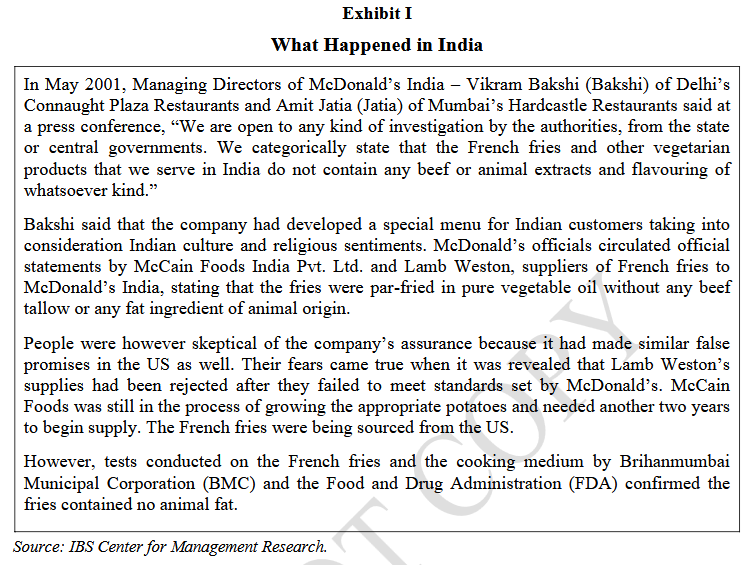
Exhibit II
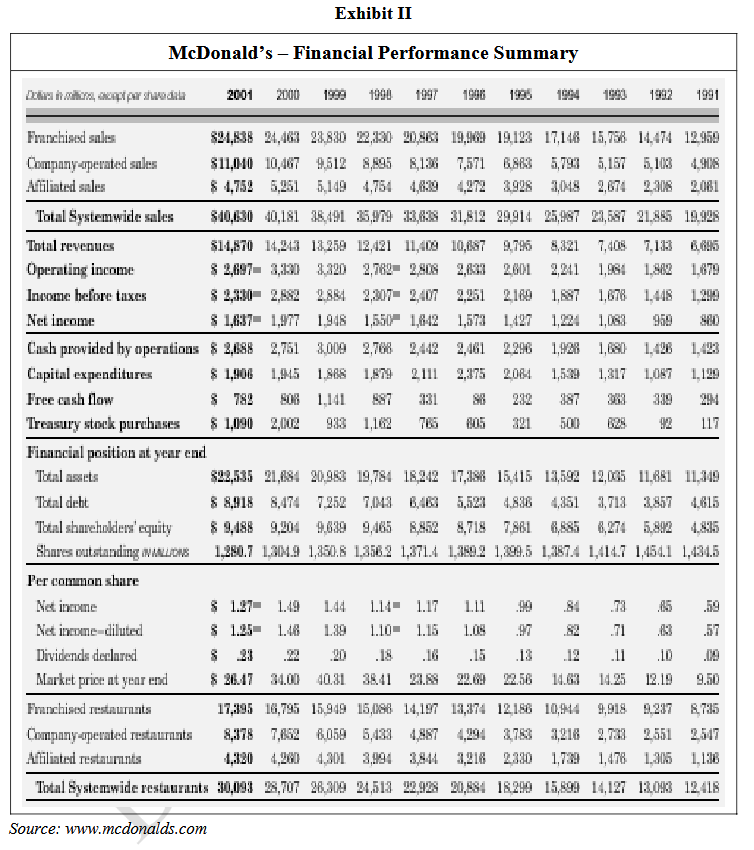
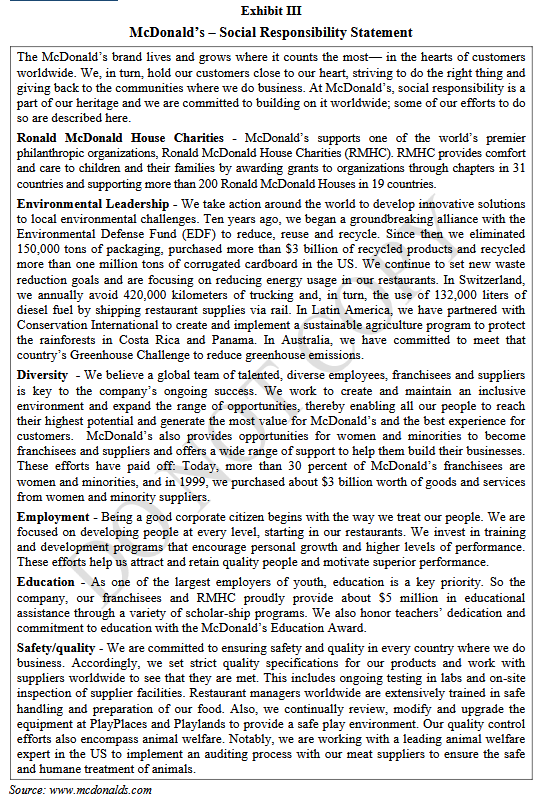
Exhibit III
Keywords
McDonald, French fries, 100% vegetarian, beef, allegations, lawsuit, paying damages, vegetarian, cases, case study
Related Case Studies
| Case Title | Details | Price | Add to Cart |
|---|---|---|---|
|
Case Title When AI Goes Off Script: The Air Canada Chatbot Liability CaseCase Code: BECG203 |
Details | 300 | Add to Cart |
|
Case Title When AI Goes Off Script: The Air Canada Chatbot Liability CaseCase Code: BECG203 |
Details | 300 | Add to Cart |
|
Case Title Maggi Noodles in India: The Revival ChallengeCase Code: CLBS151 |
Details | 200 | Add to Cart |
|
Case Title Johnson & Johnson’s Talcum Powder Controversy: Putting Profits before Consumer Safety?Case Code: CLBE024 |
Details | 200 | Add to Cart |
|
Case Title OSI China in Food ScandalCase Code: BECG142 |
Details | 500 | Add to Cart |