
The Maruti - Suzuki Conflict
🌐 International Buyers — Pay via PayPal
Details
BSTR029
9
2002
NO
0
Maruti Udyog Limited
Automotive
India; Japan
Strategic Alliances,Growth Strategy
Abstract
The case gives detailed insight into the disputes between Suzuki Motor and the Government of India (GoI), joint venture partners in Maruti Udyog Limited (MUL), an automobile giant in India. Covering the expansion plan, appointment of Bhaskarudu as the managing director and the disinvestment of MUL, it describes in-depth the disputes between the partners.
Learning Objectives
The case is structured to achieve the following Learning Objectives:
- Disinvestment of government owned companies
- problems in joint ventures.
Contents
“Maruti is a national company which has grown because of the support of the government. We can’t hand it over to Suzuki on a platter.”
– Murasoli Maran, Industry Minister, GoI, in 1997.
“Suzuki feels they can no longer afford the disadvantage of government control over Maruti’s decision making. They feel they can do better on their own.”
– A GoI source, in 1997.
In August 1997, the Government of India (GoI) appointed R.S.S.L.N. Bhaskarudu (Bhaskarudu) as managing director (MD) of India's passenger car market leader Maruti Udyog Ltd. (MUL). The appointment was strongly opposed by Suzuki Motors Corporation (SMC) of Japan, the GoI?s 50% partner in the MUL joint venture. In a press release following the appointment, Osamu Suzuki (Osamu), President of SMC, claimed that the appointment was illegal since five of the directors, comprising a majority of MUL's board strength of nine, had objected to the appointment. Osamu even alleged that Bhaskarudu was incompetent and unsuitable for the post of MD.
The GoI argued that as per the 1992 amendment in the GoI-SMC joint venture agreement, both the partners were entitled to nominate the MD for five years by turns, and there was no need for any consultation regarding the nomination. Industry minister Murasoli Maran (Maran) alleged that SMC was opposing the appointment of Bhaskarudu, as it wanted Jagdish Khattar (Khattar), Executive Director (ED), MUL (reportedly a SMC loyalist) to become the MD.
Following the disagreement over Bhaskarudu's appointment, many letters were exchanged between SMC and the Industry ministry. SMC asked for Bhaskarudu's resignation, claiming that the minutes of the meeting when Bhaskarudu was appointed did not fully record its objections to the same. However, the GoI refused to remove Bhaskarudu and reportedly even started looking for a prospective partner in the event of SMC's exit.
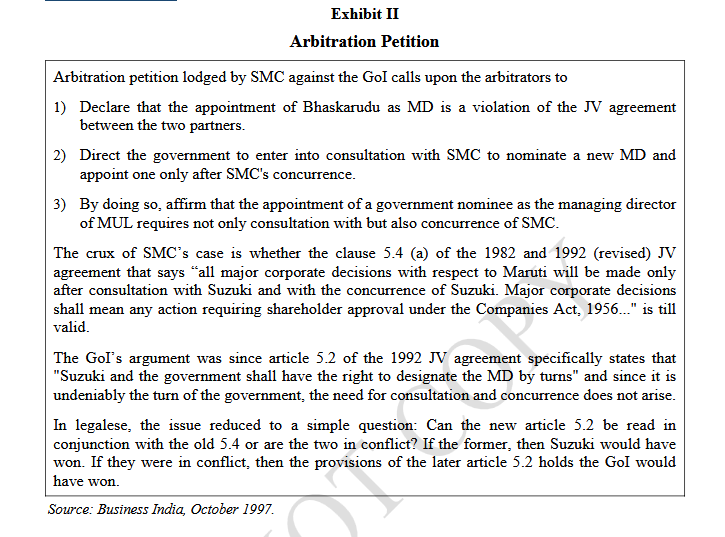
Soon after, in the AGM held on September 1997, SMC and the GoI representatives even resorted to verbal violence1. SMC?s nominees (on the board) attempted to prove Bhaskarudu's unsuitability for the post by questioning him about MUL's functioning. When Bhaskarudu's appointment was put to vote, there was a tie. Prabir Sengupta (Sengupta), Chairman of the MUL board, used his casting vote to ratify the appointment. Following this, SMC's nominees passed a no confidence motion against Sengupta and proposed the name of Yoshio Saito2 (Saito) for the chairmanship. The GoI strongly backed Sengupta, stating that he should be allowed to complete his scheduled term of five years until 2000. SMC then lodged an arbitration petition against Bhaskarudu's appointment in the International Court of Arbitration.
In June 1998, the newly elected Bharatiya Janata Party (BJP) government arranged for an out-of-court settlement between the parties.4 As per the settlement, Bhaskarudu was to step down in December 1999, two years ahead of schedule, and Khattar was to replace him in January 2000. Further, Saito was to replace Sengupta as the chairman. The dispute between SMC and GoI did not come as a major surprise to industry watchers because the company's history had been marked with frequent conflicts between the two partners.
Till the early 1980s, the Indian passenger car industry offered little choice to customers. Only two popular models were available: Hindustan Motors' (HM) Ambassador and Premier Automobiles' (PAL) Padmini. The government not only controlled the price mechanism in the industry, but also strictly regulated the entry of foreign players. However, the scenario changed in 1981, when the GoI itself entered the car business by acquiring the assets of Maruti Ltd6 and establishing MUL. In October 1982, the GoI signed a licensing and joint venture agreement with SMC wherein Suzuki acquired the 26% share of the equity.
Suzuki's history dates back to 1903, when Michio Suzuki founded Suzuki Loom Works in Hamamatsu in Shizuoka, Japan. For the first 30 years, the company focused on the development and production of complex machines for Japan's silk industry. In 1937, the company diversified into building cars and in 1939 began manufacturing cars for the Japanese market. But due to the Second World War it had to stop the production of cars and go back to manufacturing looms. The company shifted its focus back to automobiles with the termination of the war and the collapse of cotton market in 1951. In 1952 it manufactured its first motorized bicycle called 'Power Free'. By 1954, the company, which had changed its name to Suzuki Motor Co. Ltd., was producing around 6,000 cars per month. It had 57 production centers all over the world and a manufacturing and assembly network that was spread over 26 countries. The company established 22 automotive manufacturing facilities in 17 countries. Suzuki?s vehicles were sold through 134 distributors in 175 countries. By March 2001, Suzuki?s net sales were ¥ 1,600, 253 billion and it was one of the top 5 automobile manufacturers in the world.
MUL manufactured passenger cars at its factory in Gurgaon, Haryana, with an installed capacity of 350,000 vehicles. The first product, Maruti 800, was launched in 1984. Consumers hitherto without any choice rushed to buy the vehicle. Priced at Rs 40,000, Maruti 800 earned the tag of being the 'people's car.' The broad-banding policy8 announced by the GoI in 1985 changed the industry profile dramatically. Though the broad-banding policy led to increased utilization of capacity for two-wheelers and four-wheelers in the industry and resulted in substantial product innovations and upgradations, analysts opined that the policy discriminated in favor of MUL as other automobile majors like PAL, HM and Telco were not given permission to manufacture cars in partnership with Japanese companies.
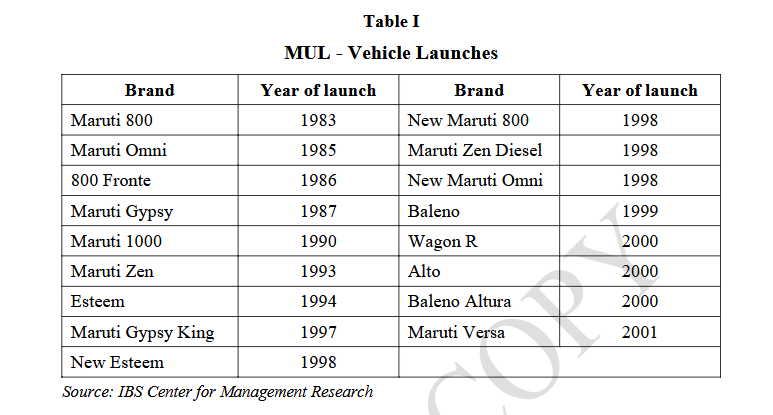
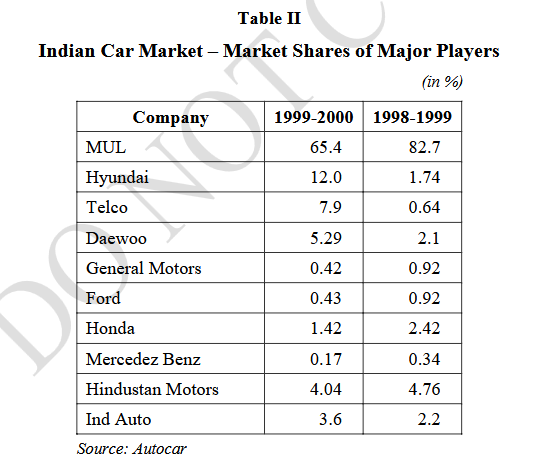
Over the next few years, MUL extended its product range to include vans, multi-utility vehicles, and mid sized cars (See Table 1 for MUL launches). By the late 1980s, MUL had become the undisputed market leader in the Indian car industry. Credited for increasing car sales in India (from 45,000 in 1984 to 409,951 in 2000), MUL retained its leadership position even in 2001 (SeeTable II for market shares). According to analysts, no other car company has so completely dominated its home market for such a long period.
MUL is known for its „value-for-money pricing? strategy, which had been made possible by the high levels of indigenisation of its vehicles. While the Maruti 800, Zen, Esteem and Omni were indigenised to the extent of over 90%, the Gypsy was indigenised to the extent of 82% and the Alto to the extent of 76%. The company developed a network of around 375 vendors and had several joint ventures with some of them to source its raw materials. Its sales (comprising 112 dealers and sales outlets in 86 locations) and service (comprising 1,010 service workshops covering 412 locations) network was one of the largest in the country. The company exported its vehicles to over 50 countries.
MUL's success was largely attributed to government support in the form of restrictions on the entry of foreign players. This gave the company over 10 years to establish itself, before the automobile sector was de-licensed in 1993. Other major factors that contributed to the company's success were the transfer of contemporary technology from SMC, focus on constant improvement in productivity and quality, effective employee-management relationship through practices like participative management, team work and kaizen,10 and strong relationships with vendors, dealers and customers.
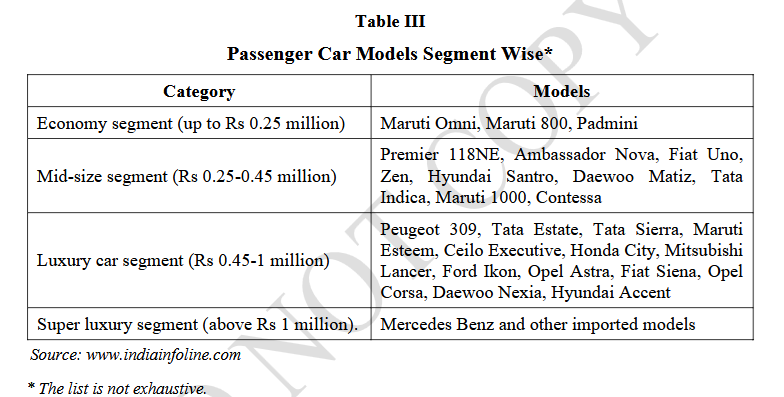
With de-licensing of the auto industry in 1993, a flood of international automakers entered the country. Many more companies including General Motors, Daimler-Benz, Hyundai and Honda entered through joint ventures and subsidiaries. The car industry was principally divided into four segments on the basis of price: the economy, mid-size, luxury and the super luxury segments. The economy segment dominated the industry, accounting for an estimated 90% of total car sales. New entrants such as Daewoo, Telco, Hyundai, General Motors, Ford, Peugeot, Mitsubishi, Honda and Fiat focused principally on the mid-size and luxury segments of the passenger car industry (See Table III for segment-wise calculation of passenger car models).
With the increase in the number of players, the car industry saw a shift from the limited supply situation to a surplus situation. In 2001, the car production capacity in India increased to over 1,210,000 from 750,000 in 1999. There were over 127 models on the roads in 2001 and with many more in the pipeline, competition had become severe. As a result, manufacturers shifted from cost-based to value-based pricing. Factors like price, brand building, technological improvements, new product features and better service and customer care also became very important.
MUL could not stay immune for long to these changes sweeping the industry. While demand for the Maruti 800 segment was declining, Zen and its archrival Santro were closely competing in terms of volume. Also, in late 2001, the Esteem's demand was declining and the Baleno, Wagon R and Alto were yet to prove themselves. Despite the fact that MUL had the largest range of products, the cheapest cars in the market, and a service network and cost structure that was better than anyone else's, it had steadily lost market share – down from 82% in 1999 to 65% in 2000.
According to analysts, apart from the increased competition, MUL?s declining market share could in part be attributed to its conflict with SMC. Because of their strained relationship, the transfer of new technology (necessary in the competitive environment) from SMC to MUL was delayed.
SMC had raised its stake in MUL to 40% in 1987 and to 50% subsequently in 1992. As MUL ceased to be a government unit, SMC began taking active part in the management of the company, with MD R.C. Bhargava (Bhargava) taking directions from Japan. As R.C. Bhargava reportedly shared a good rapport with higher officials at the Industry ministry, the relations between SMC and GoI remained cordial.
The first signs of a conflict surfaced in late 1993, when SMC proposed a Rs 22 billion expansion and modernization plan. The plan envisaged increasing the production by 1,00,000 vehicles to effectively meet the growing competition in the sector. The Heavy Industries secretary Ashok Chandra and the Finance secretary, Montek Singh Ahluwalia suggested, in an informal discussion, that SMC go in for a public issue to raise funds for the expansion plan. Though SMC was initially reluctant to go in for a public issue, Bhargava managed to persuade it to do so in 1995.
However, things changed when K.Karunakaran (Karunakaran) became the Union Minister for Industries in 1995. Karunakaran refused to accept MUL's proposal for a public issue, as it would result in further shifting the company's control into SMC's hands. Karunakaran insisted that the expansion plans be financed by the company's retained profits and internal accruals. The new Heavy Industries secretary, T.R.Prasad, endorsed Karunakaran?s view, since the suggestion made by the previous secretary (Ashok Chandra) to SMC regarding the public issue was not on file. According to analysts, the GoI thought that the public issue was SMC?s idea. This increased the
GoI?s apprehensions that SMC intended to take over total control of MUL.
SMC meanwhile accused the GoI of dragging its feet over not taking speedy decision on funding MUL's expansion plans, while the GoI stressed that the feasibility of the plan itself was yet to be established. The expansion plan had by now been revised to Rs 15 billion. However, according to analysts, just an investment of Rs 4 billion in the company's existing facilities was sufficient to increase the production by 70,000 to 80,000 vehicles. The GoI then appointed an expert committee to study the economic viability of the plan.
The GoI and Osamu held a series of meetings to discuss the above issues in mid-1995, but to no avail. The SMC-GoI differences intensified in early 1996, when the GoI appointed T.R. Prasad (and later Sengupta) as MUL?s Chairman. These moves were seen as clear proof of GoI's intention to play a more interventionist role in the company's affairs. Relations between the parties were strained further when the GoI wrote to the Department of Company Affairs (DCA), demanding Bhargava?s removal as there were three CBI chargesheets filed against him.12 SMC supported Bhargava, claiming that his removal would be 'undesirable and obstructive' to MUL's growth. However, in mid 1996, it seemed as if the conflict between the two partners had subsided. Karunakaran agreed to permit SMC to double MUL?s capacity and SMC agreed to transfer its technology to MUL.
In late 1996, the GoI finally approved the Rs 14 billion expansion cum modernization plan. The SMC accepted GoI?s proposal that the expansion be funded by the company's internal accruals and by debt. As a result of the automobile boom during 1993-97, MUL?s net profit increased from Rs 290 million in 1992 to Rs 5.01 billion in 1997. Thus, the question of funding by debt became redundant, as the company's internal accruals and profits were adequate to meet the needs of the plan.
In early 1997, the SMC approached the GoI with a proposal to raise its stake in MUL. SMC wanted to increase its stake from the existing 50% to 74%. It was also willing to sell its stake to the GoI in case the stake-hike proposal was not accepted. However, the GoI declined SMC's proposal. The row over Bhaskarudu's appointment followed soon after in August 1997. After the dispute was settled in June 1998, the two parties seemed to have buried their differences.
In late 1999, following the recommendations of the Disinvestment Commission, the GoI announced its decision to divest its stake in MUL. The GoI?s decision was a part of its policy to privatize PSUs through gradual disinvestment or strategic sale. The first phase of MUL's disinvestment was to start with a Rs 4 billion rights issue with renunciation option for the government, in December 2001.
The second and final phase of MUL disinvestment was to be completed by the end of 2002, when GoI would divest its remaining equity holdings in MUL through a public offering. The GoI was to sell its stake to the best bidder at a premium. However, subject to a clause in the MUL joint venture agreement, the GoI could not sell its stake without the written consent of SMC. This was expected to complicate the disinvestment process of MUL.
In January 2002, the GoI announced its willingness to renounce its portion of the rights in favour of SMC. The negotiations between the GoI and SMC to fixing the renunciation premium and the control premium were scheduled to begin in January 2002. The GoI was reportedly hopeful of getting a substantial „control premium? for letting SMC gain full control of MUL. However, SMC was reported to be planning to bargain for low control and renunciation premiums. Analysts were quick to comment on the possibility of yet another battle between the two partners over the issue of premium valuation.
1. MUL is often credited for having radically transformed the Indian passenger car industry? Briefly discuss the performance of the company over the years in the passenger car industry.
2. 'The row over Bhaskarudu's appointment was nothing but SMC's way of showing its displeasure over the expansion plan and stake hike issues.? Critically analyze the above statement and comment on the conflict between the GoI and SMC.
3. The conflict between SMC and GoI was in part responsible for MUL's declining market share in the late 1990s. Discuss the effects of this conflict on the company. Also discuss whether disinvestment would be beneficial to the company
Exhibit I
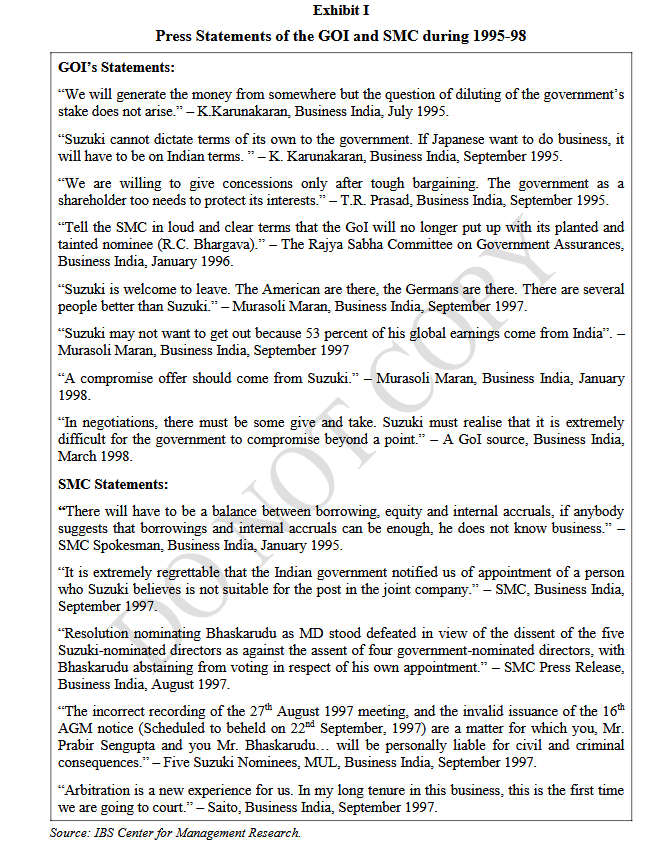
Exhibit II
Keywords
Disputes, Suzuki Motor, Government of India, GoI, joint venture, Maruti Udyog Limited, MUL, automobile giant, India, expansion plan, appointment, Bhaskarudu, managing director, disinvestment, MUL