
Electric Car Reva
🌐 International Buyers — Pay via PayPal
Details
BSTR030
9
2002
NO
300
REVA Electric Car Company
Automotive
India
Market Analysis,New Product Development, Product Launch
Abstract
The case discusses the launch of the first electric car in India - Reva, by the Bangalore-based Reva Electric Car Company. The case discusses the Indian passenger car industry and the steps taken by the Government of India as well as the major players in the global automobile industry to reduce automobile pollution. The case also explains how electric vehicles can help reduce automobile pollution and discusses the future of EVs, particularly Reva, in India.
Learning Objectives
The case is structured to achieve the following Learning Objectives:
- Alternative fuel vehicles, new product launches.
Contents
“It’s like running a car at the cost of a two-wheeler.”
- Sudarshan Maini, Chairman, Reva Electric Car Co., in August 2000.
“The largest part of the Indian car market is for small, affordable vehicles that can be driven in narrow roads and parked in the tightest of parking lots.”
- Chetan Maini, Managing Director, Reva Electric Car Co., in 2001.
In May 2001, Reva1, an electric car, was launched in Bangalore (Karnataka) by the city-based Reva Electric Car Company (RECC). Reva was claimed to be India?s first zero-polluting, battery-driven car with a running cost of just Rs2 0.40 per km. One of the first electric cars in the world to go in for mass production, Reva was slated to become the cheapest car in India. It was priced at about Rs 0.2 million and the first ten cars were delivered to customers in July 2001.
Reva generated a lot of excitement in the Indian automobile industry since it offered many significant advantages over conventional cars. Its low running cost, gearless driving, dent proof body material and other state-of-the-art technologies made it an alternative package. Reva was soon being compared with India?s largest selling car Maruti 800. Though available at almost the same price as Reva, Maruti?s running cost was almost four times higher than that of Reva. The car was also being seen as the answer to reducing the increasing pollution levels due to automobiles. Media reports claimed that Reva was all set to bring about a revolution in the Indian passenger car industry. Some analysts claimed that the electric car would create an entire new market and attract small families in hordes. Hormazd Sorabjee, auto analyst and editor, Autocar India, said, “If Reva's claim of keeping the running costs at Rs 0.40 per km is achieved, the car will be attractive to cost-conscious consumers who are ready to compromise on the limitations of an electric car.”
Till the late 1970s, the Indian passenger car industry offered limited choice to the customers, with only two popular models in the form of Hindustan Motors? (HM) Ambassador and Premier Automobiles? (PAL) Padmini. The government not only controlled the price mechanism in the industry, but the entry of foreign players was also strictly regulated.
The situation, however, changed in 1981 with the setting up of Maruti Udyog Limited (MUL), a joint venture between the Indian government and the Japanese automobile major Suzuki Motor Corporation. MUL's small, fuel-efficient and well-designed car, Maruti 800, soon became a huge success. Consumers, whose choice had been restricted to the 'old-fashioned' Fiat and Ambassador cars, went in for the small car. By the late 1980s, MUL became the market leader, leaving PAL & HML way behind.
After the Indian economy was opened up to foreign players in the early 1990s, many multinational auto manufacturers entered the country. The industry scenario changed when the foreign companies set up joint ventures or subsidiaries. The passenger car industry was segmented based on price as the small car (upto Rs 0.3 million), mid-size (Rs 0.3 - 0.5 million), luxury car (Rs 0.5 - 1 million) and super luxury car segments (above Rs 1 million) (Refer Table I & II for industry statistics).
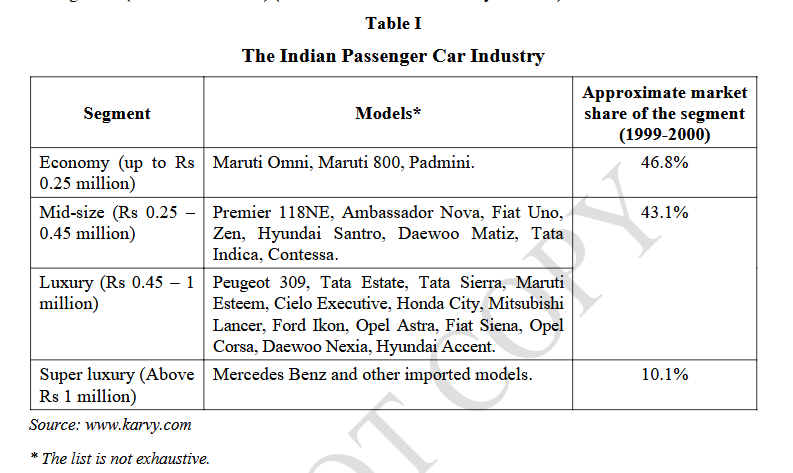
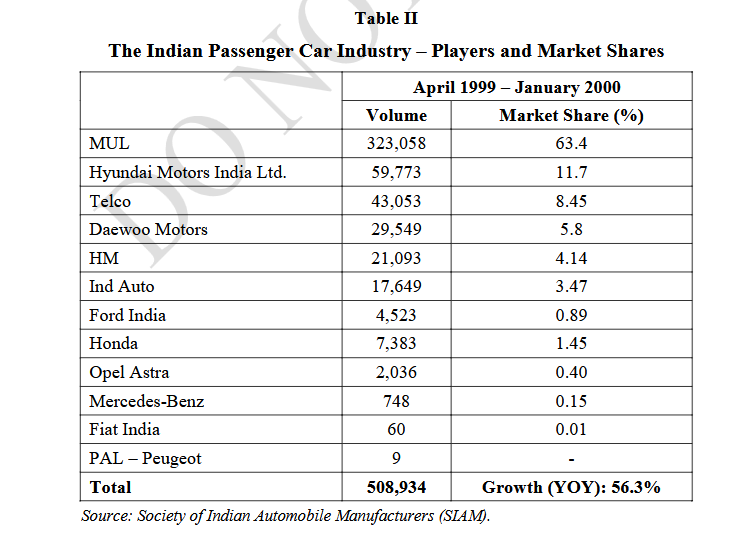
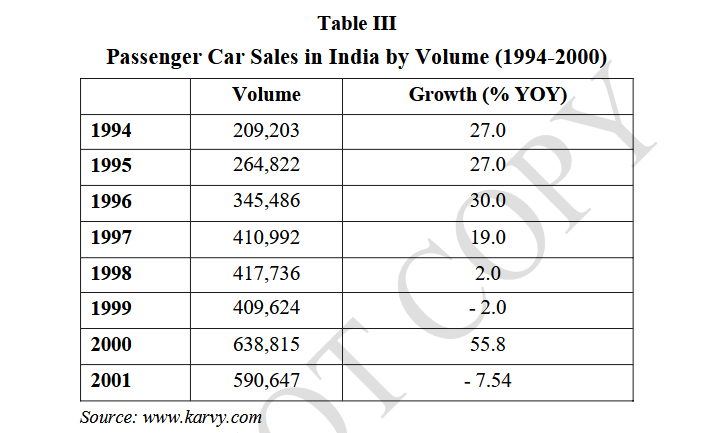
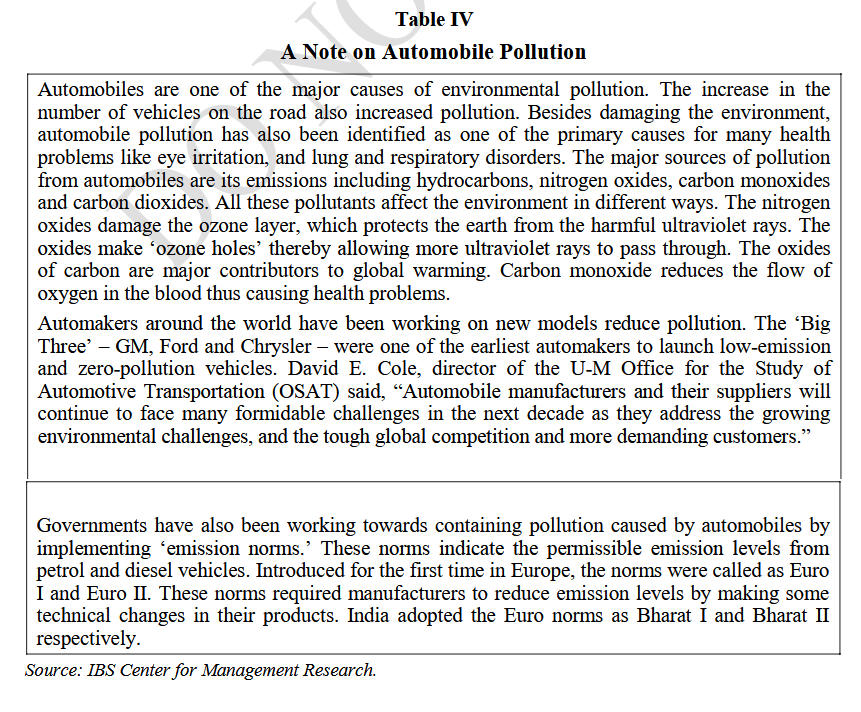
For the financial year ended March 2001, 590,647 units (Refer Table III) of cars were sold by the Indian passenger car industry. However, the industry's growth had an adverse impact on the environment, in terms of increasing pollution levels across the country (Refer Table IV for a note on the pollution caused by automobiles).
With steadily depleting oil reserves and increasing pollution, the emission regulations became stringent and automobile makers were looking at alternatives to the conventional engines. In the early 1990s, electric vehicles (EVs) started gaining popularity. They had been neglected after the onset of Internal Combustion Engines (ICE) 3 in the early 1800s. Many EVs were launched in the market by major players across the globe. GM was the first major manufacturer to produce an electric passenger car EV.
The first low-emission vehicles were the Hybrid Electric Vehicles (HEV), which combined the ICE of a conventional automobile and the battery and motor of an electric vehicle. The combination offered many advantages including fuel efficiency and environmental benefits. These vehicles were developed to overcome the disadvantages of an electric vehicle. The electric vehicles could be used only for short trips, as its battery had to be recharged after a few kilometers. Some of the first HEVs include Toyota?s Prius, Honda?s Insight and Civic.
In 1991, the GoI framed the first legislation on air pollution. By mid-1990s, the emission level for automobiles was tightened. The industry started using the latest technology and produced increasingly cleaner cars. It produced Low Emission Vehicles (LEV) in 1996 and Ultra LEV (ULEV) by 2000. By 2000, the new vehicles in the industry had emission levels, which were about 80% less compared to the 1989 levels. The emission level came down from 360 tons per day to 70 tons per day. A four-wheeler complying with the Euro II norms emitted 2-3 times less carbon monoxide and 3-4 times less hydrocarbons and nitrogen oxides.
The Maini Group (Refer Table V) was established in 1973 in Bangalore (Karnataka) by Sudarshan. K. Maini (Sudarshan), who aimed to blend western technology with Indian craftsmanship. The group followed the 'single zero principle' and its philosophy was 'Karma Parma Dharma' (Work is Worship). The group?s products ranged from precision components to in-plant material handling equipment and, from granites to abrasives. The group was also involved in international trading and offered ERP solutions.
Maini Group had technological agreements with Abressa (Spain), Clark-Blue Giant (US), Hensel (Germany), HIAB (Sweden) and STILL (UK). Some of the major clients of the group included General Motors, Bosch, BT, MIC, OMR and other Indian companies in the automobiles, consumer goods, engineering, and food processing and pharmaceuticals industries. The group was known for its quality standards and its plants had ISO 9001 and QS 9000 certification.
Chetan Maini (Chetan), son of Sudarshan, the chairman of the Maini Group, was always fascinated with cars and designed his first car during his school days. He made a remote-controlled, battery- operated toy and bagged the first prize at the school's science exhibition. He graduated from the University of Michigan, Ann Arbor, with a specialization in solar-powered vehicles. After graduating, he worked at General Motors' EV factory as an intern for six months. Chetan then joined the US-based Amerigon Electric Vehicle Technologies Inc. (Amerigon), which was involved in building EVs. At Amerigon, he built about six types of Solar and HEVs. He was also the leader of the team that won the 'GM Sun Race of Solar Vehicles' in 1990 and the team also bagged the 3rd position in the World Solar Challenges in Australia. In the early 1990s, Chetan planned to build his own EV and established RECC with the help of Sudarshan. Chetan said, “Cars are my passion, and the Reva is my dream that will soon become a reality.”
Sudarshan had dreamt of launching a small car in Bangalore and making the city pollution free. However, he planned to build an electric car after his son Chetan, joined Amerigon as a project manager for an EV project. Explaining the primary objective of RECC, he said, “It is the passion for the environment and turning Bangalore into a pollution free city.” Further, the Maini Group manufactured electrically operated material handling equipment. Sudarshan explained, “...the group's material movements division, which manufactured electrically-operated material handling equipment, offered us the obvious choice to venture into the electric car industry rather than the conventional car market. It is a car that is made for India to suit Indian conditions using material available in India.”
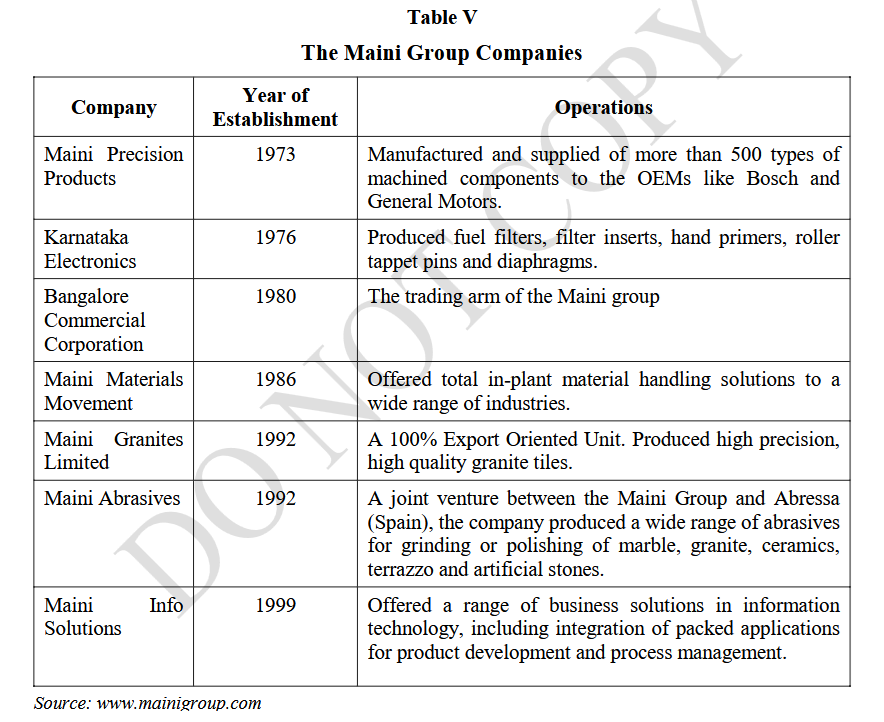
Reva Electric Car Company (RECC) was established in 1994 through a joint venture between the Maini Group and Amerigon. Amerigon had a 32% stake in RECC?s Rs 58 million equity and Maini Precision Products and Maini Materials Movement held the remaining 68%. Amerigon helped RECC in building the chassis of Reva. The car was manufactured at RECC?s plants at Bommasandra in Bangalore. The car's key technologies included its steel frame, the energy management system and a motor controller. The motor controller was developed through a technical collaboration with Curtis, one of the world?s leading manufacturers of motor controller for electric vehicles.
In 1996, RECC built the first prototype for Reva and received the mandatory certification. The prototype was also put through the 250,000 km 'shaker test' at the Automobile Research Association of India (ARAI), Pune. It was also tested at ARAI for homologation8 and was certified for road-worthiness. The prototypes were also tested in the US. They were also tested on the Indian roads in conditions of heat, humidity, and monsoons. However, Reva was not launched immediately. Chetan explained, “We had no definite plans to launch then. It's just that we've been making absolutely sure that when the product is in the market, it doesn't have any problems.” In addition, RECC wanted to ensure that at least 75% of the car's components were available in India. The car had 1,100 components out of which 99% were manufactured in India. In terms of value, the components manufactured in India accounted for about 75%. The company aimed to achieve an indigenisation of 100% by the end of 2002.
Further research was done to make the car more comfortable and efficient. AT Kearney Consultants9 had conducted a market survey, based on which it recommended some changes to the car. The recommendations included extension of the wheelbase to create more internal space and improvements in riding comfort.
In 2001, the commercial version of Reva was launched in Bangalore. Reva was a two-door hatchback10, which could accommodate 2 adults and 2 small children. RECC did not adopt any marketing or promotional strategies as the company felt that the cars should be sold without the help of advertisements. Sudarshan said, “We mostly depend on public relations and use minimal advertising.” The car was targeted at two-wheeler owners planning to buy a 4-wheeler. It was also positioned as an ideal second car for housewives, professionals and students. RECC also planned to sell the cars to tourist operators to be used as taxis. Sudarshan said, “At Rs 0.40 per km, it is the cheapest car to drive around.” RECC also promoted itself as an environment-friendly company. It promoted many environment-linked events on World Environment Day. The car also had the slogan: “I don't pollute when I commute.”
Initially, RECC had only one company-owned showroom in Bangalore and planned to open more showrooms in some of the major cities across India. The company planned to launch the car in a phased manner, nationally. Depending on the demand, the company appointed dealers nationwide. In late 2001, RECC launched Reva in Goa. By January 2002, RECC appointed about 7-10 dealers in North India. In April 2002, Reva was launched in Delhi and Surat.
To promote the sales of Reva, RECC requested the state governments to exempt Reva owners from road tax and sales tax. This was granted by the Karnataka and Rajasthan governments. In September 2001, RECC entered into an agreement with ICICI11 to provide loans to people planning to buy Reva. As per the agreement, customers could get loans covering about 75-85% of the cost of the car. In February 2002, Reva was planning to extend its agreement with ICICI for leasing the cars at a nominal cost. According to the agreement, Reva would take care of all repairs, and any customer could own the car on a pre-determined monthly amount. After three years, the customer could either retain the car or return it to the company.
The insurance premium on Reva was also low and RECC offered to replace the car in case of repairs or accidents. Sudarshan said, “We will ask no questions. They will get to drive a new car till the earlier one is repaired and the insurance claims are settled.” The company also offered to make customized cars to suit individual requirements.
In February 2002, RECC introduced a new scheme under which it agreed to buy Reva back if a customer was not satisfied with its performance. The customer could get back the money invested excluding about Rs 43,000, which accounted for taxes and insurance. Sudarshan said, “It is a new concept and the scheme is for a limited period. We want to promote electric cars as much as possible. What is heartening is that not a single customer has brought back his car to us.” By April 2002, RECC had sold about 180 cars in Bangalore and Goa.
In late 2001, RECC reported that Reva was well accepted in the four cities it was launched and that the company was working on new versions for the domestic as well as international markets. Ashok Dharwadkar, chief financial officer in a technology company, who was the third Indian owner of Reva, said, “The performance of the car is good and the company offers good service. There are still a few nagging problems like high noise level and fall in efficiency while driving uphill.”
In January 2002, RECC launched Reva Deluxe at the Auto Expo 2002 in New Delhi. The Deluxe model had a new look with upgraded interiors, defroster with heater, a stereo system, and climate control seats (CCS)12. Chetan said, “The development of the new model is a result of the feedback of our very satisfied customers in Bangalore, where over 150 cars are now running. The introduction of climate control seats is in line with Reva philosophy of using cutting edge technology, patented by Amerigon, leaders in advance automotive technology.” RECC has planned to launch the car in other cities like Jaipur and Hyderabad by the end of 2002.
RECC is currently working on a new version to be launched in the UK market. The company has also entered into alliances to export the cars to Nepal. It was also negotiating the export of the car to the UK, Japan, Mauritius, Israel, Norway and Sri Lanka. Exports to these countries were expected to start by the end of 2002. Sudarshan said, “We will be sending some cars to Nepal soon and have signed MoUs with Italy, Norway, Japan and an agreement with Israel and what we will be able to offer will be much cheaper than the EVs available outside the country. For instance, our product will cost around $9,000, while an EV in other countries come at around $20,000 or more.”
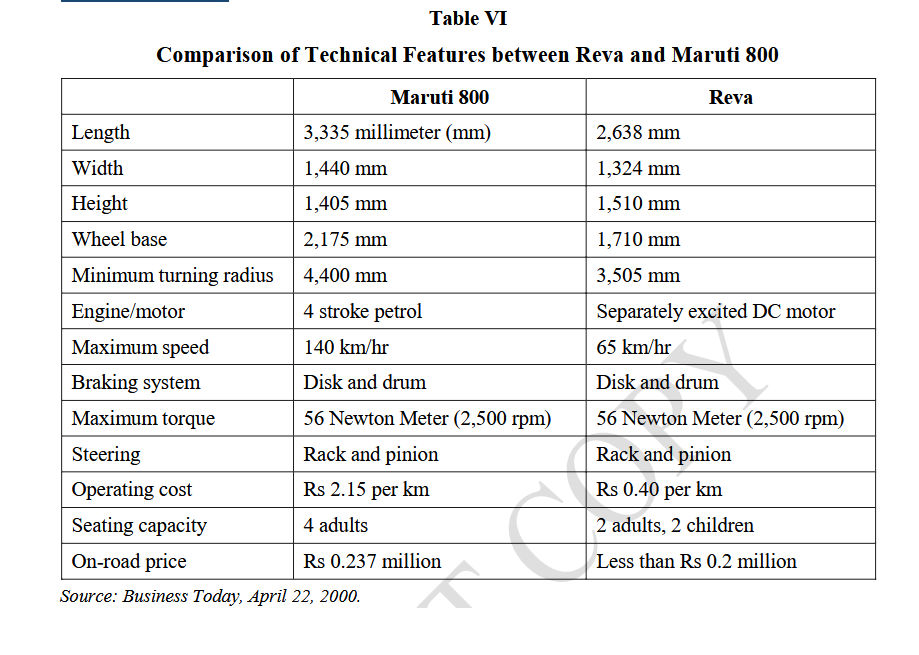
However, some analysts are skeptical about Reva's success of Reva in the long run. They feel that it would be difficult for RECC to promote the car, as the petrol-driven Maruti 800, the largest selling car in India, was available for about the same price as Reva. In addition, Maruti had a higher seating capacity (Refer Table VI). Moreover, Reva could go only up to 80 km and had to be charged before that limit. As there were no mobile recharging facilities in India, the car had to be charged at home or at the working place.
Other major Indian automakers were also entering the segment in India. In 2001, Mahindra & Mahindra was testing its three-wheeler 'Bijilee' and was planning to enter the 4-wheeler segment. However, Sudarshan seemed to be confident of success saying, “We are in a totally different market segment with the Reva being marketed as a personal 'city' car.”
Prof. C C Chan, president of the World Electric Vehicle Association, said, “The future of EVs is bright... for a sustainable ecology, we need to have environment-friendly vehicles. But it depends on whether you can mass-produce, ensure reliability and good performance at reasonable costs. These will define its future.” It remained to be seen if Reva could spark an electric revolution in the Indian passenger car industry.
1. Analyze the industry structure and the overall environment of the Indian passenger car industry since the early 1980s, identifying the major changes that have helped shape the industry structure.
2. RECC appears to have positioned Reva in the niche segment of two-wheeler owners graduating to a 4-wheeler. Do you agree with the company?s approach? Justify your answer. Examine the key challenges faced by RECC in establishing Reva in its segment profitably and successfully? What are the options and alternative strategies open to RECC to deal with the challenges?
3. What is the future of Reva? Do you think it has a chance to survive and succeed in the long run in a highly capital intensive industry? What strategies should RECC to adopt to achieve its objectives in its chosen segment?
Keywords
Electric car, India, Reva, Bangalore-based, Reva Electric Car Company, Indian passenger car industry, Government of India, global automobile industry, automobile pollution, electric vehicles, EV, Reva
Related Case Studies
| Case Title | Details | Price | Add to Cart |
|---|---|---|---|
|
Case Title Advanced Thermovoltaic Systems: Transforming Industrial Waste Heat into Clean PowerCase Code: MKTG490 |
Details | 300 | Add to Cart |
|
Case Title Burger King’s Satisfries: The Failed French FryCase Code: CLCB067 |
Details | 200 | Add to Cart |
|
Case Title Debacle of Google GlassCase Code: CLCB066 |
Details | 200 | Add to Cart |
|
Case Title Rolls-Royce: The Turnaround ChallengeCase Code: CLBS154 |
Details | 200 | Add to Cart |
|
Case Title Innovation at Tesla MotorsCase Code: CLBS150 |
Details | 200 | Add to Cart |