
The Resurgence of Radio in India
🌐 International Buyers — Pay via PayPal
Details
BSTR032
13
2002
NO
0
Not Applicable
Leisure & Entertainment
India
Market Entry ,Market Analysis
Abstract
The case examines the entry of private players in the FM radio market in India in the early 21st century. It discusses in detail the growth and decline of the radio industry in India. The case explores the reasons for the downfall of radio as a medium of communication and entertainment during the 1990s and discusses the future of radio broadcasting in the country in view of the entry of private players into the FM segment of the industry.
Learning Objectives
The case is structured to achieve the following Learning Objectives:
- Indian radio industry, revival of an industry, entry of private players.
Contents
“Nobody asks for radio and nobody gives a damn.”
- Prasoon Joshi, Creative Director of leading advertising agency, O&M, in September 2001.
“Radio won’t die; even today, the reach of radio is more than that of television. In rural India, every individual has a transistor. And you can listen to the radio even when you are tilling the soil. You can’t do that with TV.”
- Vinod Sharma, founding member and Ex-President, RAPA,1 September 10, 2001.
In July 1999, the Government of India decided to allow private players to enter the FM radio-broadcasting sector. It planned to offer ten-year licenses to private players in 40 cities across India. These private broadcasters would be permitted to offer only music, education and entertainment-based programs, not news or current affairs programs.
Hailing the government's decision as a historic one, analysts said this would change the future of Indian radio broadcasting. They added that with this development, private companies would have better control of their respective radio stations, unlike in the mid-1990s, when the private players were allowed to offer only programming content to the FM stations owned by the government operated All India Radio (AIR).
Following the announcement, many companies bid for licenses to operate in various cities. The first private FM radio station Radio City began functioning in July 2001 in Bangalore, Karnataka. By October 2001, sixteen companies were issued licenses to operate private FM radio stations. Some of these were Entertainment Network, India FM Radio, Vertex Broadcasting, Radio Today, Sun TV, Music Broadcast, Millennium Broadcast, Hitz FM Radio India, Udaya TV, Radio Mid-Day West India, Mid-day Broadcasting South, and Mid-Day Radio North.
However, many industry observers were skeptical about the survival of all these private players. They said that radio broadcasts were not popular and that industry ad revenues had been very low throughout the 1990s. Advertising revenues were as low as Rs 740 million in the financial year 2000-01, amounting to less than 1% of the total advertising expenditure. According to Prasoon Joshi, “The quality of radio advertising here is pathetic. Today, when an agency plans spends, the bulk of the money goes to television. Then come outdoor media, print, and maybe mailers. Radio comes last.”
Radio has had a tremendous impact on society in the 20th century. Though radio was invented during the late 1890s, public radio services offering information and entertainment content started only in the mid 1910s, first in the US and then in European countries (See Exhibit I for a note on how a radio works). World War I hampered public radio services to some extent, but at the end of the war, the business picked up momentum. Advertising on the radio started first in the US in 1920; this marked the beginning of commercial radio services. Radio broadcasting stations provided scheduled programs of lectures, news bulletins and other recreational and informative material. On account of the growing popularity of such radio programs, the demand for commercial airtime increased heavily by 1923, making radio broadcasting a profitable business. The far-reaching capability and immediacy of radio made it very popular across the world by the late 1920s (Refer Exhibit II for a brief note on the history of radio worldwide).
In India, radio broadcasting started in 1927 at Mumbai and Kolkata with two privately owned transmission stations. In 1930, the government acquired these stations and started operating them under the Indian Broadcasting Service. This service was later renamed AIR in 1936 and has since been operated as an independent Government department. From 1957, the radio service also came to be referred to as 'Akashvani.'
Vividh Bharati, AIR's main entertainment channel, was started in the 1960s. Commercial broadcasting was first introduced on Indian radio in 1967. In the mid-1970s, AIR started offering sponsored programs. Radio's commercials started during the early 1980s on its primary channel Vividh Bharati and were extended to other channels by the mid-1980s. All these initiatives increased the popularity of radio in the country and also generated huge revenues for AIR (from sponsorship fees and commercial advertisements).
AIR also operated an External Services Division (ESD) that broadcasted programs in 24 languages (16 foreign and 8 Indian, languages). These programs generally consisted of commentaries on current affairs; review of Indian press coverage; news bulletins; talk shows on socio-economic, cultural, historical and political subjects; and classical, folk and popular music from all corners of the country. The major ESD services included the General Overseas Service, Hindi Service and Urdu Service. Though FM radio had long been popular in Western countries, AIR started offering FM channels only in 1977. The first FM station was started in Chennai.
By the 1980s, radio had become a part of almost every household in India, enjoying the patronage of millions of people across the country. Its programs included situational comedies, suspense thrillers, film music based programs, dramas, and discussions and commentaries on health, cooking, mythology, and beauty tips. AIR also offered current affairs programs and talk shows on current issues covering politics, science, technology, education and social problems. It also conducted general knowledge competitions for students. Radio news broadcasts attracted hordes of listeners across the country. AIR popularized sports (particularly cricket) by broadcasting live commentaries of matches played in India and abroad. It conducted various music and drama competitions in order to discover and encourage talented artists.
Due to its immense popularity, extensive reach, easy accessibility and cost effectiveness, radio became a primary communication and entertainment medium during the 1970s and 1980s attracting listeners as well as advertisers.
However, from the mid-1980s, television (TV) began to lure away radio listeners. The success of TV serials like Ramayan, Hum Log, Buniyaad and Mahabharat further contributed to radio's downfall. These serials attracted millions of audiences across the country, resulting in a shift of loyalties from radio to television. As TV audiences grew, advertisers began allocating larger sums for TV advertising. Tapan Pal (Pal), President and CEO of ZenithMedia, summed up the issue: “In the golden days of radio, clients such as Dunlop assigned as much as 15-20% of its spends on radio. The industry spend was in the vicinity of 7-8%. Today, it is down to less than 1%.” By the early 1990s, in most metros, radio existed mostly as a part of two-in-one systems (cassette recorders).
Analysts felt that the government?s restrictive policies also contributed to radio's downfall to some extent. They felt that even with an extensive reach of over 98%, the penetration of the radio network remained stagnant in the 1990s (Refer Exhibit III for the Indian radio market) because the government failed to reform its broadcasting policies. Lack of good scripts and innovation in programming were also affected the quality of radio programs. Unlike a TV program or commercial that depended mainly on technology and special effects such as lighting, cinematography and camera angles, radio programs depended only on writing (script). Analysts also blamed the Indian advertising agencies for the decreasing ad spends on radio. They felt that the advertising agencies failed in exploiting the potential of radio to its fullest and simply treated it as a remainder medium. On the other hand, advertisers blamed the lack of creativity in radio programming as compared to TV. The absence of a monitoring system (to record the level of response to programs) for radio programs that could provide agencies with information to approach clients (to recommend radio) also contributed to radio's downfall.
In 1993, the government allowed private players in the FM sector by permitting them to take blocks (i.e. time slots to offer their programming content) on AIR, for FM transmissions. The purpose of this move was to earn revenues for AIR (by way of license fees) and provide more variety for listeners. The major players in the private FM market during that period were Times FM (of the media giant Bennett Coleman & Co) and Radio Mid-Day (of the Midday Multimedia group).
The programs offered by these private stations were much more listener-friendly and innovative than AIR?s programs. As a result, the channels became very successful (in the mid-1990s) and attracted high advertising revenues. By 1997-98, the private FM business in India had grown to Rs 930 million.
The growing popularity of private FM channels resulted in decreasing revenues for AIR as these FM channels attracted most of the ad revenues. In June 1998, Prasar Bharati3 stopped the operations of private FM channels, reportedly in an attempt to improve AIR?s revenues. But in July 1999, the government again decided to privatize FM broadcasts and came out with a ten-year license deal. The government refused to allow any foreign ownership in the sector. In 2000, the government called for bids for FM licenses.
By late 2000, AIR had established a network of 283 broadcasting centers (including over 180 full-fledged stations, four relay centers, three Vividh Bharati commercial centers and one auxiliary center) and 146 medium frequency (MW), 50 high frequency (SW) and 87 FM transmitters. In spite of the advent of new communication media such as satellite and cable TV and the Internet, radio broadcasting sustained its popularity through the years. FM, the most popular channel, had the largest reach of over 60%. With the entry of private players in the mid-1990s, FM radio became more popular, attracting huge ad revenues.
According to a survey conducted in February 2000, radio was still popular with over 58% of the rural and 48% of the urban population in India. With such a huge listener base, analysts felt that radio was still one of the primary mass communication mediums in the country.
The low advertisement costs and extensive reach of radio help advertisers quickly reach and appeal to their target customers. For advertisers targeting a small/niche audiences, radio worked out to be much more beneficial (Refer Exhibit IV for a summary of the advantages and disadvantages of major media types). Gopinath Menon, Executive Director of the advertising agency, TBWA Anthem, said, “Radio advertising is aptly suited for local promotions, and once audiences can be targeted, it has tremendous potential to eat into local mediums.”
Reportedly, there are more than 150 million radio sets in India – three times more than the number of TV sets in the country. On the basis of this data, private radio broadcasters claimed that radio had vast potential just waiting to be exploited. They aimed at duplicating the success of satellite television (which transformed the television industry in the 1990s) in the radio sector, with the help of latest digital technologies and innovative programming. According to estimates, radio's share in the total advertising budgets of corporates was likely to grow to 5% by 2007 as against less than 1% in 2001 (Refer Table I)
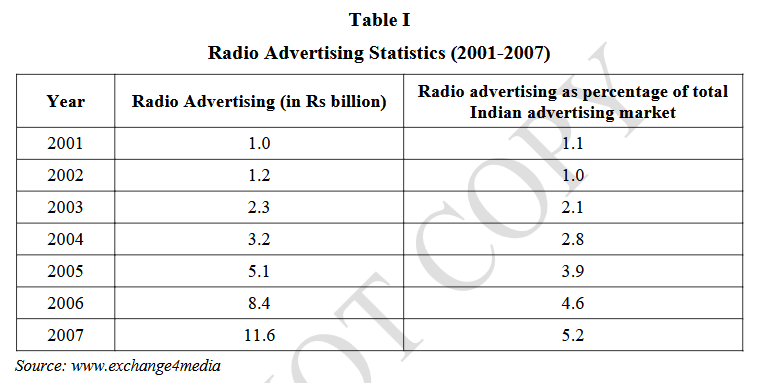
Thus, radio ad spend was expected to grow by an estimated CAGR of 45% between 2002-2007 as compared to an estimated 15% growth for total ad spend. Analysts claimed that the radio industry would follow the path of the television industry, which grew rapidly during the 1990s, with the entry of private players (TV ad spend grew at a CAGR of 30% during 1993-2001 and TV penetration doubled during 1996-2001).
Industry observers remarked that the greatest challenge before private FM channels was persuading the urban consumer to regard radio as a source of entertainment. To get the attention of the urban consumer, private players started developing programs tailored to meet the tastes of local listeners, with the help of advanced digital technologies and superior programming. As part of these efforts, private channels conducted intensive research to ascertain the demographic profiles of radio listeners in order to provide more targeted programming. Identification of demographic profiles was also expected to help private players to attract more advertising revenues, as it would enable them to offer advertisers access their target audiences.
AIR also revamped its programming during the late 1990s. As a result, it was able to increase its listener base and its advertising revenues by 2000.4 In 2000, AIR reported Rs 740 million as advertising revenues as against Rs 393 million in 1990. The restructuring efforts at AIR and the marketing strategies of private players raised the expectations of analysts about radio's growth. Pal endorsed this belief saying, “Radio is a far more intrusive medium compared to television. There is great future for radio. Even worldwide, radio is becoming a very important medium. In the US, some $ 19 billion are spent on radio advertising (India?s entire advertising market is worth $ 2.2 billion). I am certain that in a few years? time, here too radio will make a comeback. Now you have players like STAR, the Times Group, Mid-Day etc moving into the arena. Things will become more professional, monitoring will get better and advertising will increase.”
Though the government's invitation to private players resulted in an initial rush for licenses, many companies decided to stay away from the sector because of the high license fees demanded by Prasar Bharati and the risk involved in investing heavily (licensees were required to invest a minimum of $ 690,000 as capital and $ 460,000 as working capital for every station). Prasar Bharati had also imposed certain strict conditions that created resentment among the private players.
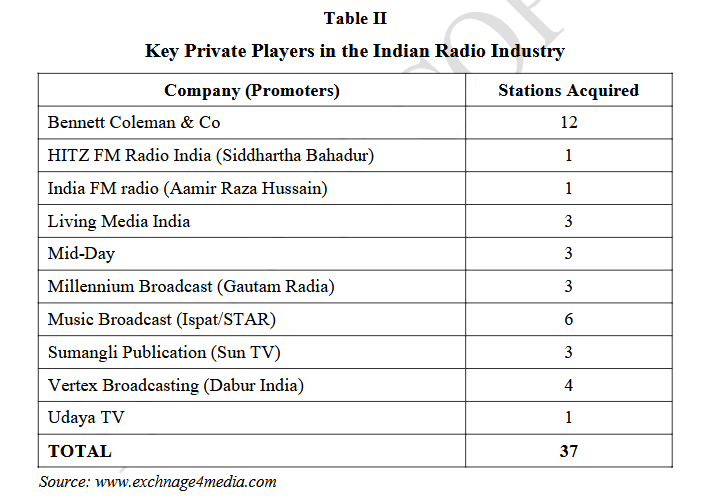
These players were not allowed to offer news or current affair programs, and they were given only a fixed number of slots per city. As a result, only a few players remained in the race. They were given licenses to set up 37 stations that would operate across 19 cities in India (Refer Table II for the key private players in the Indian radio industry).
With the launch of 'Radio City FM91' in July 2001, in Bangalore, by STAR5 and Music Broadcast Private Ltd. (MBPL), the industry began its second innings. Besides Bangalore, MBPL had FM radio licenses for five other cities: Delhi, Mumbai, Patna, Nagpur and Lucknow. The Lucknow and Mumbai stations began operations in the next few months. The other three stations were yet to become operational. STAR functioned as a content supplier and provided sales and marketing support to Radio City.
Commenting on the rationale behind Radio City?s launch, Peter Mukerjea, CEO, STAR, said, 'Radio's strength is its immense flexibility, adaptability and suitability for a modern and active life. Radio City's launch marks the introduction of a new age for radio in India. Through our participation in this emerging sector, STAR will be able to extend its relationship with audiences in India by connecting them in more ways than television.” The next player to launch its FM channel was Bennett Coleman & Co. Its „Radio Mirchi? was launched in October 2001 in Ahmedabad and Indore.
Radio City achieved significant success in Bangalore and Lucknow, registering high listenership ratings. With the launch of Radio City, overall FM radio listenership increased by 56% while the time spent on listening to radio tripled (from 1 hour to 3 hours). Home listening increased to 85%, with listenership at the workplace also growing at a rapid pace. Similar trends were observed after the launch of Radio City in Lucknow. By late 2001, FM transmission reached 21% of India's population and covered over 17% of the country's area.
The strategies followed by the players varied from one radio channel to another. Radio City's market strategy was developed after six months of intensive research conducted in Bangalore. As part of this strategy, the company focused on creating brand name and brand awareness, before moving on to specific target programming. Sumantra Dutta, COO, Radio Division, STAR, said, “What we are looking at is the first mover advantage. We are the first private FM radio station in India, and we plan to cash in on this.” The company identified music as a universal theme appealing to all sectors of the community. It therefore offered music-based programs in both
English and local languages.
In order to broaden its appeal, the channel also offered programs such as the '11 o' Clock Show' on beauty tips and the „Breakfast Show? offering the day?s horoscopes. Apart from these, the channel offered a range of entertainment programs 24 hours a day. These programs were customized to the needs and tastes of local listeners on the basis of customer research. Radio City also signed a contract with Newscorp to leverage the best international talent in the fields of technology, research, engineering, sales, marketing and programming.
The target audience for Radio Mid-Day was however, car owners. The channel's programs targeted car owners, who had to spend hours stuck in the traffic. For the afternoon slot, focused on offering programs that appealed to housewives. Rajesh Tahil, Head of Radio Mid-Day, said, “In the afternoon slot, we will have to compete with television for the attention of housewives. What we are aiming at is the top 20% of the radio audience. Thus we have decided to choose an audience, and go with it.”
The increasing popularity of FM resulted in considerable growth in the advertising revenues earned by radio companies. Seeing the growing listener base of FM radio, many companies increased the share of radio in their total advertising budgets. Many leading brands such as Kwality-Walls, Spice, Tanishq and Airtel advertised heavily.
Private players and analysts were optimistic regarding the future of the radio industry in India. In the words of Nirvik Singh, M.D., Grey Worldwide, India, “The share of radio is limited by the medium's current delivery. Given a free hand and the competition, there is no reason to believe that the medium which delivers in every other country will not perform well in India.” Analysts pointed out the success of radio (increase in number of radio stations, ad spends and market) in developed and developing nations in the 1990s. In the US, there were more than 11,400 radio stations that served nearly 240 million people and attracted over 13% of the total
ad spend.
In Australia, there were over 850 radio stations, with ad revenues increasing by an estimated 7% annually. In UK, ad spend on radio amounted to an estimated 6% of total ad spend in the country. Even in developing nation like Sri Lanka, the radio industry was reportedly attracting 14% of total ad spend. In light of these facts, analysts remarked that, given appropriate marketing strategies and awareness, radio had the potential to capture the public's attention in both rural and urban areas.
Though private companies obtained licenses to set up 37 FM stations in 19 cities by December 2001, only a few channels became operational. This was due to difficulties in setting up radio towers and the lack of basic infrastructure facilities. As a result, in December 2001, Prasar Bharati extended the deadline to April 30, 2002, and signed a memorandum of understanding (MoU) for a period of 10 years. This MoU allowed private FM operators in five cities to use AIR resources against payment.
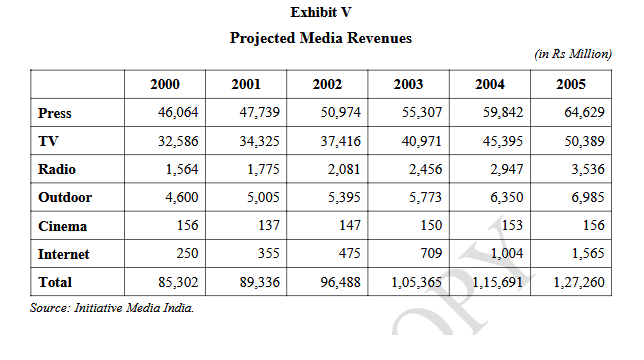
In spite of these developments and the 'bright future' predictions for radio broadcasting, there were some doubts regarding the industry's future. Given the huge amount of money spent on acquiring licenses and setting up stations, analysts pointed that it would take four to five years for the companies just to break even. Moreover, radio was not very popular in the media market and its revenues accounted for a negligible percentage of total media revenues (Refer Exhibit V For Projected Media Revenues). Thus, it seemed rather difficult for all the players to sustain the competition for long without earning any profits.
Added to this, the restrictions imposed by Prasar Bharati on the programming content (exclusion of news and current affairs programs, the core of broadcasting industry) of private players were expected to severely limit the success of these players. With the kind of programs the private players were allowed to provide, they could target only a few selected sections of the audience. This kind of programming was bound to restrict their growth. And with more than 24 languages spoken in the country, the radio networks need to develop multilingual programs to attract a nationwide audience. Developing such programs would demand heavy investments.
As all the players were focusing only on the urban areas, severe competition between the channels operating in the same city was expected to result in the survival of only two or three dominant players. To increase the audience base, private players would have to spread to rural areas. But the paucity of hardware and advanced infrastructure in rural India was a major hindrance to such expansion.
However, the greatest threat to Indian radio broadcasting seemed to be the advent of satellite radio. In light of this, the future of private channels and AIR, with their huge infrastructure costs and limited reach, appeared to be bleak. The world's first satellite radio service, WorldSpace,8 had already started operations in India and was gaining acceptance rapidly. However, to be able to access satellite radio, listeners had to buy special satellite radio sets, which were priced very high. Analysts felt that Indian consumers would not be willing to pay huge amounts when small radio sets and transistors were available at very cheap prices.
Thus, it remained to be seen whether the aggressive efforts of private FM radio players to rejuvenate the Indian radio industry would succeed and help radio regain its position as an integral part of the communication and entertainment business in India.
1. Discuss the growth and decline of radio broadcasting in India and examine the reasons for the fall in the medium's popularity during the 1990s.
2. Analyze the changes in the Indian radio market with the entry of private players into the FM sector. Critically evaluate the private players' efforts (strategies) to leverage the potential of radio. Do you suggest the new entrants might follow similar strategies to expand the market and ensure success?
3. Discuss the future of radio broadcasting players in India, in of radio's relatively small share in the communication and entertainment market, government restrictions on private players, intense competition in the FM broadcasting market, and threat from satellite radio companies.
Exhibit I
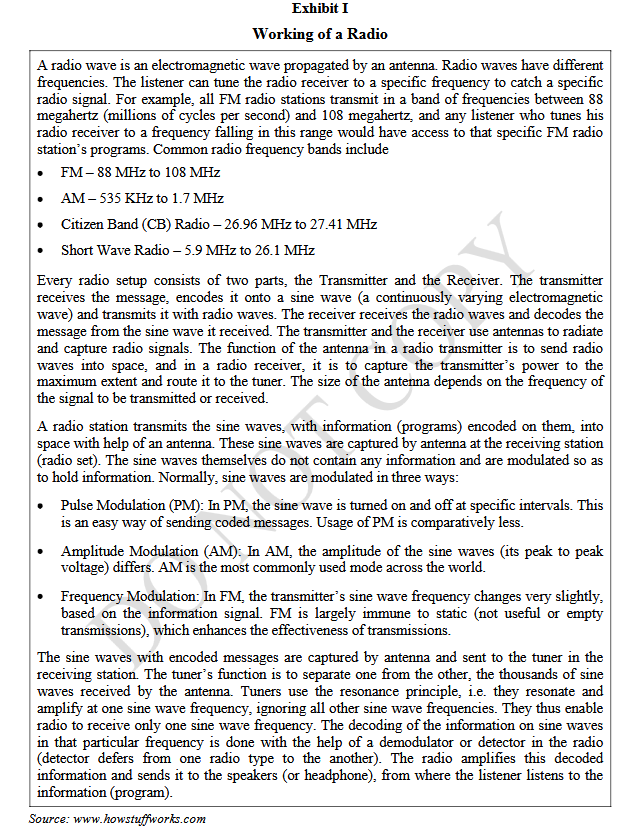
Exhibit II
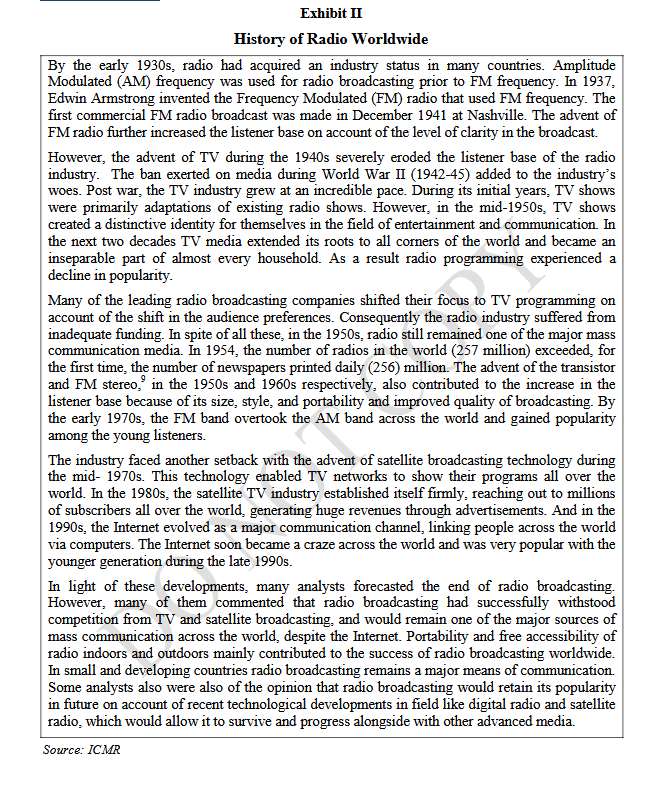
Exhibit III
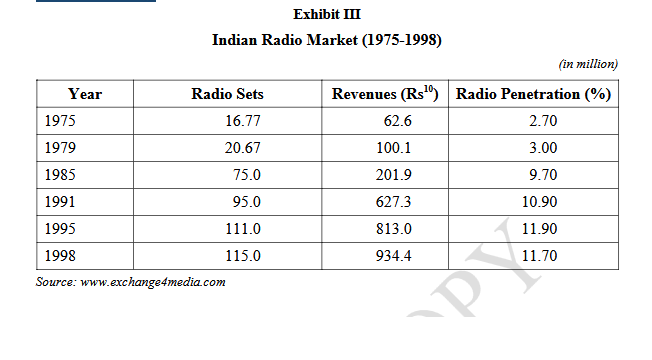
Exhibit IV
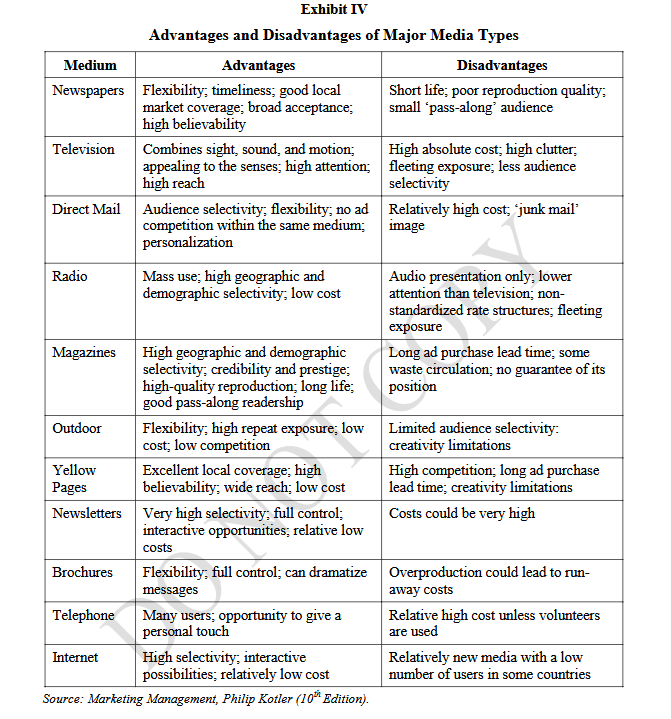
Exhibit V
Keywords
Entry, private players, FM, radio market, India, 21st century, growth, radio industry, India, downfall, medium, communication,entertainment,1990, radio broadcasting, country, private players, FM
Related Case Studies
| Case Title | Details | Price | Add to Cart |
|---|---|---|---|
|
Case Title Rolls-Royce: The Turnaround ChallengeCase Code: CLBS154 |
Details | 200 | Add to Cart |
|
Case Title Can Wal-Mart Make It In India?Case Code: CLBS153 |
Details | 200 | Add to Cart |
|
Case Title Uber’s Exit from China: A Raw Deal?Case Code: BSTR504 |
Details | 500 | Add to Cart |
|
Case Title World’s Largest Retailer in the World’s Most Populous Country: Wal-Mart in ChinaCase Code: BSTR495 |
Details | 700 | Add to Cart |
|
Case Title Tesco Exits South KoreaCase Code: BENV032 |
Details | 600 | Add to Cart |