
The NIIT Story
🌐 International Buyers — Pay via PayPal
Details
BSTR033
11
2002
NO
300
NIIT Limited
Education
India
Market Entry ,Marketing Strategy, Market Segmentation, Growth Strategy
Abstract
The case explores the reasons behind the success of the Indian IT education major, NIIT. The company's efforts in building the Indian IT education market and its own brand equity are discussed in detail. The case also takes a look at the strategy adopted by the company for improving its performance during the slowdown in the IT industry.
Learning Objectives
The case is structured to achieve the following Learning Objectives:
- Franchising, IT education/training industry in India.
Contents
“We want to reassure the students that there are enough jobs in the IT market provided they have the right kind of IT education.”
- P. Rajendran, Chief Operating Officer, NIIT, in January 2002
In early 2001, India?s leading information technology (IT) education company the National Institute of Information Technology Ltd. (NIIT) launched an aggressive marketing campaign to spread awareness among college students about the necessity of strong IT fundamentals and the need for developing new skills in the IT field. The company also launched a television campaign featuring its brand ambassador Vishwanathan Anand (Anand), world chess champion.
The advertisement highlighted the importance of a 'right' IT training institute and how NIIT met all the required standards. This television campaign was supported by an outdoor campaign as well. In addition, NIIT conducted various workshops to interact with prospective students and their parents. Analysts felt that this was the first time that an IT education player had undertaken such an elaborate, nationwide campaign using divergent communication media.
In January 2002, NIIT launched another nationwide campaign for its GNIIT career program. The ad campaign promised students, '100% job assurance or money back.' This was the first time that the company had launched such a campaign to attract students. Though most of the regional and national IT education players offered job guarantee schemes to attract students, NIIT had till then refrained from making such offers.
Industry observers pointed out that the company did not have many options. The slowdown in the IT education business and the low student enrolments had badly affected its financial performance. NIIT's education revenues, as a percentage to its total revenues, had dropped to 20% for 2001 compared to 45% in 2000. Moreover, net profits declined by 57% from Rs 2.24 billion in 2000 to Rs 960 million in 2001 (Refer Table I for NIIT's financial statements).
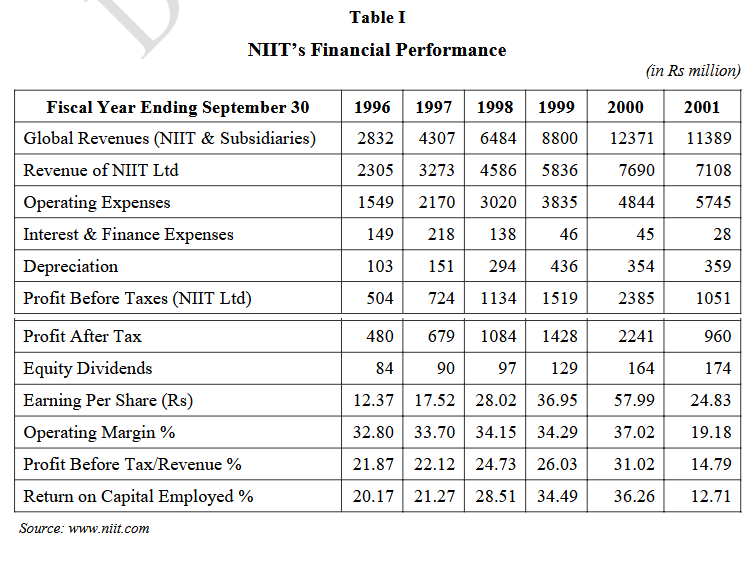
NIIT's market capitalization had also come down to Rs 90 billion in 2002 from Rs 240 billion in 2001. The company's market share in the IT education business had steadily declined from 70% in 1992 to 41% in 1996 and further down to 36% in 2001. Considering all the above factors, the company was forced to opt for the 'money-back' campaign. However, NIIT denied that the 'money-back' campaign was a desperate attempt to improve profitability by getting more student enrolments. The company claimed that the campaign?s objective was to reassure students about the availability of jobs in the IT market and of good placements for students of long-term courses offered by the institute.
Analysts, however, remained skeptical about NIIT?s claims and were doubtful whether the company would be able to reach its planned target of reaching Rs 100 billion in global revenues by 2005.
From the early 1980s, the demand for a workforce, which had computer skills, was increasing among Indian corporates. This was mainly because the economy was becoming more IT-oriented. Unlike the developed countries, in India, basic computer education was yet to become a part of the educational system. Only in a few engineering and computer science colleges offered computer education. This led to the emergence of small, regional IT training institutes offering low-end courses, focusing mainly on creating a general awareness about computers. Soon, the industry started attracting students in hordes and by the mid-1990s, it was growing at around 30-35% per year. By 2001, the global IT training market was estimated to be around $16 billion, of which India's share was $350 million.
NIIT was the first company to start a chain of computer education centers in the organized sector in India imparting IT training to a broad spectrum of people including students, IT professionals, school children and managers. Entrepreneurs Rajendran, Pawar and Vijay K Thadani, who were working with HCL promoted the company in 19811. HCL's founder, Shiv Nadar rendered support to the venture with the required capital. In 1982, NIIT started its operations, setting up centers in Bangalore, Karnataka and soon expanded to the rest of the country.
In 1989, NIIT got recognition from the American Council on Education (ACE), which enabled its students to get credit exemptions from around 1700 university members of ACE. Over the next few years, the NIIT brand became synonymous with IT education in India. Though its courses were not recognized by any Indian university, its placement records were rather good and the company was able to sustain the inflow of students.
In 1993, the company came out with an initial public offering of 3.6 million shares. In the same year, the company diversified into the software development business with the development of instructional software products to be used as teaching aids in schools. In 1994, NIIT implemented ISO 9001 standards and was certified by BVQI3. NIIT entered into several alliances with various leading global IT companies. In the mid-1990s, NIIT entered into a strategic alliance with Microsoft,4 becoming the first independent courseware developer for Microsoft outside the US. The company developed 38 out of the total 195-courseware products for Microsoft. It also
emerged as one of the largest network of Microsoft Certified Technical Education Centers (CTEC) in India and was the first official Microsoft Certified Trainer to certify faculty who could train in CTEC. In 1996, the company entered into an alliance with Oracle5 for providing training and certification exams, which enabled students to become Oracle-Certified Personnel. Major clients for NIIT products included the Ministry of Defense (Singapore), World Bank, Reuters, Chase Manhattan, and IBM Thailand.
In 2001, NIIT decided to take computer education to uneducated children living in the slums through computer kiosks. By 2001, around 65 such kiosks were set up in various slums in the country. NIIT also launched the I-Learn education system for disabled, spastics and visually impaired students and created a Computer Assisted Teaching and Rehabilitation program. NIIT received many awards and recognition for its services in the software and education business segments (Refer Exhibit I). By 2002, NIIT was operating in 38 countries with over 2497 centers, with plans to reach the 3,000 level by the end of 2002 (Refer Exhibit II). The company's strong
focus on IT education had made it the undisputed market leader in the Indian IT training market. Many analysts attribute the NIIT?s success despite stiff competition over the decades to a well-planned and executed strategic game plan.
NIIT not only pioneered the concept of IT education and training in India, it also revolutionized IT education by taking it to small towns. It was the first organization to market the concept of teaching computers for students in the age group of 18-21 and then moving on to specialized application-oriented courses for professionals. According to analysts, NIIT?s thrust on R&D in education and its customized courses were the major factors that helped it establish a stronghold in the Indian IT education market.
Initially, NIIT had to tackle two issues – gaining credibility (market acceptance) and creating a market for its products. It had to change the mindset of the people that careers in computers were only for engineering students, which made brand-building a tough exercise for NIIT. It had to establish NIIT not only as a brand but also as a career option for students. NIIT initially targeted undergraduates other than students of engineering and medicine and focused its attention in creating awareness about computers as a career option. The strategy was to project a career in computers on par with professions like law, medicine and engineering. It also highlighted the need for rigorous training, hard work and dedication. The company advertised extensively through print, outdoor and electronic media highlighting the career opportunities offered by computers.
NIIT adopted a franchise business model from the very beginning to expand its reach all over the country, as the setting up of its own centers was costly. The franchises were opened in various places all over the country. NIIT provided the necessary support for its franchises by training the faculty members and the sales personnel at the franchises. It also provided classroom training guides, courseware and promotional material. The company sent its representatives regularly to the franchise centers for providing sales, marketing, technical, and systems support. In the metros, the centers were set up with an investment of Rs 2-5 million in a 100-250 sq.m. area. In other places, the total investment required was between Rs 0.4 and 3 million and the space required was around 30-150 sq.m. For the international franchises, the investment was US $300,000-400,000 and space of 350 sq.m.
It also entered into tie-ups with schools and colleges by setting up NIIT centers in their campuses. To attract students, NIIT conducted career melas in college campuses for spreading the awareness about IT courses and job opportunities offered by the industry. It sponsored many youth events in colleges because of which it developed a strong brand recall among college students. NIIT even took initiatives to start its centers in college campuses, to attract students easily.
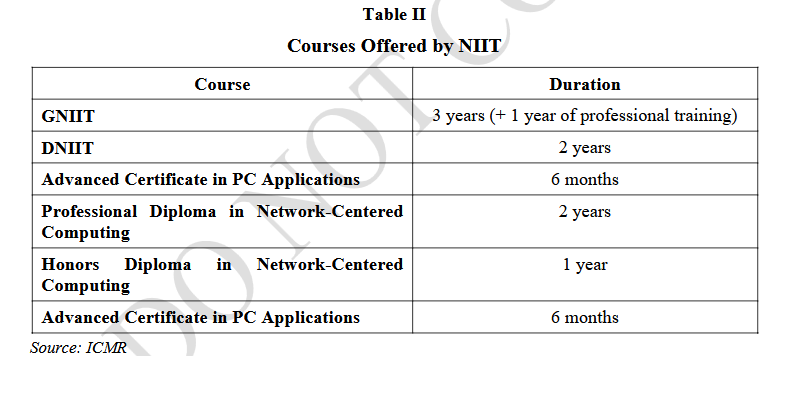
When NIIT started its operations in 1982, the instructional materials for the courses were imported from the US. Later, the R&D department, which was set up in 1990, began working extensively on course designing and the company started using the material developed here for its courses. NIIT also developed its course curriculum as per industry demands to enable its students get placement easily (Refer Table II for some of the courses offered by NIIT).
In 1990, NIIT introduced the concept of 'scholarships' to attract students, which went on to become an industry-wide practice. The scholarship was known as 'Bhavishya Jyoti Scholarship,' was awarded to students who did well in the written admission test for various courses. For students who topped in the test, concessions were given in the course fee ranging from 15-80% according to their scores. According to analysts, the scholarships played a major role in attracting students from the lower middle class and small towns.
NIIT also entered into alliances with foreign universities, to help its students gain admissions in foreign universities for higher education. It had alliances with the University of Canberra, Canberra ACT, Australia, University of Sunderland, Sunderland, UK, Southern New Hampshire University, USA and Auckland Institute of Studies, New Zealand in this regard. These alliances gave students an opportunity to get admission in a foreign university courses at the end of a two years of any NIIT course after 12 years of schooling. Analysts pointed out that these alliances also helped NIIT to tap the students who were attracted to study in foreign university. NIIT also initiated an industry collaboration programme, which helped it expand its relationship with the industry. As a result, many reputed companies started accepting NIIT students during their internships.
NIIT also conducted customer satisfaction surveys, for users and for their system supervisors about its courses. In the process it found that mostly average students, who did not have the ability to take effective decisions were being sent into the industry. This resulted in the introduction of personality development programs in its course curriculum.
In the mid-1996, NIIT launched the Learning through Education and Direct Application (LEDA) program. Through LEDA, the company successfully integrated multimedia with education, to make learning enjoyable through interactive multimedia content, which was used to teach students their school curriculum. With the LEDA project, NIIT aimed to make school children computer literate. NIIT implemented a three-pronged strategy for this project, in the form of LEDA School, LEDA Family Club and the LEDA Home.
The LEDA School was implemented in schools through integrated school solutions which consisted of interactive multimedia content on CD-ROMs sourced and developed by NIIT, curriculum maps and teachers guides. The LEDA Family Club aimed at providing children an environment in which they could learn in small groups. According to company sources, the LEDA Family Club took care of personality development and general awareness along with the children's regular studies. The family clubs also catered to the specific needs of executives and housewives through facilities like flexible timings, hobby courses, puzzles, and mind games. LEDA Home was
aimed at the families interested in self-education. Through LEDA, the company offered around 250 courses, including long-term courses (40-50 sessions) and short-term courses with only four sessions. The fee also varied from Rs 300 for short-term courses to around Rs 7000-9000 for long-term courses.
In the same year, NIIT launched an online learning facility through the website 'www.netvarsity. com' as a pilot project to understand the behavior of Internet users and the technological environment for an education portal. This launch enabled all NIIT students to access the Internet for complementary education services such as online counseling and testing for various subjects. Through this portal, NIIT offered various courses for students as well. Through feedbacks and frequent learner evaluations, NIIT ensured the quality of the content on the portal.
Aptech and SSI were NIIT's major competitors. Aptech's revenue break-up was around 30% from software business and 70% from the education and learning business. For SSI, the break-up was 34% from software and the rest was from the learning business. The other major competitors included Tata Infotech Ltd. and LCC Infotech Ltd. In 1998-99, SSI identified the demand for short-term advanced technology training courses for non-IT professionals and started short-term courses for much-in-demand subjects such as Oracle and Java. With its aggressive marketing strategies, SSI was able to gain significant market share. Though NIIT had a similar curriculum, it
failed to attract students to its short-term advance courses, primarily due to a lack of awareness among students.
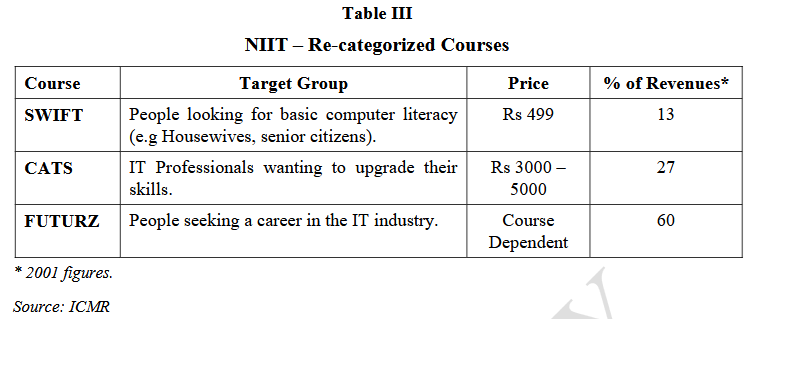
Also, the company was keener to enroll students in long-term courses instead of short-term courses, as they were high margin courses. NIIT also faced competition from Aptech, with its 200 centers for short-term courses and courses in multimedia under 'Arena Multimedia.' Aptech soon became the market leader in the multimedia segment with an over 50% market share. Alarmed by these developments, NIIT re-categorized all its courses into three distinct training programs to increase its reach (Refer Table III). The company also continued to review its courseware and designing courses, which were in demand in the market.
In 1999, NIIT signed Anand as its brand ambassador and launched the 'mind champion' campaign featuring him in print and TV advertisements. The campaign's punch line 'If you are not studying at NIIT, you are missing something,' went on to become a major factor in the popularity of NIIT as a brand.
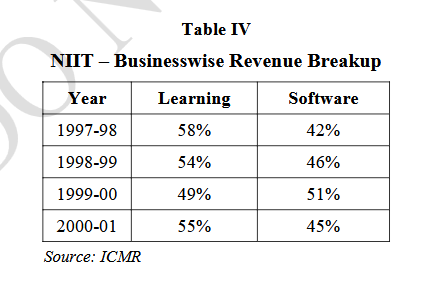
Though the company was doing rather well financially, industry observers felt that compared to other software majors such as Infosys and Wipro, NIIT was not delivering enough value to its stakeholders. NIIT chairman Rajendra S. Pawar disagreed stating, “We get forced into categories where we don't belong. A comparison with software companies is an academic exercise because we don't operate on the same footprint. We are committed to sustainable, strong and steady growth and would like to be known for a unique business model encompassing software as well as learning.”
However, analysts were skeptical regarding the above claims stating that a company deriving almost half of its revenues from the software business (Refer Exhibit III for the software solutions offered by NIIT) could not avoid such comparisons (Refer Table IV for a breakup of NIIT's revenues).
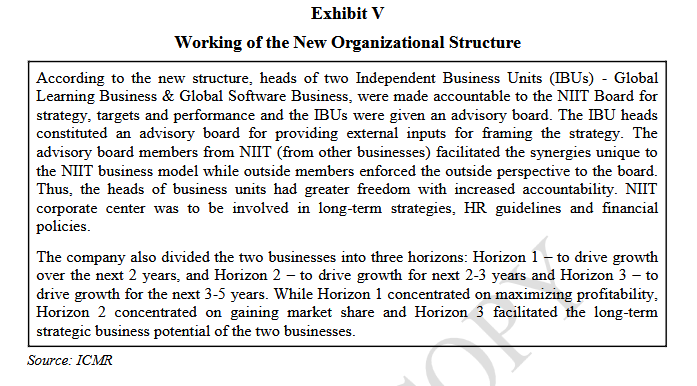
To improve its performance, NIIT decided to separate its software business from the learning business by creating two vertical organizations (Learning business and Software business) and one corporate center (Refer Exhibit IV) in October 2000. According to NIIT sources, this was done to speed up the decision-making process, thereby addressing the concerns of industry analysts that excessive centralization in its top management was slowing down the decision-making process. As per this initiative (called 'Fastfoward'), NIIT aimed to achieve global revenues of Rs 100 billion by 2005 (Refer Exhibit V). In addition to the organizational restructuring, NIIT also adopted the following three-pronged strategy for its education business:
- Expanding the network and courses to enhance its reach: NIIT planned to open new centers in small towns to increase its market presence and expand its base.
- Launching new technologies and emphasis on changing the product mix: NIIT decided to offer new courses covering the latest technologies, to enable students to get jobs easily.
- Investing in customer education programs: The company decided to conduct customer meets and career counseling programs for students regarding the slowdown in the IT industry and the importance of choosing the right institute for getting quality education.
The restructuring moves and the course re-categorization helped NIIT's global revenues to increase from Rs 2.83 billion in 1996 to Rs 12.37 billion in 2000, while the net profits increased from Rs 480 million to Rs 2.24 billion. However, NIIT could not escape the global slowdown in the IT industry. The company's global revenues declined to Rs 11.39 billion and net profit declined by around 58% to Rs 960 million in 2001.
NIIT attributed the downfall to the layoffs in the global IT industry and dismal corporate results from many global players. The above events had led prospective students to delay their decisions regarding joining computer courses. It was also noticed that the existing students were extending their inter-semester breaks to rejoin after the industry improved. NIIT also saw a fall in operational revenues from its overseas centers. Moreover, prospective partners delayed the signing-up of new centers. As the company believed its problems were primarily due to the slowdown in the industry, it undertook various initiatives to attract students. The advertisement campaigns and the money-back scheme were a few of the initiatives planned by the company.
For improving revenues from its software business, NIIT decided to increase its focus on legacy software services, including upgrading old computer systems to new technologies. A decision was taken to increase the focus on the retail finance business by providing solutions in customer relationship management. NIIT planned to concentrate on exploiting the opportunities in web enablement of sales force operations, claims management and enterprise application integration in the insurance sector.
To reach out to more customers, NIIT opened 87 centers, franchises as well as company-owned during July-September 2001. The new centers were opened in Port Blair, Digboi and several small towns. In addition, the company opened 38 international centers. After this, the company introduced courses for new technologies. NIIT introduced the iGNIIT course with a web-centric syllabus. For this course, the company partnered with the International Finance Corporation (IFC) and Citibank, to provide seven-year study loans to students – around Rs 4 billion was provided for disbursing loans to students. It was reported that the company was planning to extend the loan facilities for its other courses as well.
NIIT started extensively promoting the four-year GNIIT course extensively to attract students interested in a long-term career in IT. This course was extended from 7 cities to 16 cities. It also started a 'Swift Jyoti' course with a unique curriculum for women. The course helped women to become familiar with IT tools such as e-mail, and other office automation tools. To cater to the needs of school children, NIIT started a 'Project K-12,' which focused on implementing projects for school children. NIIT also signed up with state governments of Karnataka, Punjab, Tamil Nadu and West Bengal for introducing computer education in schools under K-12.
In May 2001, as part of its Futurz career program, NIIT devised an innovative package of short-term courses in computers for students who were appearing for the engineering and medical entrance exams. NIIT offered a fee refund for students securing admission in engineering or medical colleges through competitive exams. According to company sources, NIIT came up with the offer after a nationwide study was conducted among students who appeared for their Class XII exams. The study revealed that the students were concerned about career options and through this unique money-back offer, NIIT was confident that it could take care of that uncertainty. Due to the above measures, NIIT?s revenues started improving. According to reports, fresh student registrations for the quarter ended September 2001 was 5% higher than the quarter ended June 2001. According to NIIT sources, the GNIIT course recorded the highest number of new registrations that was around 1,16,370 in the quarter ended June 2001.
To consolidate these gains, NIIT decided to reach out to consumers through more courses. As per its decision, NIIT introduced a six-month super fast-track career program for final year graduate students. The program was aimed at students who were DNIIT titleholders and undecided about their career. The company also announced plans to set up over 50 Yuva.com centers in Karnataka for training unemployed educated youth in IT.
Due to these initiatives, at the end of the December 2001 quarter, the students' enrolment was 159, 163 as against 51,943 in the same quarter the previous year. NIIT also claimed that it had gained an important 2.5% market share for the quarter ended September 2001. But analysts pointed out that the increase in enrolments was mainly for basic elementary courses, which would fetch low income and profits, and would not help the company improve its bottomline on a sustainable basis. In July 2002, NIIT renamed its global software business as NIIT Technologies. The president of NIIT Technologies, Arvind Thakur, said, “The branding was needed since NIIT being perceived as a education company was being a hindrance to our positioning as a software company.” The move prompted analysts to state that the desire to be seen as a software company rather than as an IT education company indicated that, NIIT had finally seen the potential, in the software business.
1. NIIT has been the pioneer and leader in the Indian IT education industry. Discuss the market development strategies adopted by the company to expand its reach and become the leader.
2. NIIT's profits in 2001 decreased by more than 57% compared to 2000. Discuss the impact of external environmental factors on the company?s performance and the strategies adopted by it to improve its results.
3. Analyze the pros and cons of NIIT?s decision to diversify into the software business. In what way do you think this move affected the IT education business? In the light of the company's decision to be known as a software company, discuss the future prospects of its IT education business.
Exhibit I & Exhibit II
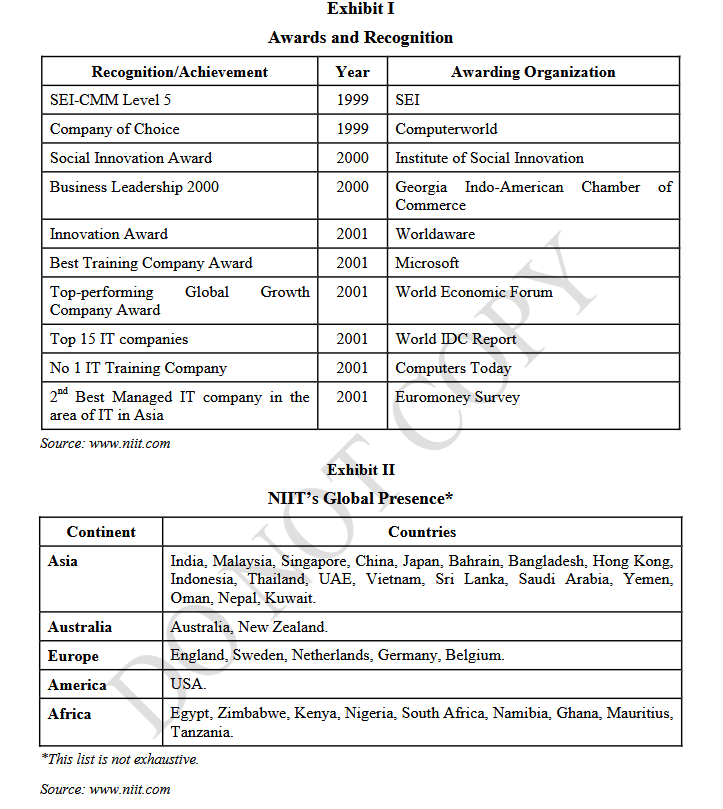
Exhibit III & Exhibit IV
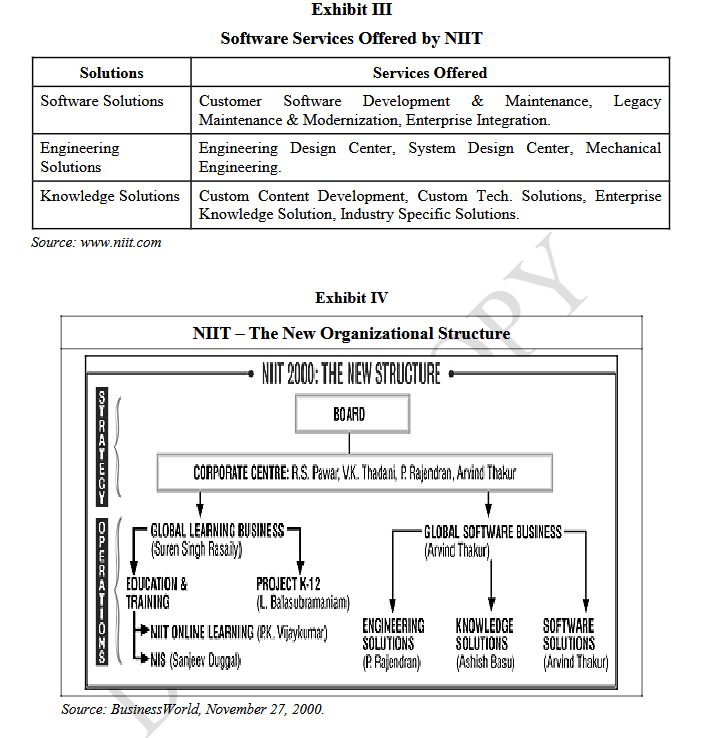
Exhibit V
Keywords
Indian IT, education major, NIIT, market, brand equity, strategy, case, case study, Business strategy
Related Case Studies
| Case Title | Details | Price | Add to Cart |
|---|---|---|---|
|
Case Title Flyadeal: Saudi Arabian Airline’s Growth ChallengesCase Code: BSTR720 |
Details | 300 | Add to Cart |
|
Case Title Calbee’s Monochrome Packaging: Crisis Management Response or Marketing Strategy?Case Code: MKTG497 |
Details | 500 | Add to Cart |
|
Case Title Reliance Jio’s Next Act: Monetizing a Mass Brand without Breaking TrustCase Code: MKTG494 |
Details | 500 | Add to Cart |
|
Case Title The Nirma StoryCase Code: MKTG008 |
Details | 200 | Add to Cart |
|
Case Title IKEA’s ‘Punch’ Moment: Using Reactive Marketing to Build Brand ConnectionCase Code: MKTG493 |
Details | 300 | Add to Cart |