
The Fall of Daewoo Motors
🌐 International Buyers — Pay via PayPal
Details
BSTR034
13
2002
NO
300
Daewoo Motors
Automotive
South Korea
Diversification Strategy,Cost of Capital
Abstract
The case examines the problems faced by South Korea-based Daewoo Motors, the flagship company of the Daewoo Group. Daewoo Motors expanded rapidly in several risky and uncertain markets by taking huge debts. The company offered its products at low prices and with huge discounts, thus further increasing its losses. The case also discusses how financial mismanagement by Daewoo's promoters and the Southeast Asian Financial Crisis in 1997-98 ultimately led to the company's bankruptcy. In early 2000, the South Korean government invited bids for the sale of Daewoo Motors. After two years of negotiations, Daewoo Motors was finally acquired by the US automaker General Motors.
Learning Objectives
The case is structured to achieve the following Learning Objectives:
- Role of culture, ethics and corporate governance in the survival of large companies.
Contents
“In a drive to go global, it (Daewoo Motors) refused to quit when it was behind.”
- BusinessWeek, August 23, 1999.
“Kim Woo Choong has been stealing money from the company, and we should not be punished for the mess he created.”
- Choi Jong Hak, Daewoo Motor Labor Union representative, in 2001.
In the late 1990s, the leading South Korean car manufacturer, Daewoo Motors (Daewoo), was in deep financial trouble. For the financial year ending 1999-2000, Daewoo generated revenues of $197.8 million and a net loss after tax of $10.43 billion (13.7 trillion won). The company's revenues had dropped by 94% since 1999. The loss reported was also three times higher than that reported in 1999, and was ranked as South Korea's largest ever corporate loss. In addition, the company's domestic marketshare fell from 33% in 1998 to just 23% in 2000.
According to analysts, Daewoo's borrowings for its expansion programs were responsible for its losses. The company's domestic and foreign debt amounted to more than $16.06 billion in December 1999. Moreover, its expansion into risky and uncertain markets like Vietnam and its decision to sell products at very low prices to gain marketshare had negatively affected its financial condition. Labor unrest was also one of the reasons cited by market observers for Daewoo?s poor financial performance. The workers at many of its plants went on strike protesting against low wages, layoffs, and lack of job security. The Southeast Asian Financial Crisis of 1997-98 further deepened Daewoo?s problems. The company's creditors started demanding repayments.
However, some analysts felt that the primary reason for Daewoo's problems was mismanagement and the corrupt corporate governance practices adopted by Kim Woo Choong (Kim), the founder of the Daewoo Group. An analyst commented, “The ill management and inability of Daewoo companies resulted in bankruptcy. The run-away irresponsible previous owner, Kim is now hiding somewhere in the world.”2 Analysts commented that because of his financial mismanagement, not only Daewoo but also the entire Daewoo Group was deep in debt.
In November 2000, the Korean government officially announced Daewoo's bankruptcy and its assets were put on sale. Amid controversies and almost a year of negotiations with the Korean government, GM signed a preliminary agreement in September 2001 to buy Daewoo's assets for $1.2 billion. However, this agreement ran into problems when GM reported a discrepancy in Daewoo?s overseas accounts. With so many skeletons in Daewoo's closet, market observers wondered when the company would find a buyer and when its problems would be solved.
There were five major business conglomerates or Chaebols3 in South Korea – LG, Samsung, Sunkyong, Hyundai and the Daewoo Group. In 1967, Kim established the Daewoo Group as a textiles business. The then Korean President Park Chung Hee4 (Park) helped Kim by handing over the management of bankrupt companies, which were slated for restructuring by the Korean government. Park also helped Kim with essential resources and official assistance. Kim also developed close contacts with politicians and managed to get huge amounts of funds from several Korean banks.
Funded by government-approved borrowings, the Daewoo Group witnessed significant growth and diversified into several businesses during the 1970s and 1980s. In the early 1990s, the Group expanded overseas and soon became the 18th largest corporation in the world. The Group had investments in more than 400 projects in about 85 countries. The Daewoo Group consisted of 24 companies, the major ones including Daewoo Motors, Daewoo Shipbuilding, Daewoo Telecom, Daewoo Engineering and Construction, Daewoo Electronics, Daewoo International, Daewoo Heavy Industries, Daewoo Securities etc. Of the 24 companies, nine were listed while the
remaining were privately owned.
The Group's management believed that expansion equaled success. However, little attention was paid to the profitability of the new businesses. In the mid-1990s, the Daewoo Group was charged for corrupt corporate governance practices. Reportedly Kim, along with 34 executives and accountants of the Group, had generated $20 billion officially and $38 billion unofficially in the form of illegal foreign exchange loans. They also pooled funds from the different subsidiaries of the Group through false documents.
The Daewoo Group had also reportedly manipulated its accounts to show fictitious profits and decrease liabilities (See Exhibit I) to present a rosy picture of its overall financial performance. The Group seemed to have hidden many of its failed ventures and also swapped assets among the Group's companies. For instance, during 1997-98, in spite of a recession in the Korean economy, the combined profit of Daewoo Heavy Industries, Daewoo Corporation, and Daewoo Electronics was reported as $272 million. The income statements of these companies showed $2.7 billion in gains resulting from sales of assets to other companies in the Group. One of the group's companies sold an asset to another much above the stated book value and posted the capital gain as profit. Government lawyers reported that the assets were actually worth far less than the quoted price. Lee Dong Gull, former economic adviser to the Korean President Kim Dae Jung, said, “By swapping their shares and other assets at inflated prices, they generated all the gains without exchanging even a single cent. Once these fictitious profits were deleted, the three companies collectively lost $2.4 billion.”
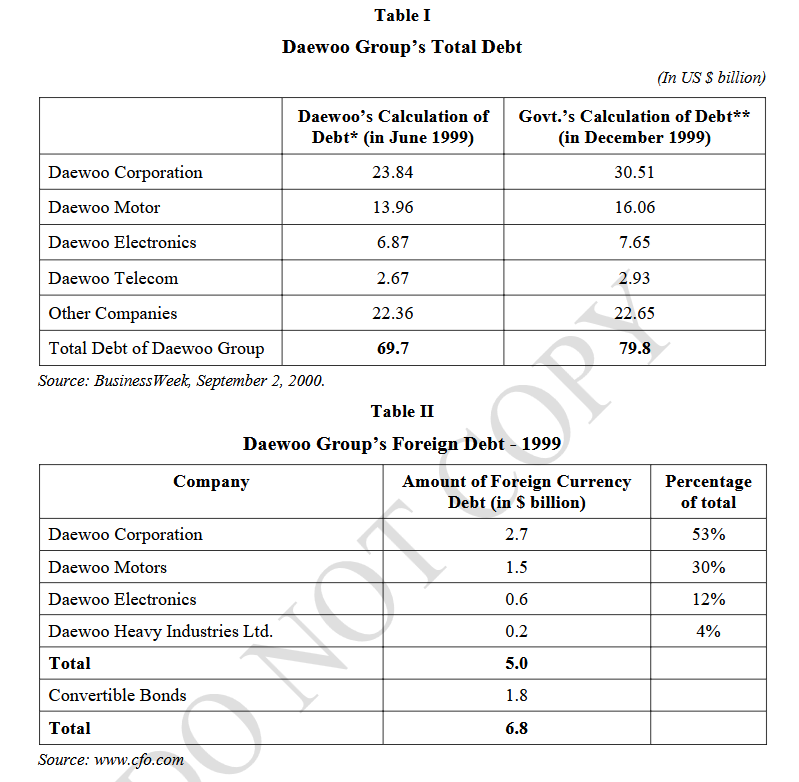
The economic scenario changed dramatically in the late 1990s. With the Southeast Asian financial crisis in 1997-98, bankers became more concerned about their funds and started demanding repayment. By that time, the Daewoo Group had taken huge loans. According to Korean Government estimates, by the end of December 1999, the Daewoo Group owed about $80 billion to various bankers as domestic and foreign debt, and the interest payments amounted to more than $6 billion per annum. Daewoo?s foreign currency debt totaled $9.9 billion: $6.8 billion from foreign creditors and $3.1 billion from Korean creditors in foreign currency. The foreign currency debt borrowed from foreign creditors was concentrated on four leading companies of the Group (Refer Table II).
The Daewoo Group entered the automobile industry in 1978 by acquiring a 50% stake in Saehan Motor Company (Saehan). Founded in 1972, Saehan was a 50-50 joint venture between Shinjin Motor, and General Motors (GM).6 In 1976, Shinjin Motors faced financial problems and sold its 50% stake in Saehan to the Korea Development Bank (KDB). In 1978, the Daewoo Group acquired the equity stake and management rights from KDB.
In 1982, Saehan owned a car assembly plant in Bupyong, a truck assembly plant in Pusan and a foundry at Inchon. In 1983, GM and the Daewoo Group agreed to rename their venture Daewoo Motor Company (Daewoo). In 1984, the partners decided to build additional assembly, stamping and engine facilities at Bupyong. The plants were dedicated to the production of a passenger car, Pontiac LeMans, based on the Opel Kadett platform. Production started in 1987 and about 50% of the cars were exported to the US and other international markets.
Pontiac LeMans was not successful in many of the international markets in which it was launched. This strained the relationship between GM and the Daewoo Group. Moreover, there were also quality problems and delayed deliveries. The partners had different opinions about capacity expansion, debt leverage, profitability objectives, marketing issues etc. Daewoo wanted to expand globally, but GM could not support the plan since it was facing financial problems in the US during the early 1990s. In 1992, GM withdrew the partnership and the Daewoo Group acquired the remaining 50% stake in the venture for $170 million. Soon after, Daewoo became the leading automaker in South Korea.
In January 1993, Daewoo established Daewoo Motor Sales and separated the sales and manufacturing operations. In the same year, the company established assembly plants in East Europe and Asia. At these plants, Daewoo manufactured successful models like Lanos, Nubira and Leganza. In late 1993, Daewoo became the first Asian carmaker to earn ISO 9001. As other companies of the Daewoo Group were not performing well, Kim concentrated on the automobile division and invested heavily in Daewoo. The company expanded its capacity rapidly. With low price and interest free installment offers, Daewoo soon became the leader in the South
Korean passenger car market, displacing Hyundai and Kia Motors. Kim wanted to make Daewoo one of the world?s top ten automakers, and to do so, he took more foreign debt for the company's expansion programs.
In 1994, Daewoo acquired an automobile engineering company IAD in the UK, and established the Worthing Technical Center. It also set up the Munich Technical Center in Germany to develop power trains. Daewoo seemed to have broken the rules of the industry when it established its own direct selling operations instead of a dealer network. The company also appointed Halfords to provide after-sales services in the UK.
Because of its price competitiveness and attractive servicing and warranty offers, Daewoo's cars attracted good demand in the international markets. By 1996-97, the company's totally indigeneous cars, Lanos, Nubira and Leganza, had captured significant marketshare in UK In 1998, Daewoo acquired Ssang Yong Motor and added new vehicles to its range, including the small car Matiz. In 1998, Daewoo Motors America was established to market Daewoo products. The company also expanded quickly to Japan and other countries.
However, the rapid expansion and the Southeast Asian Financial Crisis of 1997-98 left the company financially vulnerable. By the late 1990s, Daewoo had approximately $14.5 billion domestic and $1.5 billion foreign currency debt. As Daewoo?s debts were huge, its creditors became concerned and started demanding repayment.
Daewoo's problems started when Kim took huge debts to expand the automobile business. About $1.3 billion was spent on Daewoo?s expansion in developing countries. It acquired an additional $1.1 billion debt to buy Ssang Yong Motor. It was also reported that Kim had expanded Daewoo's global manufacturing capacities recklessly. He had established factories in Ukraine, Romania, Vietnam, and Uzbekistan with low investments and by making many false promises to the governments concerned. For example, in Poland, Daewoo acquired the government owned auto manufacturer by promising to invest $1.1 billion and to provide job opportunities for 20,000 workers. The company failed to fulfill its promises.
The company was unable to fulfill its promises because it overestimated demand in these countries. In 1994, one year after Daewoo started assembling cars in Vietnam, the country's economy witnessed a recession, which led to a 30% reduction in the demand for cars. The demand fell to just 5000 vehicles per annum. Daewoo recorded sales of only 423 units. Despite poor demand, Daewoo launched the Matiz in Vietnam, expecting a 50% increase in total demand by 1997-98. However, the actual demand did not match their expectations. To make the matters worse, the entry of competitors in the late 1990s resulted in a decline in demand for Daewoo's cars.
By late 1998, Daewoo faced problems in domestic as well as global markets. In 1998, total car sales decreased by 56% (to 234,000 units) in South Korea while Daewoo doubled its capacity, thus leaving substantial production capacity underutilized. In the same year, Daewoo America aimed to sell 100,000 cars in the US. Due to poor demand for its cars, the company offered steep rebates to increase volumes, but this move resulted in huge losses. In India, Daewoo lost more than $30 million per annum due to the discounts offered. In Western Europe, during 1998-99, Daewoo's revenues increased in UK, Germany and Italy only when it offered large discounts and interest free financing options. However, analysts expected that the trend would not continue for long.
To save Daewoo from collapsing, Kim came up with a restructuring plan in April 1999. As per He planned to sell about $7.5 billion worth of assets of other companies of the group and concentrate on the automobiles and finance business. Though the creditors appreciated the plan, it seemed difficult to execute. Lee Name, Director, Samsung Securities, explained, “Daewoo's problem is that nobody really wants to buy whatever they are selling – and certainly nowhere near their asking price.”
Kim planned to sell Daewoo Group's shipyards to a Japanese company for $4 billion. But Japan was planning to reduce its own shipyards by 50% due to over capacity. Kim also planned to sell the group's two Hilton hotels in Seoul and Kyongju. He expected $250 million for the hotel in Seoul. However, it was reported that offers did not exceed $180 million. Some analysts felt that the Group could not command the price it wanted because it lacked a strong brand name and reputation. Hunsaker, an analyst with ING Barings commented, “Daewoo never had a brand name; they were never a leader in anything; they never invested much money in research and
development. Hyundai may be as deep in debt, but it has a reputation, a brand name, and has invested in technology. You can't say that about Daewoo.”
Kim also planned to exchange the Group's electronics business for the Samsung Group's car division. However, Samsung was not interested in buying the debt-ridden Daewoo Electronics. A banker in Seoul said, “The only reason Samsung might want to buy Daewoo Electronics is to shut it down.” As part of the plan, in mid-1999, Daewoo laid off about 3000 workers and also slashed the wages of remaining workers by 30%.
Since Kim was not able to execute his restructuring plan successfully, in July 1999, the South Korean government declared Daewoo insolvent and put the company on sale. The government also set up a committee for restructuring Daewoo. In August 1999, the creditors of the Daewoo Group agreed to a restructuring program for the company. Thereafter, the Korean government released the Capital Structure Improvement (Special) Agreement (CSIA) for the Daewoo Group (See Exhibit II). As the foreign creditors were not participants in the CSIA, separate negotiations with them were planned.
Meanwhile, Daewoo employees opposed the sale of the company to a foreign automaker. There were strikes at all of Daewoo plants in Korea. One of South Korea's largest trade union groups, Korean Confederation of Trade Unions, also protested the sell-off. There were also protests from a group of activists comprising some high-profile members of the country. The group launched a campaign offering to buy Daewoo and make it a 'people's company.' The South Korean Finance Minister commented, “The campaigners are misguided. I think it's not the right direction. The most critical thing, if they want to revive Daewoo Motors, they should get labor and management and push them towards an agreement. That is the right direction.”
In February 2000, GM, Ford and DaimlerChrysler expressed interest in acquiring Daewoo. By June 2000, Ford entered into negotiations with the committee. However, after a few months of negotiations, Ford reported that its due diligence had revealed some discrepancies in Daewoo's valuation of its assets. In September 2000, Ford announced the withdrawal of its offer, citing the discrepancies in Daewoo?s accounts as the primary reason. From August 2000, Daewoo stopped paying its 19,000 employees since further loans were not sanctioned to the company.
In October 2000, GM and its partners, including Isuzu Motors, Fuji Heavy Industries and Suzuki Motors, announced their interest in acquiring a part of Daewoo?s assets. GM also insisted on the completion of the restructuring plan, which involved laying off hundreds of workers at various Daewoo plants. In November 2000, Daewoo was officially declared bankrupt and was put under court-receivership.
In February 2001, the Supreme Public Prosecution Office (SPPO)9 in Korea announced the arrest of Kim and seven of his close associates on four criminal charges (Refer Exhibit III). They were charged with organizing Asia's biggest single 'financial fraud-false accounting' between 1997-98, inflating the group's equity by $32 billion. Kim fled the country to avoid prosecution. The seven associates were tried in court and eventually jailed.
Amidst revolts and controversies, an agreement was reached between the Korean government and GM in September 2001. GM signed a memorandum of understanding with Daewoo's creditors acquire two plants in Korea and one each in Egypt and Vietnam, along with all their outstanding debts for $1.2 billion. The agreement also included the acquisition of 22 sales units of the company across the world.
In February 2002, GM made a renewed bid for some of Daewoo's assets to its main creditor KDB. In this new bid, GM expressed interest in only 9 sales units of Daewoo as against the earlier 22. It also refused to pay the $260 million debt of these units as it had discovered new debts in some of Daewoo's overseas operations, including Daewoo's plant in Egypt. GM announced that it would not honor the previous agreement if its new conditions were not accepted.
In April 2002, GM and Daewoo's creditors arrived at an agreement. According to this agreement, GM would create a new company (most likely to be named GM-Daewoo Motors), which would be owned jointly by Daewoo?s creditors and GM. GM would own a 67%10 stake in the new company, with an investment of $400 million. Creditors were to pay $137 million for the remaining 33% stake. The new venture also assumed $537 million in debt.
According to analysts, GM?s acquisition of Daewoo seemed to be the ideal solution for the latter's problems. An analyst commented, “GM badly needs Daewoo to establish a beachhead in the Asian market. And without GM, Daewoo will simply collapse.” They also opined that GM was the ideal buyer as it had owned a 50% stake in Daewoo till 1992. Moreover, most of Daewoo's vehicle designs were based on GM's. Analysts felt that in the long run, GM could use Daewoo to gain a foothold in Asia. Prior to the acquisition, GM depended solely on its European subsidiary Adam Opel to manufacture small cars for developing countries. As GM?s small car was not very successful, it planned to use Daewoo's expertise in developing such cars to tap Asian markets. The company felt that China, India and Thailand, were the key markets for the next 10 years. Alan Perriton (Perriton), who was in charge of GM?s business development in Asia, commented that Daewoo's acquisition, “gives us high-quality, low-cost products for the rest of Asia.”
However, some analysts felt that making Daewoo's acquisition successful would be a big challenge for GM. They said that restoring Daewoo?s brand image would require a lot of time and money. Commenting on the damage done, Perriton explained, “Sales have been hit badly because Koreans weren't sure Daewoo would survive. We have to let customers know that the company is back in business and stands behind its products.” By 2001, Daewoo's domestic marketshare had fallen to less than 15%.
Moreover, GM was facing problems in the US. Though its sales were more than those of DaimlerChrysler and Ford, GM's net earnings were decreasing. Some analysts felt that GM was adding to its problems by acquiring a company like Daewoo. Scott Sprinzen, a managing director at Standard & Poor, New York, said, “GM would seem to have its hands full with other challenges: struggling overseas alliances, including ones with Italy?s Fiat and Japan's Isuzu Motors.”
Will GM be able to integrate Daewoo's operations successfully? According to analysts, if the integration is successful, GM would be able to compete with Ford – world's No. 2 automaker – more effectively. An analyst commented, “If its game plan works out, the new Daewoo venture, for which it projects annual sales of $5 billion within a couple of years, could help GM put more distance between it and the No. 2 auto maker, Ford, which has been narrowing the gap.”
1. Comment on Daewoo Motor's international expansion strategy in several developed and developing markets. Briefly explain how the company built its presence in these markets. Do you agree with the approach adopted by the company?
2. To what extent is the promoter responsible for Daewoo's downfall? Comment on the culture, the ethical standards, and the corporate governance standards of the company.
3. Analysts seem to be divided over GM's decision to acquire Daewoo Motors. Briefly describe the synergies GM can achieve through the acquisition. What challenges will the acquisition pose for GM? Do you think acquiring Daewoo Motors was a good move on GM's part?
Exhibit I
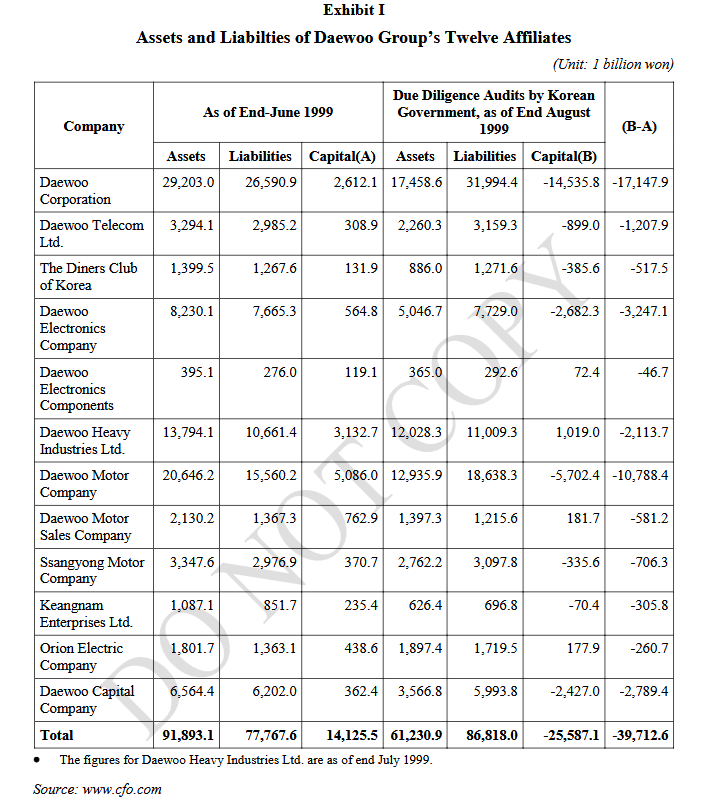
Exhibit II
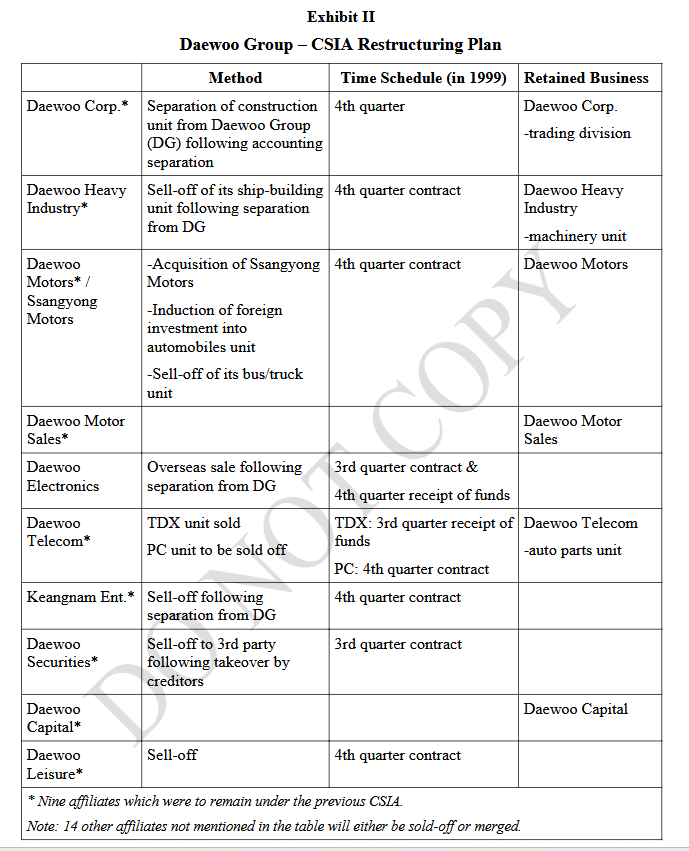
Exhibit III
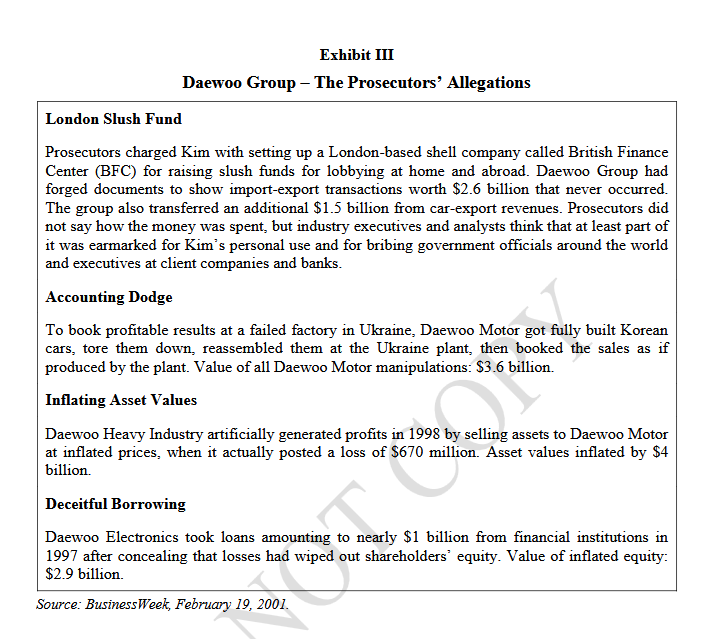
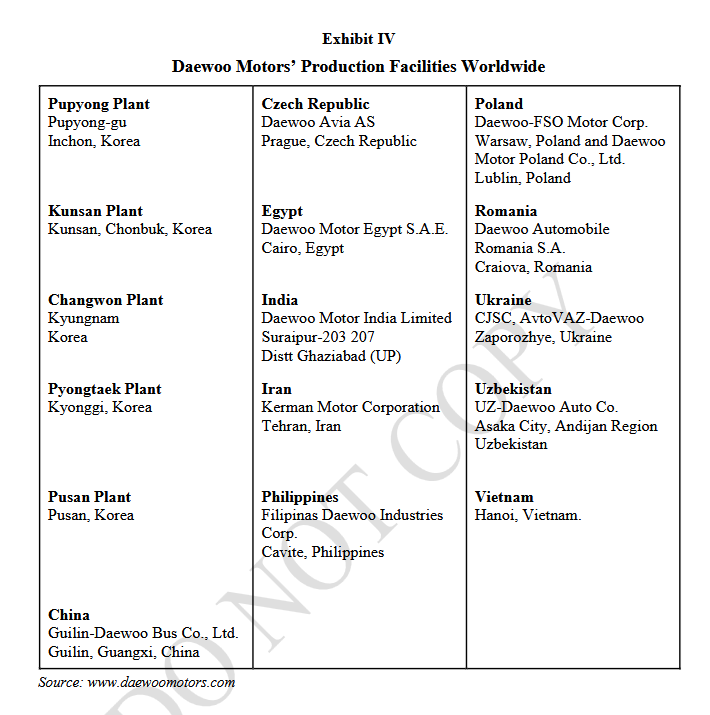
Exhibit IV
Keywords
South Korea, Daewoo Motors, Daewoo Group, huge debts, huge discounts, losses, financial mismanagement, Southeast Asian Financial Crisis, bankruptcy,negotiations, General Motors