
Modi Rubber Vs the Financial Institutions
🌐 International Buyers — Pay via PayPal
Details
FINC015
9
2003
YES
200
Modi Rubber Ltd.
Automotive
India
Financial Institutions
Abstract
The case provides a detailed insight into the events during a decade-long dispute between Modi Rubber (Modi) and its lender/owners financial institutions (FI). It examines the FI’s threat to sell their stake in Modi in the open market, which led to a major debate regarding the role of FIs in the companies in which they had an equity stake.
Learning Objectives
The case is structured to achieve the following Learning Objectives:
- Dual role of Financial Institutions as owners and lenders, Corporate Governance.
Contents
“How can they not offer us the right of first refusal to the shares? Can anyone question our commitment to the company?”
- B K Modi, commenting on the FIs selling their stake in Modi Rubber in the open market, in August 1996.
On June 30, 2001, a statement issued by Panduranga Rao (Rao),1 Chairman of Modi Rubber Ltd. (MRL) came as a big surprise to Indian corporate watchers. The statement revealed that the MRL board had, after a special meeting decided to strip Managing Director B K Modi of his functionary powers. Rao said, “We have been compelled to transfer all areas hitherto looked after by Dr B.K. Modi to the second MD (V K Modi – B K Modi's brother) for he is not giving enough attention to the affairs of the company.” The board also suspended three other directors, B K Gupta, R L Ahuja and Atul Prakash - all reported to be close aides of B K Modi.
What was more intriguing was the fact that B K Modi was absent from the meeting though a notice had been duly served to him. Rao commented, “The notice was served and the agenda was circulated. He cannot make us wait.” Further, the move was reported to have the backing of V K Modi as well. Though the two brothers were not known to be the best of friends, this move was rather unexpected.
The very next day, B K Modi held a press conference where he announced his rejection of the board's decision. He asserted that he was still the MD of the company and that the board was not empowered to remove him from the post. He claimed that the constitution of the board itself was doubtful since the previous chairman Bodhishwar Rai (an independent director) was 'unceremoniously' thrown out and replaced by a UTI nominee. This was against the guidelines of the capital markets regulator Securities and Exchange Board of India (SEBI), according to which the chairman should be an independent director and not a nominee director. He also said that there were no disputes between him and V K Modi. Analysts however took this with a pinch of salt as V K Modi was absent from the press conference.
On July 5, B K Modi sent a notice to V K Modi, charging him of breach of a shareholder's agreement between them. (The agreement mentioned that while he would look after the production side of MRL, V K Modi would look after sales and marketing. Moreover, it had been agreed that any change in this arrangement would require the mutual consent of the two brothers.) MRL's move against B K Modi eventually came to be seen as a major victory for financial institutions (FIs) in the decade long MRL/FI battle for control of the company.
MRL, established in 1971, was a part of the Modi Group of companies.While B K and V K Modi held 23.87% of MRL's equity, the FIs held 44.5% and the public held 31.63%2. A major part of the FI stake in MRL was with Life Insurance Corporation (LIC) and UTI. The other FIs involved were the Industrial Finance Corporation of India (IFCI) and the Industrial Credit and Investment Corporation of India (ICICI). The FIs had acquired their stake in MRL over the years, both through conversion of unpaid loans into equity and market purchases.
The company's business comprised the manufacturing and marketing of automobile tyres/tubes/flaps and retreading materials. A small portion of the revenue came from trading in tyres, tubes, flaps, garments and other articles. The company had a technical collaboration with Continental AG of Germany for manufacturing tyres. MRL's major customers included Telco, Ashok Leyland, Maruti Udyog, Punjab Tractors and Escorts. The company was present in almost all segments of the tyre industry - truck, bus, car, jeep, tractor (front, rear and trailer), scooter and motorcycle tyres. The company had an overall market share of 14.8% in June 1999 and its sales were concentrated in the truck and bus (T&B) tyres segment (around 45% in 1998-99). About 9.7% of the total production catered to the passenger car segment. Almost 10% of the total industry production of tractor tyres came from MRL.
The company had two plants in Meerut district and one in Ghaziabad district in Uttar Pradesh. In 1998-99, on an installed capacity of 2.42 million tyres and tubes each, MRL produced 2.31 million tyres and 2.144 million tubes. The company sold around 2.279 million tyres and 2.142 million tubes. Tyre sales contributed 90.9% to the gross sales turnover while sales of tubes formed 7%. About 87% of its production was sold locally with the rest catering to the export market. MRL was quite successful in building a strong base for itself in the export market.
Since the early days of MRL, B K Modi and V K Modi were reported to have 'rarely seen eye to eye.' Even after they signed a shareholder's agreement, their relationship never really improved. One of the main reasons for their differences was B K Modi's desire to get a higher share in MRL. The Modis had been defaulting on FI loans since the 1980s. After a formal split in the family in 1989, the Modis refused to repay the money they owed the FIs on the grounds that the crossholdings of the various family factions in Modi companies were so complex that the liability of each of the brothers could not be fixed till the division of property was effected. Since the Modi brothers could not arrive at an equitable division of assets, the Government appointed an arbitrator from IFCI. The arbitrator came up with a solution, which was summarily rejected by the Modis. Unhappy with the constant fights between the Modis and the way MRL was being run, Continental suggested an operational restructuring for the company in 1993, making it a pre-requisite for a joint venture to manufacture radial tyres, which was then under consideration. The FIs sanctioned a Rs 900 million loan and the restructuring exercise was initiated.
At this point, Modistone - a Modi group company slated to be merged with MRL - floated a Rs 360 million rights issue. This issue was heavily under-subscribed and UTI purchased Rs 200 million worth of shares it had under-written. According to the terms of the merger, if the merger was approved, the remaining Rs 160 million had to be accounted for by MRL. However, if the merger was not approved, the Modis would have to bring in Rs 80 million each because of the personal guarantees they had provided. MRL sources revealed that B K Modi saw this as an opportunity to acquire a bigger stake in Modistone - and consequently in MRL. He came up with the plan of opposing the merger proposal - which meant that the brothers would have to pay up Rs 80 million each. B K Modi was working on the premise that V K Modi would not be able to arrange this amount. In February 1995, B K Modi even stormed out of the meeting held for approving the merger proposal, hoping that it would be adjourned. However, the meeting continued and the merger was approved, dashing B K Modi's plans.
Even as the company was negotiating the joint venture with Continental in July, 1996, the FIs announced their decision to sell their MRL stake in the open market. In August, 1996, B K Modi's request to the FIs to reconsider their stance was turned down. This move was reported to be a result of a meeting, where B K Modi had misbehaved with P R Khanna, an independent director. This infuriated the FIs who then began thinking of ousting the Modis from the board. Media reports claimed that as a result of B K Modi's letter to the then Prime Minister Narasimha Rao, the FIs decided not to oust the brothers and agreed on a stake sell-off instead.
In early 1997, the FIs initiated moves to change MRL's management. This resulted in the resignation of five directors. In March, 1997, a committee headed by Unit Trust of India's (UTI) Chief General Manager, Research and Planning, Basudev Sen, (set up in 1996 to draw up guidelines on good corporate governance) submitted its report to the Government. In accordance with the report's recommendations, in August 1997, the FIs decided to recall their loans to the Modi Group and offered their holding to the Modi family, provided the deal was struck at an acceptable price. This announcement was a major climb down from their earlier stand that they would sell their holdings in the market.
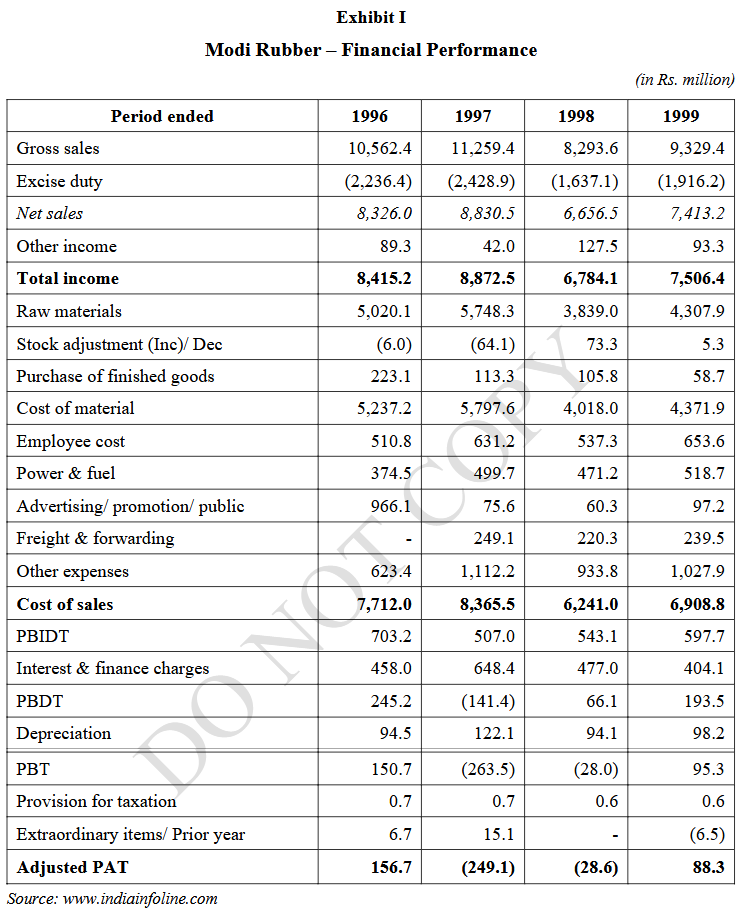
However, the recall of the loans to the Modi group clearly indicated that the intense lobbying by the Modis to pressure the FIs to abandon the use of the group approach policy4 (on fresh loans) against them had failed. The FIs threatened that if the Modis failed to raise the requisite funds, the open market sale option could be utilized. The FIs also refused to stand guarantee for loans raised by the Modis from other sources. The Modis continued to argue that the FIs would be playing a partisan role if they offered the shares to any other party without first offering it to them. For the year ending June 30, 1997, MRL posted a loss of Rs 150 million, against a profit of Rs 182 million in the previous year. (Refer Exhibit I for a summary of MRL's financial performance). This prompted MRL to appoint consultants McKinsey & Co, who designed a 42-point turnaround program for the company with a focus on raising productivity levels. Around 29 of these action points were to be implemented at the plant level and were aimed at improving worker efficiency. The turnaround plan also involved outsourcing tyres in those categories, where MRL did not make a good margin.
In December 1997, the FIs and Modis agreed to negotiate the purchase price of shares with in a period of three months and acquire the stake in another three months. The FIs also agreed to withdraw a proposal of coming out with a rights issue and on clearing off loan defaults by MRL without linking the acquisition of shareholding by the Modis. Though the FIs held a series of meetings with the Modis, the issue remained deadlocked due to differences regarding the loan repayments. The FIs did not want to have any exposure in the company after disinvestment of their holding. On the other hand, the Modis argued that the sale of stake and the issue of loans should not be clubbed together. The stalemate continued over the next few months with neither of the parties willing to budge from their positions.
In March, 1998, the Modis agreed to repay the entire outstanding FI loans if the FIs sold their stake to MRL for a price higher than the ruling market price of Rs 26.90 a share. This development was attributed to an agreement between the Modi brothers to put an end to their quarrels. The Modis offered to buy back UTI's holding in MRL at Rs 58 a share. However, UTI was asking for Rs 70 per share. The FIs had formed a committee to negotiate the price at which their holdings were to be sold. However, the negotiations reached a deadlock since the FIs were not willing to bring down the sale price from Rs 123 per share.
Meanwhile, MRL's sales declined to Rs 1.96 billion in the first quarter of 1998 from Rs 2.16 billion in the same period in the previous year. This was largely due to the shutting down of one of the company's units. In November, 1999, the Modis appointed Hong Kong & Shanghai Banking Corporation (HSBC) to provide a blueprint for increasing their stake in the company to 51%. The FIs responded by appointing SBI Capital Markets to divest their MRL stake through an open offer. The issue dragged on into the new millennium when another controversy arose. In February, 2000, some MRL shareholders filed charges against the FIs with the Monopolies and Restrictive Trade Practices Commission (MRTPC). The shareholders alleged that the FIs were acting in connivance with other tyre manufacturers.
In March, 2001, the Modis again made an open offer to buy a 35% stake in MRL at Rs 80 per share. By June, 2001, the price was revised to Rs 81.50. In a meeting of the heads of the FIs, it was decided that the price revision was not in line with the indicative offer made by the Modis earlier. They decided not to participate in the open offer and instead began planning their counter offer.
By July 1, the open offer price had been increased to Rs 90 per share, and within the next week the Modis picked up around 12% additional stake in the company. They also claimed to have reached an agreement with the FIs for buying out their stake at Rs 90 per share. However, the FIs denied this and confirmed that they would not participate in the open offer as they were not willing to sell their stake on a piecemeal basis6. Reacting to this, B K Modi said, “I fail to understand this new development. We have agreed to all the demands by FIs, whether it be buying out their entire stake, giving them a bank guarantee or whatever else it takes.”
By the end of July 2001, the Modis had received about 36% of MRL's shares through the open offer. Of this, around 10.8% had been sold by LIC. This came as a big surprise to all the parties concerned as it was directly against the stand taken by the insurance company as part of the FI consortium earlier. The other FIs involved lashed out strongly against LIC's move. Things soon took an interesting turn when LIC sent a letter to MRL stating that it wanted to withdraw the shares it had tendered in the open offer. But the Modis accepted LIC's shares after consulting legal experts. These experts confirmed that a company could not go back on an open offer. The matter
was referred to the SEBI, which decided that LIC could not withdraw the shares as it had itself tendered them in an open offer. SEBI argued that if such about turns were allowed, the whole process of open offers would be plunged into chaos and people would begin finding different reasons for withdrawing their shares from open offers.
LIC then moved the Mumbai High Court for an injunction against transfer of its holding in MRL to the Modis. LIC sources revealed that the transfer of its 12% holding had happened 'inadvertently.' They said it happened without the approval of its investment committee, whose clearance was mandatory. The transfer documents allowing the Stock Holding Corporation of India (SHCIL) to transfer LIC's shares to MRL were signed by two officers 'by mistake' - both of whom were later suspended by LIC. The Court granted a temporary injunction on LIC's participation in the MRL open offer. In an interim order, the court said that LIC's shares could not be considered for the open offer. In turn, LIC was asked to submit an undertaking that it would not transfer its shares until the final hearing and disposal of the suit.
The Modis' predicament was not difficult to understand. The brothers claimed that on the one hand, the FIs refused to sell their stake; on the other, they were not allowing MRL to borrow from anyone else. The Modis also claimed that the interest rates being charged by the FIs (nearly 19%) were very high. After repaying these loans, they wanted to look for cheaper loans elsewhere. B K Modi said, “We want to return the entire loan taken from them, and look for cheaper loans from other banks. Why should we service such a high cost debt? And if we return their loan, we would also get them out of our board. For a long time, they sat on our board and did not allow us to borrow from other banks. With them out of our board, we would be able to run the company in a productive manner.”
The MRL issue came to be seen as an example of the controversial role of FI lenders in Indian companies. The FI announcement to sell their stake in the open market in 1996 sent shock waves through India's family-run businesses (in which the FIs held large stakes7.) For decades, the promoters had management control despite having low stakes because the FIs neither voted against the management, nor sold any shares. But now, businessmen across the country feared that if the MRL stake sell-off succeeded, FIs would make it a norm to sell out if any company defaulted on any loan. Besides, companies operating in industries suffering from cyclical downturns could be unduly penalized this way. K P Singh, President, Associated Chambers of Commerce & Industry (ASSOCHAM8), said, “Certain cyclical industries may suffer a bad period, but this is no reason to punish an entrepreneur. This man has put in sweat for his company and now suddenly by selling out, the institutions are punishing him.”
MRL's predicament raised a heated debate in the chambers of commerce as well. Statements from business houses, chambers of companies and FI officials regarding the MRL issue kept appearing frequently in the media. A FICCI9 source said that if the FIs decided to sell out, they should offer the first right of refusal to the promoter at the market price. Both FICCI and ASSOCHAM appealed to the Government to intervene and stop the FIs, while the Confederation of Indian Industry (CII)10 supported the FIs. Though there were rumors of some pressure from the Government, eventually it decided to keep out of the tussle. In November, 1999, the Government declined to take sides in the MRL/FI tussle. Finance Minister Yashwant Sinha said, “Would you like the government to intervene in the commercial decisions of the financial institutions? Here, the question is of trust, and the FIs should not do anything to destroy this trust. They should work on mutual understanding, and transparency cannot be made a victim. If the FIs feel that they are getting a good deal by selling their stake, who am I to ask?”
More than the fear of getting a bad price for their stake, the companies feared that no one could predict exactly when the FIs would decide to sell their stake. The FIs played a dual role in the companies in which they held stakes – they were term lending bodies as well as investors. This made it difficult to predict their moves. For instance, if an FI was facing a problem with non- performing assets (NPAs),11 it could either start selling shares indiscriminately to raise money, or it could selectively target companies or groups which were defaulting on their loans.
The fact that different categories of FIs had different motivations for lending to companies further compounded the problem. Broadly, the FIs could be put in three categories - development finance institutions (IDBI, ICICI, IFCI); insurance companies (LIC, GIC); and the UTI, an asset management company. The development finance institutions were believed to be rather stable, long-term shareholders, who claimed not to be interested in destabilizing existing managements. A senior IDBI official commented, “By selling in Tata Steel or ITC alone, we can provision for most of our NPAs. But I don't think this will ever happen. The whole country will be up in arms against us.” A senior ICICI executive added, “Any sale of equity is bound to be controversial.”
However, it was a different story where the insurance companies and the UTI were concerned. These institutions were under increasing pressure to maximize returns on their investments, and they had to consider shifting their investments from traditional manufacturing companies to the then sunrise sectors like IT and Pharmaceuticals. Moreover, unlike development finance institutions, their investments were marked to market - hence, they needed to constantly review their investments. UTI General Manager, Basudeb Sen said, “Institutions like ours are asset managers now; we have a responsibility towards our shareholders. Now, decisions have to be made looking at the market. Conditions of 10 years ago don't have any meaning today.” This was why UTI sold 7% of its stake in MRL in 1997. Though UTI, LIC and GIC sources said that they would never resort to selling shares of any company arbitrarily, they maintained that MRL was a special case.
The core issue involved in the MRL affair seemed to be the accountability of the management to its shareholders. The fact that MRL had been performing badly over the years reflected badly on its commitment to enhance shareholder wealth. The company's defaults on loan repayments were largely responsible for FIs acquiring almost 44% of its equity. A report claimed, “Sound corporate governance can be effected only through an efficient market for corporate control. Companies should be allowed to be taken over by those who think that they can run them better. When a company is run sub-optimally, it makes sense to buy up a controlling stake in it by making an outlay justified by future income streams from the company bought over, and to run that company.”
In mid-2001, MRL was reported to have begun work on a comprehensive turnaround strategy. It infused Rs 500 million to modernize its operations and implemented stringent cost-cutting measures. The Modis also began negotiations for selling the non-tyre assets of the company to raise the money for augmenting the working capital base. This was deemed necessary to make the company profitable once again.
The Modis had begun negotiations to get the FI loan freeze removed. The total capacity utilization of MRL?s facilities was under 60-65%, which was proposed to be raised after the restructuring. Substantial salary cuts for senior executives of the company and the formation of a management team with well-defined work targets and instructions to report to the Modis were also on the anvil.
Even as legal battles over the dispute with LIC?s open offer issue continued, MRL suspended the manufacturing activities at its Modipuram plant in August, 2001. Though the exact reasons were not revealed, sources cited certain administrative reasons, beyond the control of the management, for the decision. B K Modi meanwhile had unconditionally withdrawn the notice sent to V K Modi and the two brothers were reported to be working frantically to get the plant operational again. There appeared to be a lull in the battle between the FIs and the Modis - at least until one of them made a move.
1. Study the Modi Rubber/FI issue and prepare a brief note outlining the major events occurring during the course of the dispute.
2. Were the FIs justified in adopting the group approach policy towards MRL? Do you think that the company's poor performance over the years is partly because of the FIs? Give reasons to support your answer.
3. The FI threat to sell their MRL stake in the open market was part of a plan to ensure that Indian companies adopt good corporate governance practices. Critically comment on the above statement.
 |
Keywords
Insight, decade-long, Modi Rubber, Modi, lender/owners, financial institutions, FI, Modi, open market, equity stake