Consumers Behavior
 |


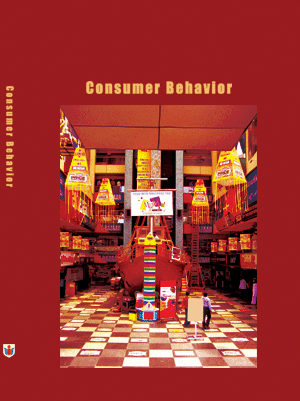
Details
Chapter Code: CBC01
Textbook:
Pages : 374; Paperback
210 X 275 mm approx.
Short Case Studies
Detail Table of Contents
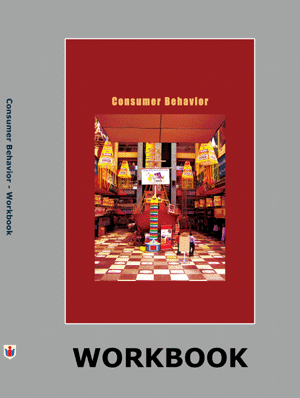
Workbook:
Pages : 304; Paperback;
210 X 275 mm approx
Pricing
Textbook Price: Rs. 750;
Workbook Price: Rs. 700;
Shipping & Handling Charges: Rs. 50 per book;
Books Available only in INDIA
Chapter Price : Rs. 100
To download this chapter in electronic format, click on the button below,
and select the chapter from the list of available chapters.

Buy Now
To order the entire book click on the button below, and select the book from
the list of available books:
Please allow 5 to 10 days for delivery of the
Book.

Consumer Behavior : Chapter 1
SUMMARY:
The discipline of consumer research has its roots in marketing research. There are two paradigms of consumer research – qualitative and quantitative. While qualitative deals with consumer insights in a visual form or in words, quantitative is primarily number driven. Some researchers now use both these techniques together to get more accurate insights. The consumer research process focuses on defining the research problem, conducting exploratory and evaluation, conclusive research design and qualitative and data collection, analysis, and report.
|
|
The researcher has to select the methods of data collection, which can be quantitative and qualitative. Quantitative data collection methods include: observation (researcher observes the activities of the consumer), experimentation (the consumer reactions to change in product feature, price etc. are studied in the laboratory, under controlled conditions, or in the field), and survey (consumer is directly approached for information). There are many quantitative techniques or tools which are used for primary data collection – questionnaire (consumer is directly asked questions through mail, over telephone, online, or through personal interview) and attitude scales (attitude measurements techniques like graphic rating, semantic differential, ranking, and Likert scale).
The qualitative methods of data collection are – depth interviews like in-depth interviews (personal interview with unstructured questionnaire) and focus groups (group interaction to study the consumer); projective techniques like completion technique (sentence and story completion), association technique (single word, phrase, or sentence), and construction technique; and metaphor analysis (collage making, ZMET, and means-end chain model). Sampling is an important part of the research design and involves the selection of sampling unit, sampling method, and sample size depending on the time and cost factors. Sampling is followed by data collection, analysis, and report.
Related Case Books:-
 Case Studies in Consumer Behavior
323 pages, Paperback,
Available only in INDIA

Related Textbook:-
 Marketing Communications Textbook
210 X 275 mm approx,
Price: Rs. 750;
Available only in INDIA
