Consumers Behavior
 |


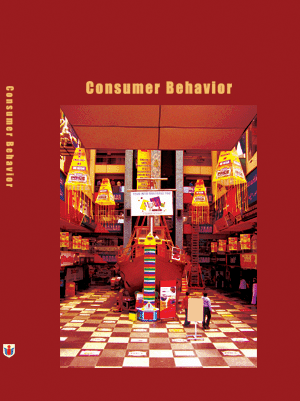
Details
Chapter Code: CBC11
Textbook:
210 X 275 mm approx.
Short Case Studies
Detail Table of Contents
Workbook:
Pages : 304; Paperback;
210 X 275 mm approx
Pricing
Textbook Price: Rs. 750;
Workbook Price: Rs. 700;
Shipping & Handling Charges: Rs. 50 per book;
Books Available only in INDIA
Chapter Price : Rs. 100
To download this chapter in electronic format, click on the button below,
and select the chapter from the list of available chapters.

Buy Now
To order the entire book click on the button below, and select the book from
the list of available books:
Please allow 5 to 10 days for delivery of the
Book.

Consumer Behavior : Chapter 11
SUMMARY:
Culture is a set of socially transmitted beliefs, values, and customs. It is a collective social phenomenon and influences the consumption behavior of individuals throughout the world. Consumer beliefs are related to consumers' knowledge and both consumer beliefs and values help them in the evaluation of stores, products, and brands.
|
|
Different cultures differ in their basic beliefs, values, and customs. The learning of one's own culture is known as
'enculturation' while learning of a foreign culture is known as 'acculturation. 'Language, symbols and rituals are also important ingredients of a culture and play an important part in marketers' communication to the target market, which may be a local community or a foreign market.
There are three techniques to measure culture - content analysis (the content of local communication is reflective of the cultural values and way of life of a society); consumer fieldwork (the use of qualitative and quantitative techniques of consumer research to understand the cultural behavior and its influence on consumption); value measurement survey instruments (directly asking people about their cultural values). There are three instruments of value measurement survey
- the Rokeach Value Survey, List of Values method (LOV), and Values and Lifestyle Survey (VALS).
Every culture has some core values; however, in the context of consumer behavior, core values are determined on the basis of - acceptance by a majority of people in a society, endurance over a long period of time, and significant relationship with consumption behavior. Cultures are further divided into smaller cultural units known as sub-cultures. The basis of division can be nationality, social class, religion, region, language, occupation, age, sex, etc. An individual can be a member of one or more sub-cultures simultaneously.
Consumers all over the world are from different nations and have different cultures. The world focus on free trade has led to a large number of marketers targeting consumers in foreign countries. These marketers need to understand that the purchase intention of the potential consumer is greatly influenced by the image of the country-of-origin. The image of the country can be related to some specific products or product categories. Consumers from different countries can have different perceptions of products from a country. The domestic consumers themselves may be greatly influenced by the image of the country and may prefer a foreign product from a country that they perceive to be good at producing such products.
Sometimes, the international relations among nations also influence the purchase intentions of the potential consumers. Consumers of nations with a recent history of animosity may not buy products from each other even though they are aware of the better quality of these products/brands. Consumers may also feel that that it is immoral to buy foreign made product/brands (consumer ethnocentrism).
Marketers often have to make choices on whether to adopt a global marketing strategy or a local marketing strategy. Global strategy means that there is no change in brand name, attributes and promotion strategy across nations. Many marketers, however, prefer a more flexible approach to marketing, using a mixture of both global and local strategies, i.e., a global strategy with local implementation. Marketers often make the mistake of ignoring the cultural differences in terms of consumer needs (product problems), promotion, pricing, and distribution, leading to failure.
Related Case Books:-
 Case Studies in Consumer Behavior
323 pages, Paperback,
Available only in INDIA

Related Textbook:-
 Marketing Communications Textbook
210 X 275 mm approx,
Price: Rs. 750;
Available only in INDIA
