Consumers Behavior
 |


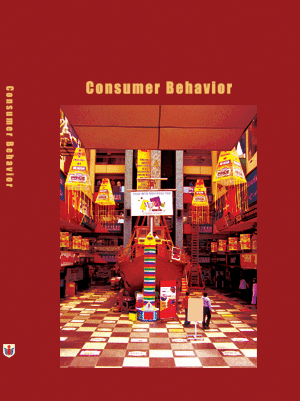
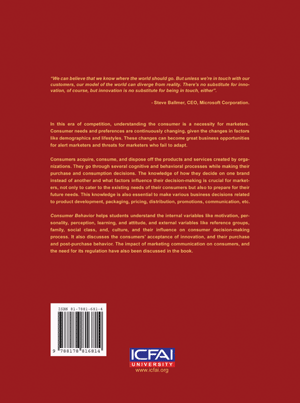
Details
Chapter Code: CBC18
Textbook:
Pages : 374; 210 X 275 mm approx.
Short Case Studies
Detail Table of Contents
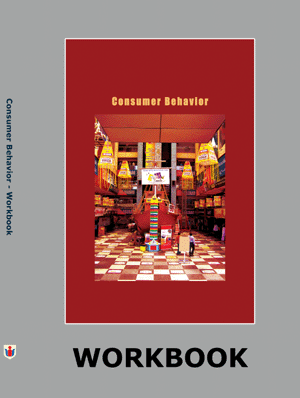
Workbook:
Pages : 304; Paperback;
210 X 275 mm approx
Pricing
Textbook Price: Rs. 750;
Workbook Price: Rs. 700;
Shipping & Handling Charges: Rs. 50 per book;
Books Available only in INDIA
Chapter Price : Rs. 100
To download this chapter in electronic format, click on the button below,
and select the chapter from the list of available chapters.

Buy Now
To order the entire book click on the button below, and select the book from
the list of available books:
Please allow 5 to 10 days for delivery of the
Book.

Consumer Behavior : Chapter 18
SUMMARY:
Consumerism or consumer activism, seeks to protect consumer rights. It can yield better results if supported by a large section of the consumer population and the benefits are greater than the costs involved. The issues related to consumerism could be many - from increasing prices to misleading advertising to business ethics to environment. In the U.S., consumer movements started in the early twentieth century and are still a part of their society.
|
|
The privacy of information provided by children to various websites too is becoming a major cause for concern. Consumers, however, are realizing the value of information on their purchase pattern and are showing a willingness to sell it to marketers through some trustworthy intermediaries.
Consumers are bombarded with marketing messages on a continuous basis. They, however, do not agree that advertisements are always for their information. The many charges brought by consumers against advertisements are
- deception (false promises), artificial need creation, increased cost, materialism, use of offensive images or wording, etc.
A major concern for consumers has been with respect to marketing activities that directly or indirectly target children. It is believed that advertising can impact children adversely, as they are unable to understand the hidden motivators in it. Even products targeted at adults can affect children and influence their brand/product preference. Marketers also sometimes show children in the wrong light, say as child laborers, thereby glorifying a social evil.. Parents also charge that many products targeted at children promote consumerism.
Products like credit cards and debit cards, lemon-flavored alcoholic drinks, nicotine water, and candy-flavored cigarettes are directly or indirectly influencing children. Despite their perils, advertisements serve an important purpose in the form of social marketing. Social marketing refers to the use of commercial concepts for non-commercial causes like AIDS control, anti-child labor movement, family planning, etc. Social marketing initiatives usually lead to gradual changes in attitudes of the society. Marketers, on their part, blame consumers for consumer frauds, consumer terrorism, and anti-consumerism.
Consumer frauds include shoplifting, returning used merchandise, eating an unbilled item in the store, not reporting a favorable billing error, and returning merchandise bought on sale from one store to another store to get a refund, etc. Consumer terrorism refers to the tendency of some consumers to benefit at the cost of marketers. Anti-consumerism is a concept finding favor all over the world, with many organizations around the world actively considering
'buy nothing' days.
The watchdogs, i.e., the government and non-government organizations, are actively promoting consumer rights, which include the right to safety, right to be informed, right to choose, right to be heard, right to seek redress, and right to consumer education. Some important acts/regulations related to Indian consumers are the Consumer Protection Act, 1986; Bureau of Indian Standards Act, 1986; Essential Commodities Act, 1955; and The Standards of Weights and Measures Act, 1976.
Indian advertising has a self-regulatory body, the Advertising Standards Council of India or ASCI, to monitor advertising and take appropriate action. Non-governmental initiatives for consumer rights are the various consumer-action groups like the Voluntary Organization in Interest of Consumer Education (VOICE), Consumer Coordination Council (CCC), and Consumer Education & Research Centre (CERC). All these work for diverse consumer issues.
Related Case Books:-
 Case Studies in Consumer Behavior
323 pages, Paperback,
Available only in INDIA

Related Textbook:-
 Marketing Communications Textbook
210 X 275 mm approx,
Price: Rs. 750;
Available only in INDIA
