
Prudential Financial Inc.
Details
BSTR114
31
2002
YES
500
Prudential Financial Inc.
Financial Services
US
Corporate Strategy
Abstract
The case provides detailed information on various functional areas of Prudential Financial Inc (Prudential) including marketing, human resources and finance. The case discusses the company's history since inception, product segments including US Consumer, Employee Benefits, International, and Asset Management and the various geographic regions in which the company operates and the revenues derived from these regions. The case also includes information regarding the company's social responsibility initiatives and corporate governance standards. It covers the future prospects of Prudential and problems faced by the company like market conduct allegations and unethical sales tactics adopted by the company's sales personnel. It also covers information on the reorganization of business segments in August 2002. Finally, the case includes a detailed note on the global insurance industry outlook.
Learning Objectives
The case is structured to achieve the following Learning Objectives:
- Strategies to be adopted by Prudential in the global insurance industry.
Contents
Prudential Financial Inc.
"I wouldn't say they are as lean and mean as John Hancock was when it went public, but they have come a tremendous way. I think in terms of corporate culture, Prudential needs to get organized to decide with whom it competes – other financial services such as Merrill Lynch and [Charles] Schwab, not just MetLife, New York Life and other insurance companies."
- Colin W. Devine, vice-president of Salomon Smith Barney, New York in (January 2001).
"Prudential remains a highly respected name in insurance. The company's biggest challenge now is to change its corporate culture to one that reports to shareholders every 90 days.”
- Thomas Upton, Analyst, Standard & Poor’s in (January 2001).
INTRODUCTION
With revenues of $27.18 billion in 2001, Prudential Financial Inc. (Prudential) was the second largest individual life insurance company in the US. Founded in 1875, Prudential had emerged as the leading life insurance company in the US and one of the largest providers of financial services in the world. The company had more than 15 million individual and institutional customers across the globe, in more than 30 countries. In the Fortune 2002 Survey, Prudential was ranked 62, up from its rank of 80, in the Fortune 2001 Survey.
Prudential offered a variety of products and services, such as life insurance, property and casualty insurance, mutual funds, annuities, pension and retirement-related services. Prudential also offered administration services, asset management, securities brokerage, banking services, real estate brokerage franchises3, and relocation services.
Before December 2001, Prudential was known as Prudential Insurance Company of America. In December 2001, Prudential embarked on a demutualization5 program, with an initial public offering (IPO) worth $3.48 billion. After demutualization, the shares were traded in the name of Prudential Financial Inc. The IPO transformed most of the Prudential Insurance's 11 million policyholders into shareholders.
In August 2002, Prudential reported a 62% drop in its profit for the first quarter from $250 million in 2001 to $95 million in 2002. The company had huge losses on bad investments particularly in telecommunications and energy companies. Prudential put its losses from bad investments at about $343 million, including losses of $83 million arising out of its holdings in WorldCom6. As the stock markets were sliding, Prudential announced that it expected very low full-year earnings per share – between $2.10 and $2.30 (Refer Exhibit I).
HISTORY
EARLY HISTORY
In 1875, John Dryden (Dryden), an American senator, founded a life insurance company, the Prudential Friendly Society (Prudential Friendly) in Newark, New Jersey, USA. He founded the company with the revolutionary idea of offering coverage to the industrial workers and people with low incomes. He believed that poor people, who were on daily wages, were the ones who really needed insurance. In its initial years, the company's operations were limited to Newark. Prudential Friendly settled claims within 24 hours, which no other company did in those days. In 1877, the Prudential Friendly Society was renamed Prudential Insurance Company of America.
(Prudential Insurance). As the fame of the company spread, the company decided to open branches in other towns of New Jersey in as well. In April 1878, the company opened its first branch office in Paterson, New Jersey.
In 1879, the John Hancock Mutual Life Insurance Company and the Metropolitan Life Insurance Company (MetLife) of New York also entered the industrial insurance business. Prudential Insurance and these two companies experienced exceptional growth. In 1885, Prudential Insurance reached the 'one million policies' mark, which was commemorated by issuing the one millionth policy to its founder, Dryden. In 1886, Prudential Insurance opened an agency in Missouri. By 1891, Prudential, Hancock and MetLife were called the 'Big Three' and held about 95% of the entire industrial insurance business in the US. MetLife was the leader with 4,855,766 policies, followed by Prudential Insurance with 3,406,189 policies, and John Hancock with 1,069,197 policies. With the business proving very successful, Dryden decided to establish the company's status by constructing the „Prudential Building? in 1890. The Prudential Building was New Jersey's largest office building at that time, with new facilities like electric lights, hot and cold running water, elevators, etc.
In 1898, Prudential Insurance entered into the largest transaction in the insurance industry until that time. The company received a check worth $13,221 from Hahn and Company, a departmental store in Newark, as the annual premium on a $400,000 partnership life insurance policy. The transaction marked a great achievement for the company and it became a leading company in terms of revenues displacing many of the established insurance companies during that time. In 1909, Prudential Insurance entered Canada, and established offices in Hamilton, London, Stratford, Toronto and Montreal. By the end of the year, the company had offices in 25 cities in
Canada. By the late 1920s, Prudential was a leading insurance company in Canada.
During the early 1900s, Prudential Insurance worked towards increasing public awareness of the need for insurance. In 1912, all the employees of the Evanston, Illinois branch in the US, started working as agents and made weekly visits to the policyholders. An old employee at Prudential Insurance recollected, "An agent was sent out with a rate book on foot or bicycle. In heat, blizzard, or flood, Prudential Insurance agents sold countless policies in every town in the country. They did more – they sold the idea of insurance to the people of America." In 1918, during World War I, an influenza epidemic struck and hundreds of people died. This stretched the company's finances, beyond limit but Prudential was able to process a record 85,000 claims in four months.
During the 1930s, Prudential Insurance expanded to most states in the US. Its agents were extremely committed, and worked even in conditions of bad weather to reach people in remote areas, such as the miners in Montana. The employees were also committed to larger civic causes and participated in various social programs.
In the early 1940s, during World War II, Prudential Insurance created a special war division to speed up the processing of military claims. From the late 1930s to June 1946, Prudential paid more than $70 million in claims for about 100,000 policies.
In January 1948, Prudential Insurance established a Western Home office in Los Angeles, California, US. By the year-end, more than 1100 employees and families were shifted to the new location. In December 1950, Prudential Insurance opened its Canadian head office at King and Bay Streets in Toronto. In 1952, Prudential Insurance opened its Southwestern Home office in Ontario, Canada. Prudential Insurance had made sales worth $108 million in 1950, in Canada, and was an established name there.
In the mid-1950s, Prudential decentralized its administration, which had, until then, been concentrated in Newark. The company felt that decentralization was the best way to speed up customer service. It wanted to offer the fastest, most efficient and most personalized service to its customers.
Prudential Insurance strengthened its network of agents throughout the country. It advertised widely, encouraging people to become Prudential Insurance agents. The agents reported to the regional offices of Prudential, which, by this time, had spread all over the country. Carroll Shanks, President, Prudential Insurance, said that the company was committed to remain, “essentially a home-town operation, serving thousands of local communities.”
In 1971, Prudential Insurance established the Prudential Property and Casualty Insurance Company (PRUPAC) to underwrite and market automobile and homeowners? insurance. At the same time, Prudential created subsidiaries to market personal lines property and casualty (P&C) insurance. This new segment witnessed rapid growth throughout the US.
In 1976, Prudential entered into a joint venture with Bradesco Seguros, a Brazilian insurance company. The joint venture was called Prudential-Bradesco Seguros Life Insurance. In 1979, Prudential entered Japan through a joint venture with Sony Corporation and formed Sony Prudential Life Insurance Corporation.12 In 1983, Prudential Insurance started marketing individual variable life policies.
RECENT HISTORY
During the 1980s and 1990s, Prudential Insurance expanded its operations to other countries in Asia. It formed a new division – International Operations in the early 1980s. In 1987, Prudential started its own operations in Japan. In the mid-1990s, Prudential Insurance conducted surveys in various international markets. Based on its surveys, the company established operations in Korea, Taiwan and Italy in 1995-96. The company also started operations in Spain but closed down soon. In 1997, Prudential Insurance entered several countries including Brazil, Argentina, Philippines and Poland.
In September 1998, Prudential Insurance established a joint venture with Mitsui Trust and Banking Company Limited (the largest trust bank in Japan), called Prudential Mitsui Trust Investments Limited.. The venture was established to market investment trusts14 in Japan. In November 1998, Prudential Insurance formed a joint venture with Cousins Properties based in the US, with an investment of about $230 million. The joint venture raised funds for real estate development. Cousins Properties contributed nine properties including four power centers, to the joint venture. In January 2000, Prudential acquired Mexico-based Operating Apolo Societies of Investment, a portfolio management company involved in offering access to different financial markets in Mexico. Founded in 1998, Apolo managed the portfolios of more than 3000 clients, and was the third largest portfolio management company in Mexico. It was renamed Prudential Operating Apolo Societies of Investment (Prudential Apolo).
In February 2001, Prudential Insurance formed a web-based insurance agency named Fusura, jointly with American International Group (AIG) and Kemper Insurance Company. The agency initially offered automobile insurance through its website www.fusura.com. It also planned to offer personal lines insurance and financial services products.
In August 2001, Prudential Insurance acquired Kyoei Life Insurance, Japan's 11th largest insurance company. In October 2000, Kyoei Life had declared bankruptcy with debts of about $42 billion. It was reportedly Japan's biggest-ever-corporate failure. Prudential acquired the total capital of Kyoei for $403 million and paid subordinated loans15 of about $790 million. Prudential announced that Kyoei Life would resume operations under the name Gibraltar Life Insurance Ltd. Analysts felt that the acquisition would support Prudential's existing operations in Japan, which focused on individual life policies. The acquisition also brought with it 6000 agents, 500 offices and about 5 million policies.
In December 2001, Prudential completed its demutualization process, which had started in January 1998 (Refer Exhibit II). It came out with an IPO which raised $3.48 billion including an additional $450 million raised by underwriters. After demutualization, Prudential?s businesses were reorganized into two separate segments – the Closed Block business and the Financial Services business. The closed block business retained the participating policies and annuities. The Financial Services business was listed on the NYSE under the name Prudential Financial Inc.
In January 2002, Prudential entered into an agreement to make an investment in FinanzAttiva Gestioni SGR, the asset management business of Banca Popolare di Bergamo - Credito Varesino (BPB-CV), one of Italy?s largest private banking groups. Initially, Prudential had acquired a 5% equity stake in the company with the option of increasing the stake to 35% in 2003 or later. The venture, called BPB Prumerica Global Investments SGR, was expected to function as a joint venture to develop, manage, market and sell investment products and solutions in the retail and institutional markets of Italy.
In February 2002, Prudential entered into a stock purchase agreement with IXE Grupo Financiero of Mexico, to acquire a stake in Afore XXI S.A. de C.V., which was a joint venture between IXE and Instituto Mexicano del Seguro Social (IMSS).16 The acquisition was expected to expand Prudential?s presence in Mexico. Afore was the ninth largest pension manager in Mexico. In March 2002, Prudential entered into a partnership with Evergreen Investment Services Inc., SunAmerica Capital Services and Schoolhouse Capital LLC to launch Arrive Education Savings Plan. The product was aimed at college students designed to finance books, tuition fee, boarding
and lodging and other expenses of college students.
In July 2002, Prudential acquired a 100% equity stake in Pma Finanz-und Versicherungsmakler AG, a leading independent financial advisory firm in Germany. Pma had a network of 200 independent financial advisors and about 50,000 clients across Germany. To further expand in Germany and enter the retail mutual fund market, Prudential established a joint venture with Sal Oppenheim Jr. & Cie KGaA, which was one of the leading private banks in Europe. In the same month, Prudential entered into an agreement with Grupo Financiero Finamex SA de CV and Finamex Casa de Bolsa, SA de CV17 through its subsidiary Prudential Apolo. As per the agreement, Prudential was to acquire a 100% stake in a mutual fund management company, Operadora Finamex SA de CV (Operadora Finamex) – the 19th largest fund management company in Mexico based on assets under management (AUM). Prudential wanted to integrate this company with Prudential Apolo.
BUSINESS SEGMENTS
After the demutualization process was completed in December 2001, Prudential's operations were organized into two business segments - Closed Block Business and Financial Services Business. The Closed Block business was established for certain individual life insurance policies and annuities issued by Prudential Insurance Company of America in the US. It represented the traditional participating products segment18 before the demutualization process. It also included the company's participating life insurance and annuity policies; assets that were used for paying the dividends and other benefits of the policies; and, other assets and equity that supported these policies. As the company was demutualized, Prudential stopped offering the participating products. No policies sold after the demutualization were added to the closed block business.
The Financial Services business segment (Refer Table I) operated through four business divisions including US Consumer, Employee Benefits, International, and Asset Management. The US Consumer division offered insurance, financial advisory services, consumer banking and investments. The Employee Benefits division offered insurance, disability and retirement plans. While the international division offered insurance, securities trading and international asset management services, Asset Management division offered institutional asset management and proprietary activities.
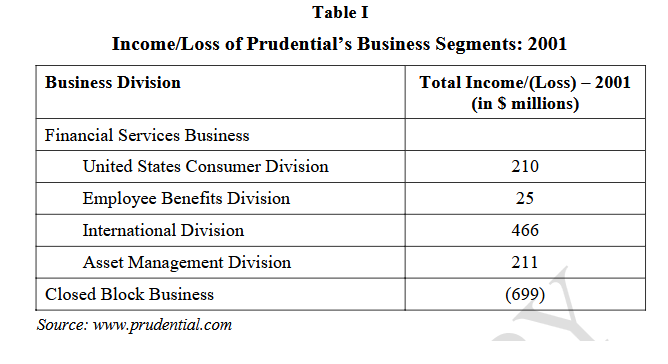
United States Consumer: With a total income of $210 million in 2001, this division comprised of four segments, i.e., Individual Life Insurance, Private Client Group, Retail Investments, and Property and Casualty (P&C) Insurance.
The Individual Life Insurance segment offered individual, variable life, term life and other non-participating life insurance products. This segment distributed its life insurance products and investment-and-protection products in the US retail market. The Private Client Group offered full-service securities brokerage and financial advisory services to the retail market in the US. The Retail Investments segment designed and distributed mutual funds, variable and fixed annuities in the US retail markets. The P&C Insurance segment designed and distributed personal lines P&C insurance products including automobile and homeowners' insurance.
The US Consumer division distributed its individual life insurance products in the United States through Prudential agents. The segment also used PRUSEL, the company?s third party distribution channel, to distribute its products domestically. PRUSEL targeted the affluent and mass affluent markets.20 In 2001, PRUSEL had accounted for 54% of the company?s total sales of individual life insurance products in the US.
Employee Benefits: This division comprised of two segments: Group Insurance, and Other Employee Benefits. The former segment offered group life, disability and related insurance products for employee and member benefit plans. The Other Employee Benefits segment offered products that addressed the retirement needs of employees. The Employee Benefits division used direct sales force, third parties and financial advisors to distribute its products. It reported a total income of $25 million in 2001.
International: This division reported $466 million as total income in 2001 and comprised of two segments: International Insurance; and International Investments and Securities. The International Insurance segment offered individual life insurance products in the retail markets of Japan, Korea, and Taiwan and in some countries of Asia, Latin America and Europe. This division also included the Gibraltar Life Insurance Company Ltd. of Japan that distributed four types of individual protection products. The International Investments and Securities segment offered full service securities brokerage, asset management and financial advisory services to retail and institutional clients outside the US.
Asset Management: This division comprised of Investment Management and Advisory Services that mainly offered investment management and advisory services to the US Consumer division and Employee Benefits divisions. With an income of $211 million in 2001, this division also offered its services to institutional clients. The other segment in this division was the Other Asset Management segment, which offered equity securities and was involved in trading and investment research. It also participated in securities underwriting and as a co-manager. The division also included the commercial mortgage securitization21 and hedge portfolio22 investing operations.
GEOGRAPHIC SEGMENTS
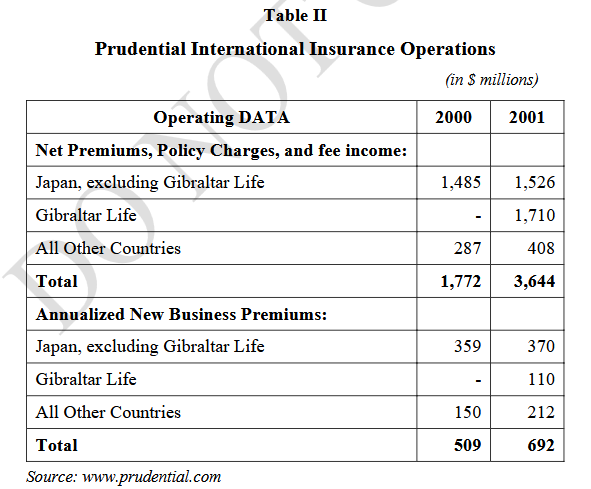
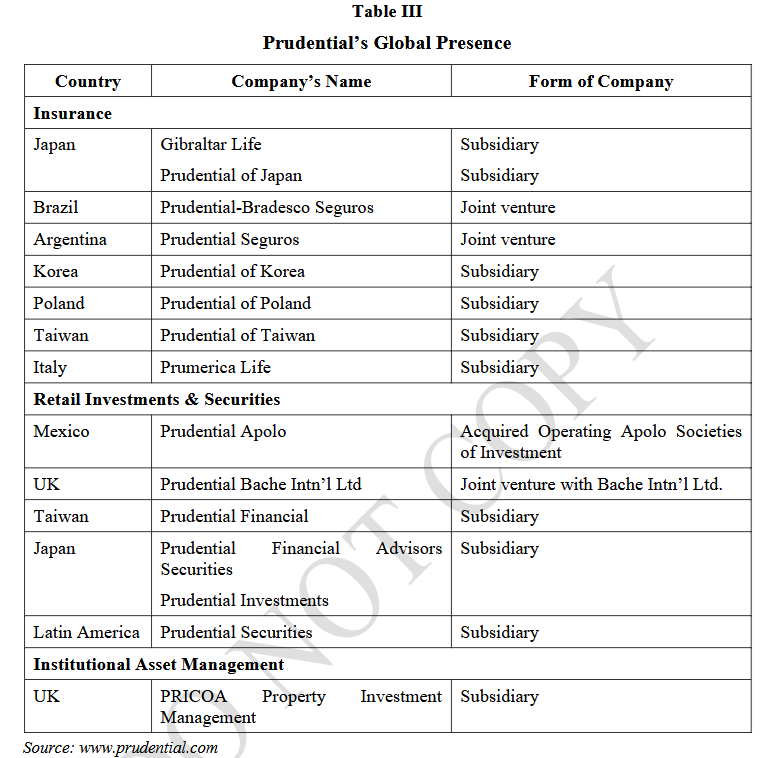
Prudential?s international operations were divided into two segments – Japan and all other countries. Japan was largest contributor to the company's revenue after the domestic operations (Refer Table II). In Japan, Prudential operated through four companies in the insurance and retail investments & securities segment (Refer Table III).
Though Prudential had established its first overseas office much earlier in 1909 in Canada, the real growth in its international operations started when the company established its wholly-owned subsidiary, named Prudential of Japan, in Japan in 1988. By 2000, Prudential had not only become one of the fastest growing life insurers in Japan, but had also expanded to other markets in Asia. The company said that the key to its success in Japan was its 'needs-based23' business model, which increased the standards for selling life insurance in Japan. This resulted in higher productivity, long-term extension of policies, and customer satisfaction. During the 1990s,
Prudential reported that it had transferred the skills learned in Japan to Korea and Taiwan. In the same period, the company entered Europe and some Latin American countries.
Prudential described its units in different geographic areas as 'stand-alone, fully functioning life insurance companies that operate independently of any stateside entity.' It operated subsidiaries in the different geographic locations in different business segments.
MARKETING
Prudential focused on marketing since its early days. In 1896, Prudential came out with its first advertisement in Leslie’s Weekly24. The advertisement had the Rock of Gibraltar as the company's logo, symbolizing its strength and security. In 1898, the company came out with another ad showing the $13,221 check given by Hahn and Company as annual premium for its $400,000 policy.
Until 1993, Prudential had a single Individual Insurance Business unit, which had three alternate marketing channels, namely, district agencies, ordinary agencies and independent brokers and agents. In 1993, three separate business units were created with distinct marketing objectives. The three units included Prudential Insurance and Financial Services (PIFS) Prudential Preferred Financial Services (PPFS) and Prudential Select (PRUSEL).
The above three units had separate marketing functions. PIFS focused on the middle-income households in America, with income ranging between $20,000 and $75,000 per annum. This was the largest segment with more than 11,000 representatives and 28,000 employees. In January 1996, PPFS established three national marketing offices with headquarters in New Jersey, and offered support services nationwide from Minnesota. PPFS aimed to be the premier provider of individual and complementary financial products to an upscale market. This business unit operated through more than 75 Financial Service Offices (FSOs), with a total of 5,100 associates including 2,300 special agents.
PRUSEL offered individual life insurance and annuity products through independent brokers. PRUSEL targeted its products to high net worth individuals and medium and large corporations. Though it was the smallest segment in terms of new insurance business generated in terms of quantity, the amount involved was high with face value amounting on an average of $1,000,000 and first year premium averaging $19,000. All the work related to these policies (establishing, approving, corporate marketing, human resources, legal and others) was carried out by the corporate office at Newark, New Jersey. The corporate office was also responsible for the coordination and control of marketing office activities.
HUMAN RESOURCES
Prudential was recognized for its HR practices and policies. In 1999, the Congress of Industrial Organizations (CIO) magazine had placed Prudential among CIO's 100 best companies based on HR management, innovation and customer relationship. In the same year, the company's Executive Vice President – HR, Michele Darling, (Darling) was named the 'HR Executive of the Year' by a leading magazine, Human Resource Executive.
Darling designed a training initiative called the One Prudential Exchange in which the employees learnt details about the company's operations, its strategic mission, and the action necessary to achieve its organizational goals. More than 60,000 employees of the company were part of the training program.
Under the One Prudential Exchange program, groups of 300 employees, ranging from new entrants to those at the executive level, had to attend four one-day sessions across the US. With the help of the coaches, employees learnt about the functioning of the company, in all its complexity. The program also helped the employees to understand their own roles in driving the growth of the company. A survey was conducted by the HR department to measure the effectiveness of the program. It revealed that managers could link their job responsibilities with the company's goals 8% more effectively.
Darling also realigned the HR function with new organizational goals and formed a team of HR leaders to fuel the growth of the company. The team created another program called 'Communities of Practice' under which, employees were taught specialist functions like succession planning, learning and leadership. Darling also emphasized the importance of individual employees and their personal responsibility for success or failure. Individual employees were given a stake in what they did for the company and were rewarded for their contributions in terms of innovations and special efforts. Darling encouraged the voicing of employees' concerns through various forums and media in the organization. She herself traveled to company offices all over the US and conducted interactive programs like 'Road to Resolution', which were designed to resolve employees' problems quickly. She sent e-mail messages called Michele-O-Grams and newsletters on important issues of the company.
Prudential's HR department became a 'role model' of how a functional unit could cut down costs and at the same time improve services. Prior to the realignment program, the HR department had 1400 HR executives who spent more than $200 million on personnel plans. Post-realignment, the budget fell to $181 million with only 840 executives, and the addition of new functions. The budget also included the $38 million spent for the training initiatives.
Prudential determined salaries on the basis of the importance of the vacant position, competition in the job market, and the performance and contribution of the employee. The company reviewed salaries every year and increments were given after appraisals. However, salary rise was infrequent; instead, the company offered many incentives including the annual bonus and other long term incentives.
Under the Annual Incentive Plan, about 11,000 officers, managerial and professional associates, executives and the CEO were eligible for various incentives. The plan had different bonus pools like the senior executive pool, different business group pools, and the corporate staff function pools. In every pool, the employee was assigned a basic funding amount. The total sum of the basic funding amounts of all the employees in a pool became the target bonus pool for the employees in that pool.
Each target bonus pool was modified every year to reflect the performance of the group for the year, using a multiplier factor ranging from 0 to 4.0. The multiplier was determined by assessing the financial, non-financial and strategic objectives set for the company. The performance of the company as a whole contributed to 25% of the multiplier and the performance of the business group contributed to 75% of the multiplier. The multiplier for the senior executive pool was 1.8225 in 2000 and 1.5625 in 2001.
In 1995, Prudential introduced long term incentives in the form of cash performance units, called the Prudential Long-Term Performance Unit Plan (PUP). Every year, selected vice-presidents and other executives above the senior vice-president level were granted a new PUP. The performance period taken into account for a PUP grant was three years. At a given point of time, there were three overlapping performance unit cycles. There were 510 participants in the 2001-2003 PUP grant cycle. At the beginning of each PUP grant cycle, performance goals were set throughout the company. Based on the individual's performance, market considerations and the company's evaluation of the importance of the position, performance units were allocated to all the participants at the beginning of each PUP grant cycle from a pool. The target payment value of each performance unit was calculated by dividing the total value of the pool by the total number of performance units allocated to the participants.
The performance units equalled their target payment value if the company's cumulative performance of the company in each of the three years of the cycle met the performance goal set at the beginning of the cycle. The company also set minimum performance standards, which when met, made the performance units worth 50% of the target value. If the performance was below the minimum standard, the performance units did not have any value. Similarly, if the performance was above the target, the value of the performance unit increased correspondingly.
In February 2002, Prudential Financial paid for the performance units granted under the 1999 PUP cycle. Though the company performed well in 1999 and 2000, the company's performance in 2001 was below the minimum targets and this affected the cumulative performance of the company. Hence, the performance unit pool's value was 21.3% below the target value and the final value for each unit stood at $706.
During 2002, after the process of demutualization was over, Prudential also initiated a change in its compensation program reflecting its new status of a publicly traded company. The company aimed at aligning the interests of its executives and officers with those of its shareholders. The program brought about two changes in the form of compensation: the introduction of stock options as a part of the total compensation plan; and use of performance measures for incentive compensation prevalent in a public company. The program started with a one-time 'founder's grant' of stock option, which was offered to a broad number of employees and agents of the
company and its subsidiaries globally, excluding officers. The grant was called Associates Grant and had 240 shares for full-time associates and 120 shares for part-time employees. The exercise price of these shares was equal to the IPO price at $27.50. For executives, stock options were made a part of their long-term incentives. Prudential announced that stock options would be allotted to vice presidents and equivalent posts after June 19, 2002. Prudential also adopted stock ownership guidelines for senior officers to encourage officers to build their ownership position in the company's stock by:
- Directly purchasing stock in the market.
- Making investments available through the Prudential Employee Savings Plan (PSEP).
- Retaining shares they earned through the stock option and other incentive plans.
SOCIAL RESPONSIBILITY
Prudential seemed to be conscious of its social responsibility from the time it was set up. The very idea behind starting the company was to offer insurance services to people with limited means by collecting premiums on a weekly basis. The company also supported many civic causes. In 1933, more than 1000 employees of Prudential joined a parade organized by workers of many companies in Newark. The parade was organized to support the National Recovery Administration, one of the programs initiated by the then president of the US Franklin Roosevelt in an attempt to alleviate the Great Depression.
Prudential participated in several programs to improve living conditions in Newark. In 1960, Prudential started an urban redevelopment program, which aimed at improving downtown Newark. Prudential also gave financial support during the construction of the New Jersey Performing Arts Center in Newark in 1986. The company contributed more than $6.5 million and many of its employees participated in the project.
The Prudential Helping Hearts Program introduced in 1994 by the company, helped the volunteer Emergency Medical Service (EMS) squads to purchase cardiac defibrillators26, used to deal with sudden cardiac arrests. Prudential invested about $5 million in this program and helped about 2,500 EMS Squads across the US.
In 1995, Prudential started the Prudential National Volunteer Day, which later became the Global Volunteer Day program. The program was aimed at encouraging its employees and their families to get involved in community programs. The employees and their neighbors collected food, worked at food banks, cleaned parks and helped senior citizens to repair their homes. In its first year, the program enrolled more than 5000 employees and their families in more than 100 community service projects. The program was very successful and improved over the years. In October 2000, the company's sixth Annual Global Volunteer Day was conducted which ended with the celebration of the company's 125th anniversary. Prudential's employees throughout the world spent time to tutor children, paint the homes of elderly people, beautifying parks, renovating churches etc.
Prudential sponsored the 'Prudential Spirit of Community Awards' in recognition of student volunteers from middle and high school. The awards program was introduced in 1995 together with the National Association of Secondary School Principals (NASSP)27. In May 1998, the organizers conducted a four-day celebration of the outstanding community service of 104 students. The students visited Washington as State Honorees. Annually, about 11,000 students participated in the program. In 2000, Prudential initiated an effort to revitalize Times Square – one of the largest urban renewal projects in the US – in partnership with other firms.
Prudential funded an independent non-profit grant-making organization, Prudential Foundation. The Foundation offered support to innovative direct-service programs to fulfill the needs of the community. It focused on three areas – Ready to Learn, Ready to Work and Ready to Live. (Refer Exhibit III). In January 1997, the Foundation initiated the Prudential Charter School Lending Program, under which it offered loans at concessional rates to support the starting, early operations and facility needs of charter schools, which are accountable public schools in the US.28 Prudential also conducted the Retirees Offering Community Service (ROCS) program, under
which retirees across the country worked for their local communities, with the help of Prudential.
CORPORATE GOVERNANCE
Prudential's Board of Directors reviewed the company's policies and strategies and also advised the Chairman and the CEO. The Board comprised of 21 directors including the Chairman, 20 of whom were outside directors.
As of June 1996, Prudential announced that there were about 240 lawsuits pending against Prudential and Pruco Securities. Most of the complaints were market conduct allegations and alleged short-term unethical sales tactics. The company paid more than $425 million in 1996 to claims of hundreds of customers in suits of deceptive sales practices. It was reported that the company's internal auditors had warned the directors in 1982 that the company's agents were following unethical tactics to boost sales. However, the company did not make an attempt to resolve the issue at that time.
There were many complaints from Prudential's customers that its agents, in order to gain high commissions, successfully persuaded their current customers to buy costly new policies. There were also complaints that the agents were not giving their customers complete information. They alleged that Prudential agents did not inform policy owners that dividends were not guaranteed and, were, in fact, abbreviated payment plan policies. This forced the policy owners to make additional out-of-pocket premium payments. Another common allegation was that some of the Prudential agents misled their customers into believing that the product being sold was an
investment or savings vehicle, and not primarily life insurance.
In late 1999, the Department of Insurance (DoI) fined Prudential $1.5 million for violating the New York State Insurance Law. The violations reportedly occurred between January 1996 and December 31, 1997. According the DoI, Prudential Insurance violated the regulations by:
- Failing to produce or delaying the delivery of documents requested by the Department during the market conduct examination;
- Failing to disclose the administrative fee for the company's 'Living Needs Benefit Rider' in advertising and marketing materials;
- Failing to comply fully with Department advertising regulations;
- Failing to comply with certain Department annual statement reporting requirements; and Using unapproved policy forms;
FINANCE
Prudential's consolidated31 revenues increased to $27.177 billion in 2001 from $26.504 billion in 2000. The gross written premiums increased from $10.18 billion in 2000 to $12.477 billion in 2001. The company reported a loss of $154 million in 2001 compared to a net income of $398 million in 2000. (Refer Exhibits IV and V)
The closed block business reported lower revenues of $7.728 billion in 2001 compared to $8.729 billion in 2001. It reported a net loss of $456 million in 2001 as against a profit of $87 million in 2000. The financial services business of Prudential Financial reported revenues of $19.625 billion in 2001, compared to $17.885 billion in 2000. The income before taxes stood at $1.263 billion in 2001 compared to $1.721 billion in 2000.
In 2001, about 41% of the adjusted operating income of Prudential's financial services segment came from international business, 25% from the US consumer business, 17% from asset management and the remaining 15% from the employee benefits business. The international insurance business of the company witnessed strong growth in earnings and contributed a higher percentage of the company's adjusted operating income. The total income of the US consumer division decreased significantly to $210 million in 2001 from $744 million in 2000. This was mainly due to the losses of $239 million incurred by the private client group segment, as against an
income of $237 million in 2000. The total income of the employee benefits segment witnessed a sharp decline of about 90.7% to $26 million in 2001 compared to $269 million in 2000. Prudential said that in spite of its strong balance sheet, its return on equity did not meet the levels required of a public company.
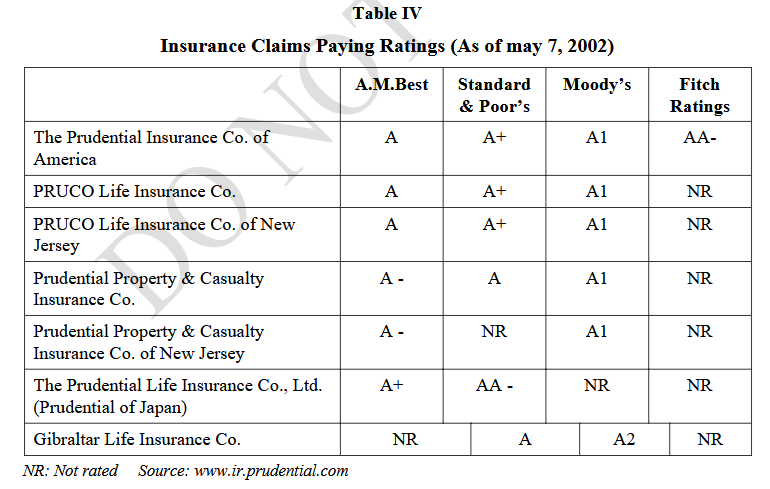
In 2002, Prudential was rated as 'very good' and 'excellent' by various rating agencies (Refer Table IV). S&P's 'A' rating represented 'strong'; companies with this rating were considered to have strong financial security characteristics but were more likely to be affected by adverse business conditions. Moody's rating A1 represented the higher end of the 'good financial security' category. A.M.Best rated companies 'A' if they were considered to have a strong ability to meet their obligations to policyholders over a long period of time.
For the first half of 2002, the closed block business reported losses from operations before income tax of $429 million, compared to losses of $29 million in 2001. The net losses of this division stood at $273 million for the same period compared to losses of $21 million for the first half of 2001. The losses were mainly attributed to the low net investment income. In the second quarter of 2002, the losses of the closed block business included net realized investment losses of $177 million and losses of $77 million, which accrued from the sale of WorldCom holdings.
In the first half of 2002, the financial services business reported operating income after tax of $636 million as against $556 million in 2001. In the second quarter of 2002, the financial services business reported income after tax of $304 million compared to $260 million during the same period in 2001.
FUTURE OUTLOOK
The company's IPO in December 2001 was the largest ever in the insurance industry with total proceeds of $3.48 billion, including an additional $450 million raised by underwriters. Prudential aimed at becoming a well-capitalized, strategically focused, well-positioned company, increasing customer and shareholder value. The company outlined two objectives to achieve the above goals – making the business expand; and increasing the return on equity.
Public ownership offered many advantages to insurance companies. The capital market exposure enabled them to grow faster as money could be raised for restructuring and acquisitions. Public ownership also resulted in shareholder trust and provided more transparency in the overall earnings and business development. In a mutual insurance company, the policyholders received either shares or money for their ownership rights. In contrast, a publicly traded company offered the policyholders stocks, which could be traded or sold. This opened up the possibility of profitable trading for policyholders.
Prudential took some initiatives to increase return on equity and increase shareholder value. The company was listed in the Fortune 500 Index32 in mid-January 2002 after it fulfilled the share price, volume and market capitalization criteria. The FFX Index was developed with a benchmark value of 1000.00 on December 31, 1999.
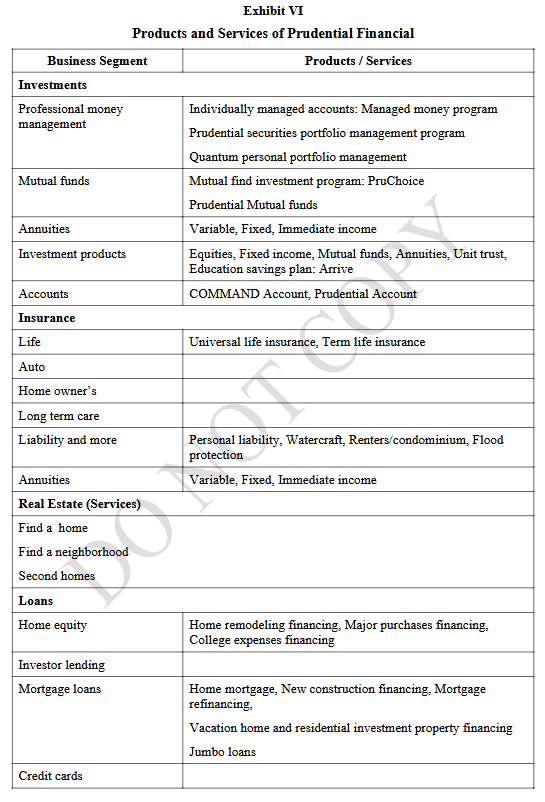
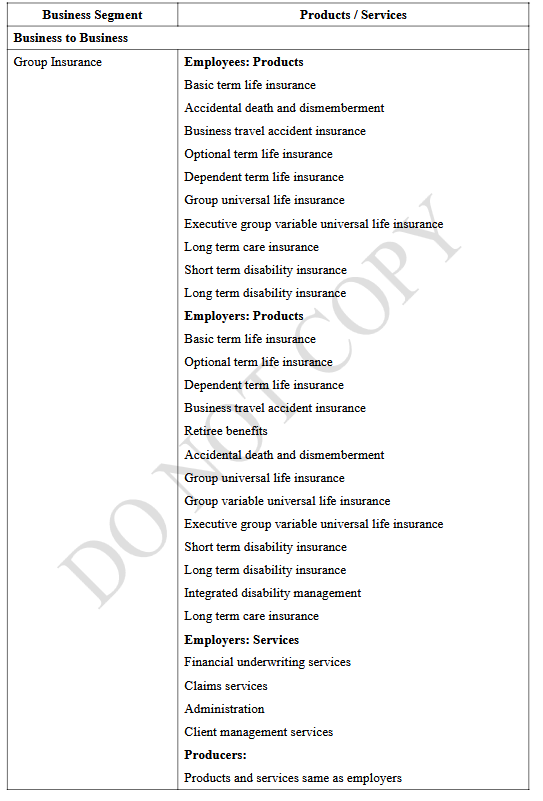
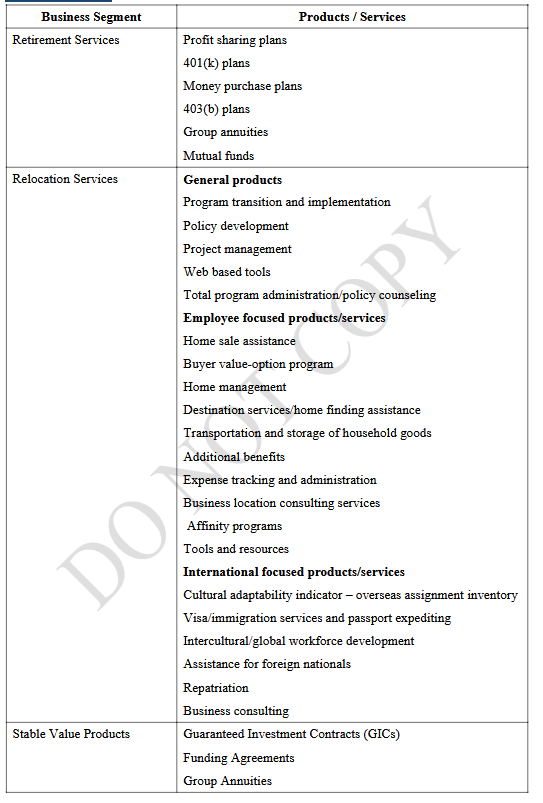
Prudential aimed to increase its domestic revenues by improving the quality and value of its products and services (Refer Exhibit VI); expanding its distribution network; and increasing productivity. In 2000, Prudential introduced a unique, research-driven strategy called 'advised choice', under which the company used external asset managers to provide investment advice for its products.
Prudential also laid focus on its e-business strategies. In May 2002, Prudential introduced a new integrated technology platform that could electronically provide appropriate forms and marketing materials to its sales personnel. The new platform, named Prudential Electronic Application, was supplied by Communication Intelligence Corp. (CIC)33. The platform automatically found the appropriate forms, marketing material, and rules of the new request based on the product and geographic location. The Electronic Application reduced the time taken for completing the application by two-thirds from an hour to just 20 minutes. Barbara Koster, chief information
officer, said, “At first, we were unsure if our agents and customers would embrace this new way of doing business, but our experience has been very positive. Almost all of the agents - 93 percent - who participated in the pilot gave Electronic Application a favorable rating.”
Prudential used Electronic Application for its life products and announced plans to extend it to mutual funds and annuities. Prudential also introduced the CIC's Sign-it® biometric electronic signature software and an ePad pen input device developed by Interlink Electronics, Inc.34 The Sign-it line of products offered companies a solution for secure electronic document approval and on-line transactions. It helped in document approval, contract execution, and e-commerce. The application enabled real time signature capture, verification, and binding of a signature to a document.
In July 2002, PRUPAC launched its website where policy holders could see information on their policies and also carry out some transactions on the website. Policyholders had to log on to www.prudential.com and enroll themselves. They could then change the address, request duplicate documents for any of their policies, make a payment, add or remove deductibles or coverages or check their claims information.
In July 2002, Prudential reached an agreement with Bradesco Seguros Group of Brazil to acquire Bradesco Seguros' shares in the Prudential-Bradesco Seguros life insurance joint venture, which was formed in 1976. The joint venture had familiarized Prudential with the Brazilian market. Full control over the joint venture was expected to strengthen Prudential's growth in Brazil. In August 2002, Prudential opened its second office in Hong Kong through the acquisition of the business and assets of Hong Kong Homefront Ltd. (HKHF), a relocation company. The acquisition further strengthened Prudential?s established relocation operations in Hong Kong.
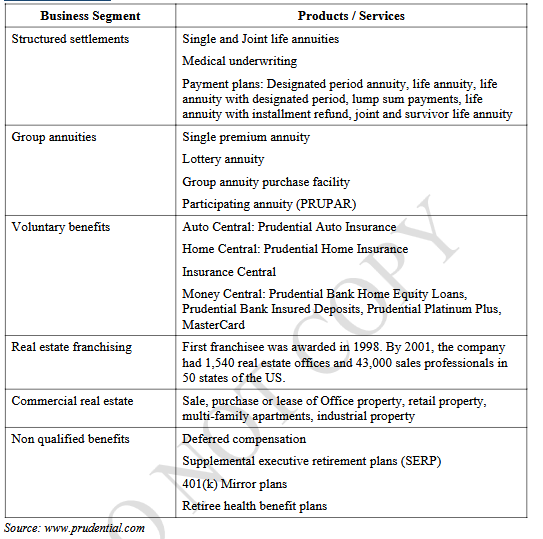
In late August 2002, Prudential announced a major restructuring of its business segments. The restructuring was mainly aimed at enhancing operating effectiveness. It was also expected to result in cost savings and improve revenues growth. Prudential's Chairman and CEO Arthur F Ryan explained, “These changes create greater alignment of our product and distribution activities in Prudential's divisions while enhancing our ability to achieve the ongoing growth and efficiency goals we have targeted.” The three new business segments included Insurance, Investments, and International Insurance and Investments (Refer Table V). The company announced its 2002 third quarter results based on the reorganized structure.
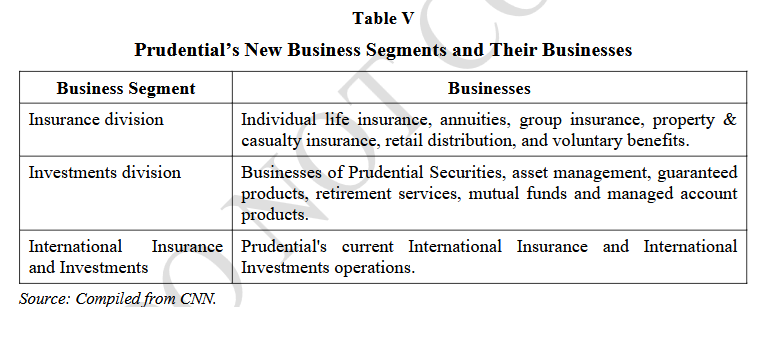
The restructuring also included the establishment of an Office of the Chairman. Four Vice Chairmen positions were created in the Office of Chairman. Ryan commented, “The new Office of the Chairman is charged with the consistent, common execution of Prudential's global strategy to 'Grow and Protect' client wealth and will materially enhance the company's ability to take advantage of its substantial growth opportunities.”
OUTLOOK FOR THE GLOBAL INSURANCE INDUSTRY
The global insurance industry was being influenced by several external factors including new distribution channels to market insurance products, consolidation and globalization of insurance companies, rapidly developing technology, and new laws and regulations. In the late 1990s, insurance companies around the world believed that the size of the company influenced market power and helped in reaping the benefits of economies of scale in the insurance industry. Industry watchers felt that a huge capital base was necessary to achieve global dominance and to establish a presence in all the lines of highly competitive insurance industry.
Zhou Yan Li, Commissioner of China's Insurance Regulatory Commission, contradicted this view of global dominance. He said of the scenario in the insurance industry in China, "Although foreign companies have certain advantages in some aspects, our domestic companies are in the same market with the same language, culture and legislation. It is easier for domestic companies to contact each other. In these aspects, the foreign companies are no match at all."
Analysts felt that the global insurance companies needed to focus on key areas where they had significant competitive advantages over their competitors, and exit those areas in which they were lagging. Analysts expected outsourcing of non-core activities in the insurance industry to increase and felt there would be more strategic alliances with financial services and non-financial services companies.
The Internet was expected to become a strong distribution channel for simple insurance products in the industry. However, analysts remarked that distribution in this industry was 'self-selected' by the consumer. Moreover, in an internet world, no-body 'owned' the customer, and the customer had more knowledge than before. In some regions of the world, the Internet was not yet widely used. However, the Internet had some definite advantages – it could support complex business models to handle many processes of an insurance firm, help in acquiring new customers, and was an effective channel for distribution. Internet also reduced costs for the companies and simplified the process of claims management.
In the initial years of the new millennium, all major global insurance companies were spending billions of dollars on new business strategies. Online selling was very popular in the personal lines segment of the industry. Analysts felt that insurers should use the Internet first to re-engineer business processes, then to enhance existing distribution channels, and only then for creating new distribution channels.
Technological advancements in health care had extended the human lifespan. In addition, many governments across the world were withdrawing from offering social security. These factors fuelled the growth of retirement savings and health care segments. Although the conventional life products continued to dominate the market, analysts expected rapid growth in wealth management products, which gave the consumer a wide investment choice. In the US, life insurance was expected to be linked with investment choice and fund management. Also, many life insurance agents were likely to become personal financial planners.
Markets were being deregulated worldwide. This led to the emergence of universal financial services rather than the conventional stand-alone banks, insurers and brokerage firms. This trend was attracting new and non-traditional players into the market particularly in the Asian insurance industry. Simultaneously, there was more regulation on the way products were sold. An analyst at PriceWaterhouse Coopers said, 'There is a shift from regulation of what is sold by a particular institution to regulation of how it is sold.' Many countries were forming regulatory bodies for this purpose like the FSA37 in the UK and APRA38 in Australia. As customers also became more aware and exacting, companies had to meet their customers' needs and follow appropriate policies of corporate governance.
Economies were becoming borderless. Many labor-intensive tasks were shifted to low-wage countries, using the Internet. Companies based in the US shifted service centers to Canada to reduce processing costs. The most suitable processes for relocation were claims management, policy administration, accounting and underwriting. European companies established back-office operations in countries like India.
Branding began to play an important role in the insurance industry. Financial services brands were promoted in the same way as consumer product brands like Coca-Cola and Levi's. It was advantageous for global companies to build a brand. Many global companies, like Allianz, AXA and ING, brought all their insurance operations across the world under the name of the parent company. Some companies like Sun Life of Canada, HSBC in Hong Kong and Tokio Marine and Fire in Japan had strong domestic brands. But, analysts felt that such companies too would need to build up a global brand.
In 2001-02, the P&C insurance market reported about $380 billion in earned premiums. All through the 1990s, premium rates had not increased significantly. However, during 2001-02, the scenario changed and the insurance companies increased the premium rates. Casualty losses were also reported to be high during this period. Despite the increase in premium rates, many companies in the US posted losses.
The September 11, 2001 terrorist attacks on the US resulted in an increase in premium rates for many types of insurance coverage. Rates were estimated to increase by 16% in 2002. Other reasons for the increase in premium rates were the high number of workers' compensation claims and homeowners' insurance claims. Insurers withdrew many types of insurance, and the terms of the remaining types of coverage were also changed. The September 11, 2001 attacks resulted in a sharp increase in the sale of life insurance products. It was estimated that, by mid 2002, the premium rates for the coverage of private homes and automobiles increased by 6%, for
commercial business by 30%, and for other specialty insurance by 400%.
Mergers and acquisitions continued at a rapid pace in the insurance industry in the US in the between early 2000 and mid 2002. There were reportedly 201 mergers in the first nine months of 2001, in the sectors of life, P&C, and health care. Most of the mergers were of life and health care insurance companies (Refer Table VI). Consolidation among insurance companies reportedly proceeded at a slower pace than among commercial banks. This was probably on account of differences in the types of insurance policies offered, and the different setups for distribution, marketing and claims processing of the companies.
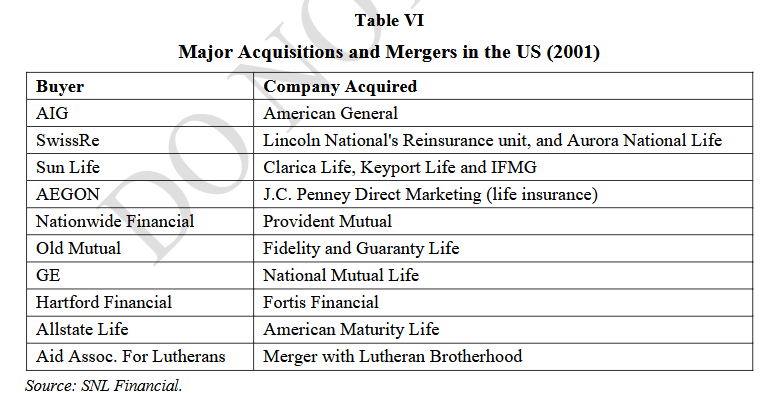
Another major trend in the US insurance industry in recent years was 'demutualization'. This enabled companies to distribute their assets in the form of shares through an IPO, transforming policyholders into stockholders. Some of the major companies like Prudential Financial, John Hancock and others were demutualized in 2001-02.
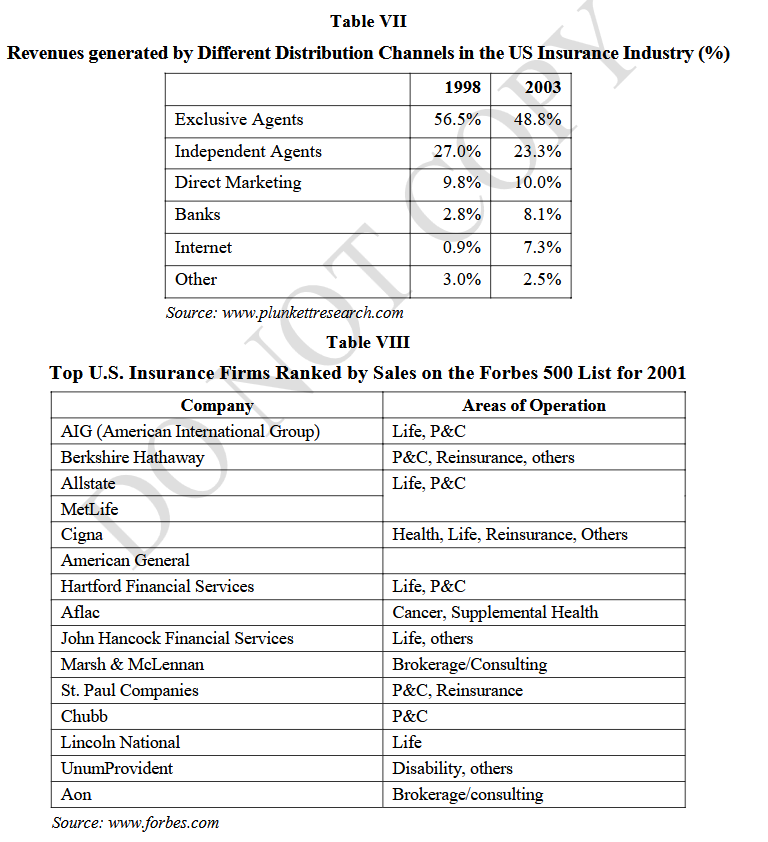
There were also significant changes in the channels of distribution of insurance products in the US. Distribution through banks and e-commerce gained momentum and the sale of insurance through traditional agents decreased (Refer Table VII). Customers were acquired online and then assigned to an agent, who received a lower commission on such customers. This mode of operation was first used by Allstate, a major player in the US industry. (Refer Table VIII for major players). Allstate was a leading player in the savings products market in the US.
Among the other important insurers in the US was Berkshire Hathaway, a holding company operating in the P&C insurance industry through its subsidiaries, National Indemnity and GEICO Corp., and in the reinsurance industry through GeneralCologne Re. Allstate was the second largest personal lines insurer in the US. About 75% of the company's sales came from auto and homeowners? insurance. The company also sold P&C and life products in the US, Asia and Europe. The company operated its life insurance business through Allstate Life and Gleenbrook Life, while Allstate Financial offered investment products.
QUESTIONS FOR DISCUSSION
1. Briefly explain the concept of demutualization of insurance companies. What do you think are the advantages and disadvantages of the demutalization process? Explain.
2. Prudential Financial had a presence in a broad range of business segments. However, the company did not seem to be the market leader in any of the segments. What according to you were the possible reasons? Why did the company choose to reorganize its business segments?
3. In 1999, the CIO magazine placed Prudential among CIO's 100 best companies based on HR management and other factors. What do you think are the salient features of Prudential's human resource policy?
4. Prudential seemed to be highly responsible towards the society in which it operated, particularly Newark, NJ. Briefly discuss the various steps taken by the company as a part of its social responsibility initiatives.
5. Prudential planned to align its HR policy in accordance with a public limited company. What other aspects do you think Prudential should focus on, now that it has become a public limited company?
EXHIBITS
Exhibit I
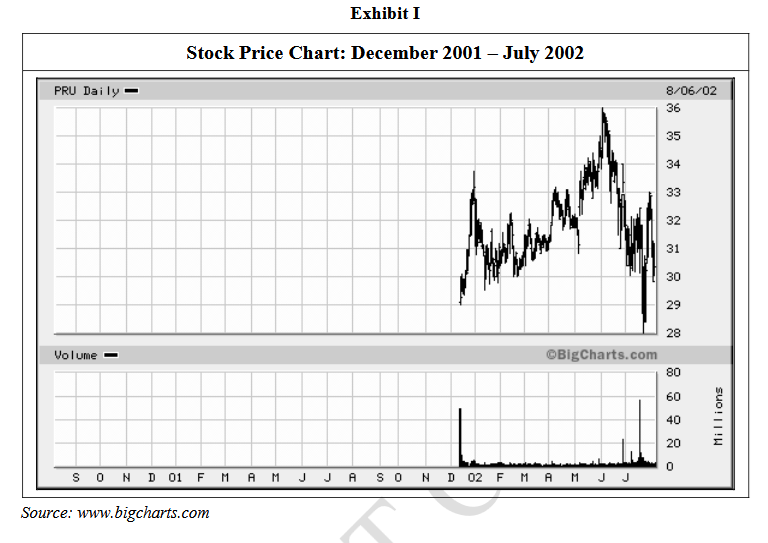
Exhibit II
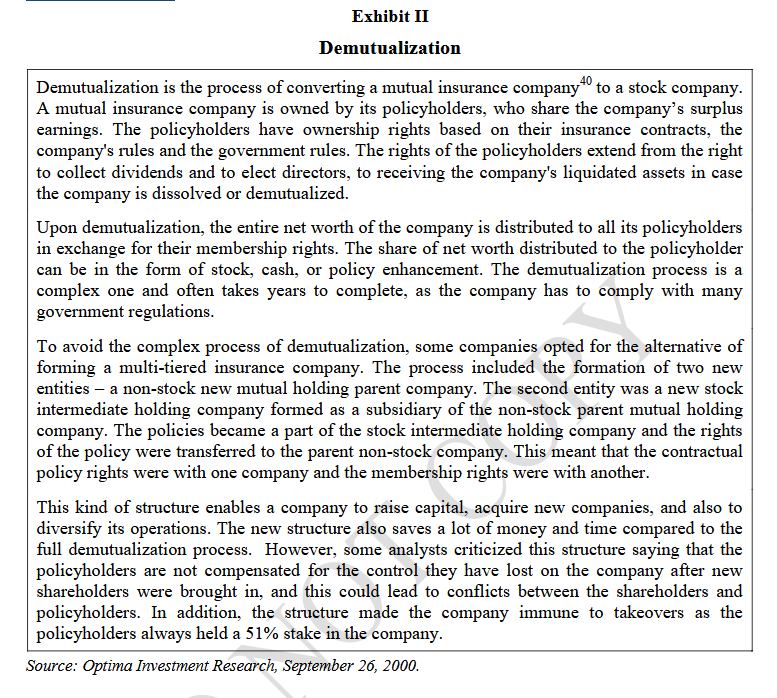
Exhibit III
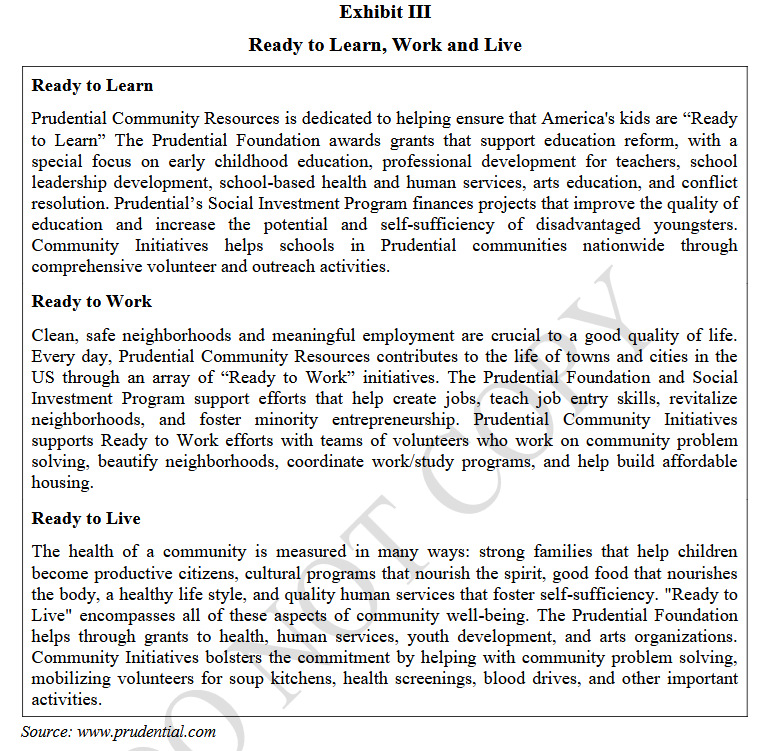
Exhibit IV
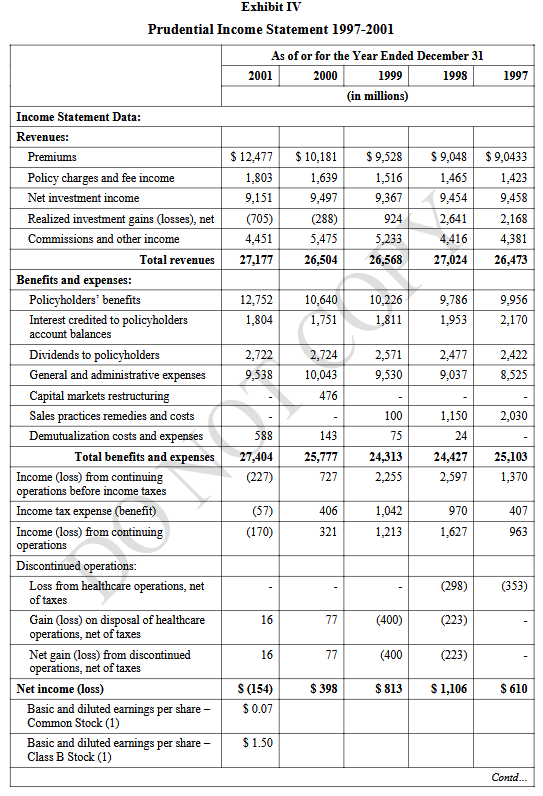
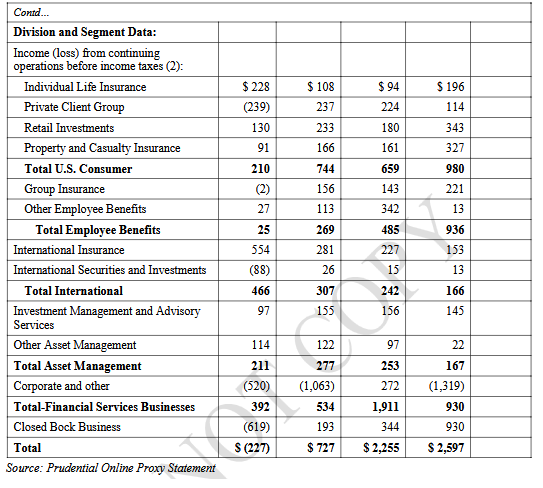
Exhibit V
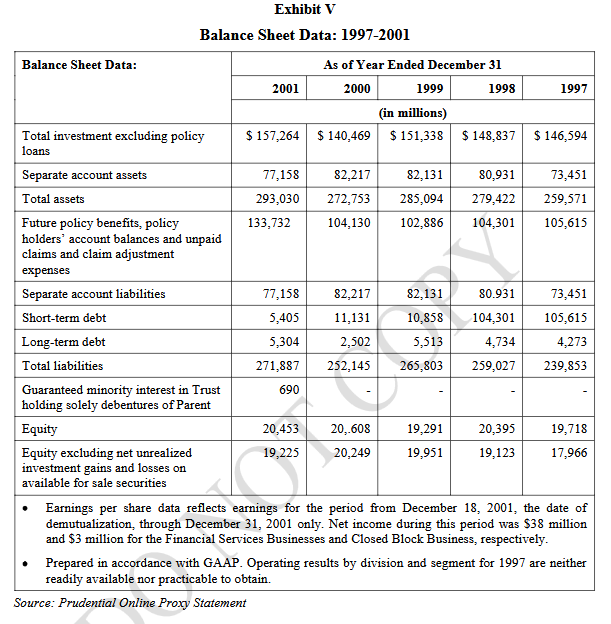
Exhibit VI
Keywords
Prudential Financial Inc, marketing, human resources, finance, history since inception, product segments, US Consumer, Employee Benefits, International, Asset Management, geographic regions, revenues, social responsibility, corporate governance standards, future prospects, unethical sales tactics, sales personnel, reorganization
Related Case Studies
| Case Title | Details |
|---|---|
|
Case Title Iridium: Making a ComebackCase Code: CLBS048 |
Details |
|
Case Title Evolution of InfosysCase Code: CLBS034 |
Details |
|
Case Title The Fall of Daewoo MotorsCase Code: CLBS030 |
Details |
|
Case Title Reinventing Cadbury (Caselet)Case Code: CLBS024 |
Details |
|
Case Title The Resurgence of Radio in IndiaCase Code: CLBS021 |
Details |