
Dell.com’s Managing the Electronic Supply Chain Effectively
Details
ITSY012
11
2002
YES
300
Dell Inc.
Technology & Communications
US
Systems Design ,Service Operations, E-Business Strategy
Abstract
The case study ‘Dell.com’s IT architecture’ discusses the hardware and software infrastructure of DELL’s website. It also shows how the website benefited DELL’s customers and suppliers and brought considerable cost savings for the company.
Learning Objectives
The case is structured to achieve the following Learning Objectives:
- Need for the development of an e-comxmerce-enabled website Architecture of an e-commerce-enabled website and the problems faced by Dell.
Contents
Dell.com – Managing the Electronic Supply Chain Effectively
“We’re essentially moving every process in our business online, whether it’s things we do with our suppliers, our internal operations or our customers. Everything is moving online, and www.dell.com is at the core of that.”
- Michael Dell, CEO, DELL Computer Corporation.
INTRODUCTION
DELL Computer Corporation's (DELL) founder, Michael Dell (Dell) is often credited with bringing about a revolution in the personal computer industry. After a late entry into the PC business in 1984, Dell put in place a new business paradigm. In DELL's direct model (See Exhibit I), there were no retailers or resellers. By eliminating intermediaries and managing its inventory and distribution process efficiently, DELL offered its customers more powerful and customized computers at prices much lower than its competitors. The company incorporated the latest technology in its product lines much before its competitors did, as it kept only a maximum of six days of inventory while most of its competitors stocked inventory for about 40 days.
DELL had started its Internet initiative in the late 1980s to provide customer support. Whenever DELL received a call from its customers for support, DELL customer-care executives advised them to obtain a new disk driver or some other software update available at DELL. The customer had the choice of receiving the software on a diskette, which was expensive, or to download the software. Initially, these software downloads were made available from a DELL Bulletin Board site on CompuServe1. By 1989, DELL began online distribution of software updates, which became extremely popular among customers. They could download the software as they talked over the telephone to the DELL technician who guided the customer through the installation and configuration updates. Over the next few years, DELL's Internet initiatives were limited to customer support services.
In 1996, DELL launched www.dell.com to provide technical support online. Later, it allowed customers to configure and order systems online. By logging onto www.dell.com, customers could get details of products being offered by DELL. They could also configure their PCs by adding or subtracting various combinations of components, such as memory, disk drives, modems etc. and have the final price of their system calculated in real time. By entering a credit card number, they could also place the order for the machine. Manish Mehta, Director of online support, recalled:2 “Initially, dell.com had no commerce capability. It wasn't until three or four years ago that we began to change the face of dell.com from being a technical support website to one with commerce capability.”
DELL collected information from customers to support its sales and call-center activities. The website initially provided only product description. As its popularity and customer traffic increased, the marketing and technical support groups added more and more product information to keep up with customer demand. Customers began to make use of the information while purchasing their systems and for troubleshooting.
In mid 1996, DELL?s management felt the need to coordinate Internet activities throughout the whole organization. By centralizing its Internet activities, DELL expected to be in a position to improve performance, quality, and eliminate inconsistencies, which would result if each segment acted independently. By the late 1990s, DELL had emerged as one of the global leaders in e-business. DELL?s Internet sales alone ranked it among the 125 largest companies in the US. DELL had attempted to use its online activities to strengthen its brick and mortar business model by speeding up the flow of information. Using the Internet, DELL had been integrating its customers and suppliers into its supply chain to smoothen the flow of information. According to company sources, the robust IT architecture and the technology used by Dell.com was largely responsible for its success.
THE TECHNOLOGY
Dell.com's hardware infrastructure consisted of its own PowerEdge servers and PowerVault Storage systems. The company had tied-up with Microsoft for most of its software solutions requirements. Dell.com used Site Server 3.0 Commerce edition as its web e-commerce software. The database server was SQL Server 7.0. The servers provided web content, commerce and non-commerce applications and back-end SQL databases. Its front-end web servers held static web pages and were hosted via multiple mirrored copies of all data. The servers were hosted on the Web solution platform.
The operating systems used were Windows 2000 Advanced Server and Windows NT Server 4.0 with Internet Information Server 4.06. The site had a number of back-up devices. To distribute the load on its website, DELL used a Cisco-distributed director for all the servers. DELL fed incoming web requests through one of its many front-end servers, which mirrored each other's content to serve up data quickly. A DELL technician explained: “All we have to do is create a new mirror of the latest information on a new server to the network, then alert the distribution systems to the newest addition to the network.”
The Visual Studio tools were used for the development of Dell.com. Visual Studio tools integrated well with products such as SQL Server. Within a database, for instance, they could attach components directly to the database without the need to exit and open another program.
A 'click' on the Dell.com site was initially answered by the Internet Information Server running on Windows 2000 across a cluster of PowerEdge Servers. They served static HTML (HyperText Markup Language) pages, which were displayed on the client side. Based on the visitor's choices, the person was passed onto a business-specific Dell site: home, home office, business, education and large corporate accounts.
In 1998, Dell.com faced problems due to the significant increase in its user base, which was growing at a rate of 50 percent a year. On an average, the company received 2.7 million messages and 4.3 million e-mails per month. To overcome the problem, Dell consolidated its 200 servers into 25 NT PowerEdge servers running on Microsoft Exchange. In the initial days, Dell.com had used HTML to develop the content. However, HTML made upgradation a tedious task. Much of the information for various configurations was similar except for a few items. Some information had to be adapted to local factors and HTML made changes difficult to carry out. To overcome these limitations, DELL redesigned its web page using XML.
These initiatives helped reduce the number of servers and related management costs by almost ten times. Dell.com required a development platform, which was scalable, flexible, reliable, and interoperable to bring new Internet services to the market as quickly as possible. The company evaluated almost every major platform, finally settling down on Microsoft's products. By early 2000, Dell.com had developed three tier architecture (See Exhibit II) for infrastructure computing which offered flexibility, scalability, and availability.
Dell.com's parallel architecture ensured good performance and stability. Steve Scivally, Internet Technologist, Dell explained, “As applications become more complex, it's the application code that can cause problems, not the operating system or something else. If you consolidate objects in second-tier servers and one of those objects has a problem, all of your front-line Web servers will be impacted by that problem. Instead, we duplicate objects and put them on all our Web/commerce servers. If one object has a problem, we can take out just the affected server without affecting the others.”
Dell's distribution scheme consisted of Windows Load Balancing Server9 (WLBS) running under Windows NT Server 4.0 and Network Load Balancing (NLB) running under Windows 2000. WLBS and NLB balanced traffic as incoming Web requests were fed through many front-end PowerEdge Servers. This scheme allowed the introduction of additional servers without affecting online operations. It also ensured that customers could access the data they were looking for – such as pricing and model configurations – quickly, with minimal waiting. This was just one of the many benefits DELL offered its customers through Dell.com.
MANAGING THE VALUE CHAIN
THE DEMAND CHAIN
Over the years, DELL introduced several value-added features at Dell.com in order to enhance customer convenience. Customers could log onto the website to check the status of the order placed through the DELL Order Maintenance System. Customers, who chose not to check the status frequently, could use Order Watch. They could enter the order number and e-mail address and the system would automatically send an e-mail notification to the customer once the machine had been actually shipped.
Dell.com offered personalized treatment to its visitors. Site Server 3.0 Commerce Edition ensured a unique user experience. Major customers could access specific products and their pricing, enabling authorized shoppers to build their own configurations as dictated by their contracts with DELL.
In 1997, DELL introduced Premier Pages, an electronic catalog that allowed corporate customers to purchase DELL machines over the Internet. By the year 2000, there were about 40,000 fully customized and password protected Premier Pages that contained purchase order processes and information pertaining to each customer. Premier Pages allowed DELL to deliver critical service and support information to its customers based on the specific products they used and bought. This allowed DELL to interact more closely with its customers. These pages gave large corporate customers access to automated paperless purchase orders, predefined configuration, order tracking and status, a worldwide view of their assets, and customized service tools.
Earlier, if the State of Louisiana wanted to make a purchase, it had to go through a long procedure of filling in details about the components required. The procedure was long and time consuming and the order was often cancelled if there were any price changes. With the help of Premier Pages the State could directly access DELL's site and configure the system and get the updated price of the system. The transaction costs were less and the rejections due to price changes were minimized as price changes could be automatically reviewed. All the end users in the state agencies, legislature, and schools could access this information. The delivery cycle was thus made shorter. These early efforts enabled DELL to build up its Internet sales to about $16 billion a year, which accounted for half of its revenues in 2001 (See Exhibit III).
Till mid 2000, many of Dell.com's incoming orders were handled manually by employees. In July 2000, DELL tied-up with WebMethods, a developer of B2B integration software based in Fairfax, VA. WebMethods' software technology created a kind of hub that allowed instantaneous communication among the internal business systems of companies. The software helped DELL in e-procurement. A customer after getting product information from Dell.com, could click into his purchasing system, and create an electronic requisition. After the customer approved the requisition online, a computer-generated purchase order came back to DELL over the Internet.
The entire process took 60 seconds. If the product manager concerned did not approve or reject a requisition within 24 hours, it was routed to another manager who had to respond immediately. After two approvals, the order went to DELL, which started building the machines. On an average, the product was delivered within two days of the order being placed. The software helped reduce errors in DELL's procurement processes from about 200 per million transactions to ten per million. It also reduced the cost of processing by $40, to $50 for each order.
DELL also believed that collaboration with suppliers was a pre-requisite for the success of its unique business model, and took initiatives to achieve frictionless supplier partnerships.
THE SUPPLY CHAIN
In mid 1998, DELL launched Valuechain.dell.com, a site which offered the same services for suppliers that Premier Pages offered for customers. The site let suppliers know what DELL's component requirements were at any given moment, so that they could plan their own production schedules accordingly. This helped improve vendor management as it let DELL exchange information with its suppliers10. Dell explained: “By sharing with suppliers the intimate details of our company and our plans, we literally bring them into the business as a partner and blur traditional boundaries between suppliers and manufacturers.”
Valuechain@dell.com also helped DELL to place orders in real time instead of relying on daily or weekly batch order transfers. Suppliers could also view a „Scorecard' compared the price, performance and quality of their products with those of their competitors and rated them accordingly. Parts that failed during production or after sale were tracked on the extranet11 and the information was conveyed to the concerned supplier. Lance Van Hooser, director of Internet commerce at Dell explained, “We want to be more proactive about quality concerns. It's more effective to get failure information from their lines rather than to find defects after they appear in finished products.” Initially, DELL expected savings of $150 million from Valuechain.dell.com by 2003, but by 2000, the company had achieved that figure. By 2001, more than 90 percent of DELL's suppliers were using Valuechain.dell.com.
In its efforts to reduce inventory, DELL tied up with i2 Technologies, a developer of supply chain management software. The software provided by i2 enabled DELL to achieve considerable precision in linking orders to the raw materials and components. Orders coming in online were downloaded every hour, and an i2 software application called Factory Planner generated a new manufacturing schedule every two hours. Factory Planner and other i2 applications worked together to let suppliers know in real time exactly what materials DELL required.
The software system prioritized orders based on the availability of these materials. It managed the factory schedule in such way that machines were built while the parts needed for the next two-hour orders were being shipped from suppliers' hubs. The hub had 15 minutes to confirm that it had the requested parts, and an hour and 15 minutes to get them to the plant. Any supplier that missed the schedule got a written reprimand almost immediately.
Traditionally, DELL had followed a certification program that subjected suppliers to periodic evaluation. With the Internet, the evaluation was done in real time. Suppliers were provided online metrics of their performance by region, line of business, and customer feedback. By reducing the number of suppliers from 204 to 27, DELL was able to maintain better control over the quality and supply of components. DELL had stopped accepting deliveries of video displays for its PCs. Instead, when a machine was ready to be shipped from any of its factories, DELL would send an e-mail to a shipper, such as United Parcel Service, which pulled a computer monitor from a supplier's stocks and scheduled it to arrive with the PC. These changes in the supply chain enabled DELL to cut costs significantly.
THE FUTURE
In late 2000, DELL began efforts to link Premier Pages and valuechain@dell.com. This would enable DELL's suppliers to view an order as soon as it was placed and ship the inventory in even less time compared to the earlier process.
According to analysts, the success of DELL's Internet initiatives was largely because it saw these, not as a move from the brick-and-mortar business to a virtual business, but as a logical extension of the company's direct business model. Dell said, “You can't treat the Internet as a department or as a site activity or something that gets bolted into your company. You've got to treat it as your strategy – intimately wound with every part of a common strategy from its core.”
Dell, however, admitted that there were difficulties to overcome. One of them was routing information online to the right person at the customer's end, as computer configuration and computer ordering were separate processes for most clients. He, however, believed that this was the only way to go: “There is nothing more direct than letting customers configure their own system in real time and giving them an order configuration right away.”
QUESTIONS FOR DISCUSSION
1. DELL had emerged as one of the leading companies in e-business with almost 50 percent of its 2001 revenues coming through the Internet. Briefly describe how dell.com grew into a full- fledged e-commerce-enabled website.
2. The robust IT architecture of Dell.com was one of the major reasons for the success of Dell. Study the IT architecture of dell.com and comment on the problems faced by the company during its operations.
3. According to Michael Dell, “We?re essentially moving every process in our business online, and www.dell.com is at the core of that.” What benefits did dell.com bring for DELL, its customers and suppliers?
EXHIBITS
Exhibit I
| Dell.com’s Build-to-Customer Order |
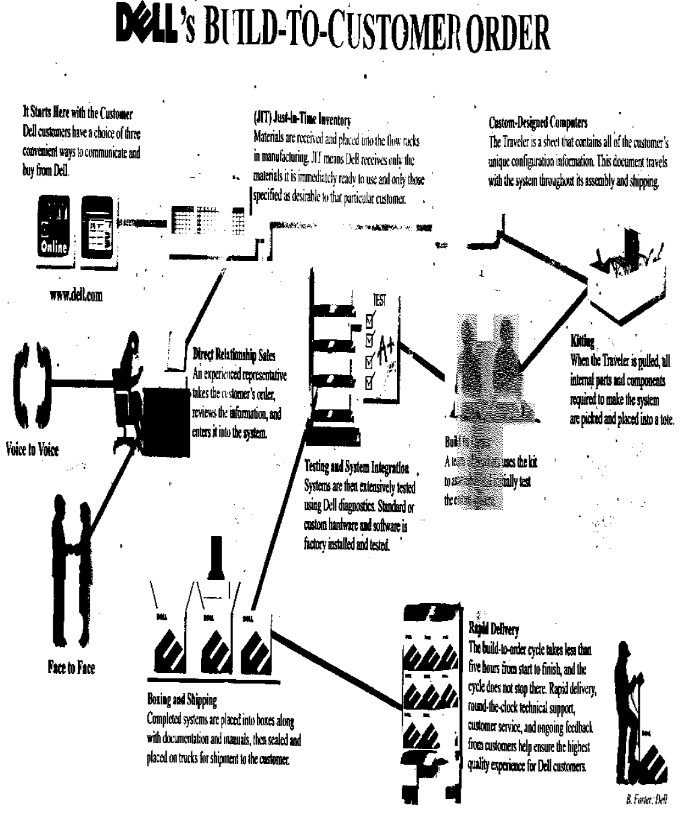 |
Source: Direct From Dell, Michael Dell and Catherine Fredman, Harper Business, 1999.
Exhibit II
Dell.com’s Three-Tier Architecture
|
The three-tier architecture of Dell.com's web infrastructure included:
Dell implemented the presentation and business logic layers logically, rather than physically, on the same servers. Each presentation/business logic server had a |
Adapted from www.dell.com
Exhibit III
Dell’s Consolidated Statements of Income
(In $ million, except per share data)
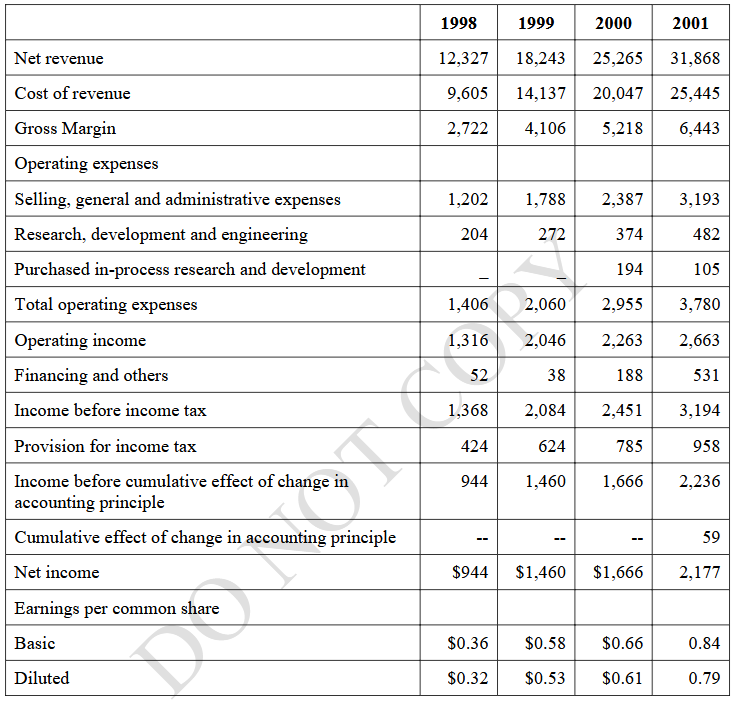 |
Source: Company Annual Reports.
Keywords
Dell.com, IT architecture, hardware, software, infrastructure, DELL, website, website, benefited, customers, suppliers, cost savings